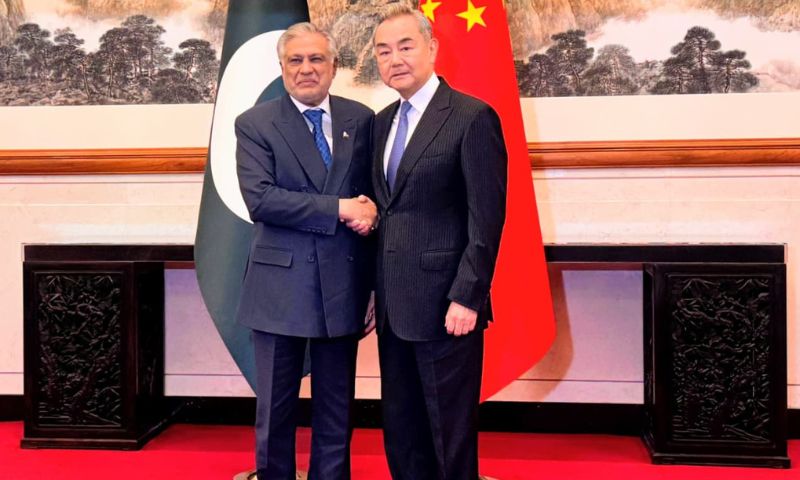



ISLAMABAD: Pakistan and China have agreed on a comprehensive five-point framework aimed at restoring peace and stability in the Gulf and Middle East, following high-level talks between Pakistan’s Deputy Prime Minister and Foreign Minister Ishaq Dar and China’s Foreign Minister Wang Yi in Beijing on Tuesday.
The two sides called for an immediate cessation of hostilities, the initiation of dialogue among all parties, protection of civilians and critical infrastructure, ensuring the security of key maritime routes including the Strait of Hormuz, and upholding the principles of the United Nations Charter to achieve lasting peace in the region, according to a statement issued by Pakistan’s Foreign Ministry.
According to the Foreign Ministry statement, Chinese Foreign Minister Wang Yi and Pakistan’s Deputy Prime Minister and Foreign Minister Ishaq Dar met in Beijing on Tuesday to review the situation in the Gulf and Middle East Region.
🔊PR No.8️⃣5️⃣/2️⃣0️⃣2️⃣6️⃣
Five-Point Initiative of China and Pakistan for Restoring Peace and Stability in the Gulf and Middle East Region (Beijing, March 31,2026)
🔗⬇️ pic.twitter.com/E3qOU2VhjC
— Ministry of Foreign Affairs – Pakistan (@ForeignOfficePk) March 31, 2026
Both Pakistan and China forward a five-point plan for restoring peace in the Gulf and the Middle East.
Immediate cessation of hostilities
China and Pakistan call for the immediate cessation of hostilities and utmost efforts to prevent the conflict from spreading. “Humanitarian assistance must be allowed to all war-affected areas.”
Start peace talks as soon as possible
Beijing and Islamabad urged the initiation of peace talks as soon as possible. China and Pakistan stressed that sovereignty, territorial integrity, national independence and security of Iran and the Gulf states should be safeguarded.
“Sovereignty, territorial integrity, national independence and security of Iran and the Gulf states should be safeguarded.”
Dar and Wang agreed that dialogue and diplomacy are the only viable options to resolve conflicts.
China and Pakistan support the relevant parties in initiating talks, with all parties committing to a peaceful resolution of disputes, and refraining from the use or the threat of use of force during peace talks, according to the statement.
Stop attacks on civilian and nonmilitary targets
China and Pakistan demanded that the principle of protecting civilians in military conflict should be observed.
“China and Pakistan call on parties to the conflict to immediately stop attacks on civilians and nonmilitary targets, and fully adhere to International Humanitarian Law (IHL), and stop attacking important infrastructure, including energy, desalination and power facilities, and peaceful nuclear infrastructure, such as nuclear power plants,” the Foreign Ministry statement added.
Security of shipping lanes
The Strait of Hormuz, together with its adjacent waters, is an important global shipping route for goods and energy.
China and Pakistan called on the parties to protect the security of ships and crew members stranded in the Strait of Hormuz, allow the early and safe passage of civilian and commercial ships, and restore normal passage through the Strait as soon as possible.
Primacy of UN Charter
China and Pakistan called for efforts to practice true multilateralism, to jointly strengthen the primacy of the United Nations, and to support the conclusion of an agreement for establishing a comprehensive peace framework and realising lasting peace based on the purposes and principles of the UN Charter and international law.
Earlier today, Ishaq Dar was received by Wang Yi at the Diaoyutai State Guest House in Beijing for high-level talks focused on regional developments.
Deputy Prime Minister/ Foreign Minister, Senator Mohammad Ishaq Dar @MIshaqDar50 is received by Foreign Minister of China, Wang Yi at the Diaoytai State Guest House for their bilateral meeting. pic.twitter.com/UU62BIukfT
— Ministry of Foreign Affairs – Pakistan (@ForeignOfficePk) March 31, 2026
China backs Pakistan’s peace efforts
China has expressed support for Pakistan’s diplomatic efforts to de-escalate tensions between the United States and Iran.
Speaking at a regular press briefing, Chinese foreign ministry spokeswoman Mao Ning said Beijing supports “all efforts conducive to de-escalation, cooling the situation and the resumption of dialogue”.
“We appreciate Pakistan’s efforts to promote the easing of the situation and support Pakistan in continuing to play its mediation role,” she said.
Mao added that China was ready to strengthen coordination with Pakistan and other stakeholders to promote peace, end hostilities and safeguard regional stability.
#FMsays Foreign Ministry spokeswoman Mao Ning said on Monday that China supports Pakistan’s efforts to mediate dialogue between the United States and Iran to end the #MiddleEast conflict. “We appreciate Pakistan’s efforts to promote the easing of the situation and support… pic.twitter.com/YNKj25U7Bo
— China Daily (@ChinaDaily) March 30, 2026
Pakistan steps up diplomatic efforts
Pakistan has intensified diplomatic outreach to de-escalate the Middle East conflict, positioning itself as a key intermediary between Washington and Tehran.
On Sunday, Pakistan hosted a quadrilateral meeting attended by Pakistan’s Deputy PM Dar and foreign ministers of Saudi Arabia, Turkiye, and Egypt for key talks on the Middle East conflict.
The meeting called for an immediate and permanent end to hostilities.
Briefing the media after the meeting, Dar said both the United States and Iran had expressed confidence in Islamabad’s ability to facilitate dialogue.
He added that Pakistan would be “honoured” to host negotiations aimed at ending the conflict.
The initiative has received backing from China and the United Nations Secretary-General, according to Dar.
US and Iran express confidence in Pakistan to facilitate talks. Possible US-Iran negotiations may take place in Pakistan in the coming days. Pakistan would be honoured to host and facilitate the talks.
Deputy Prime Minister and Foreign Minister Ishaq Dar pic.twitter.com/Ix84IWBdt8— The Thursday Times (@thursday_times) March 29, 2026
Officials said Islamabad has also been relaying messages between the two sides, placing the country at the centre of ongoing diplomatic efforts.
The conflict between the United States, Israel and Iran, which began on February 28, has entered its second month, with significant regional and global repercussions.
The fighting has disrupted energy supplies, with Iran effectively blocking key oil and gas shipments through the Strait of Hormuz, contributing to global economic strain.