ISLAMABAD: Iran on Saturday warned of strong retaliation if its economic centres or infrastructure are targeted, as hostilities involving the United States and Israel intensified across the region.
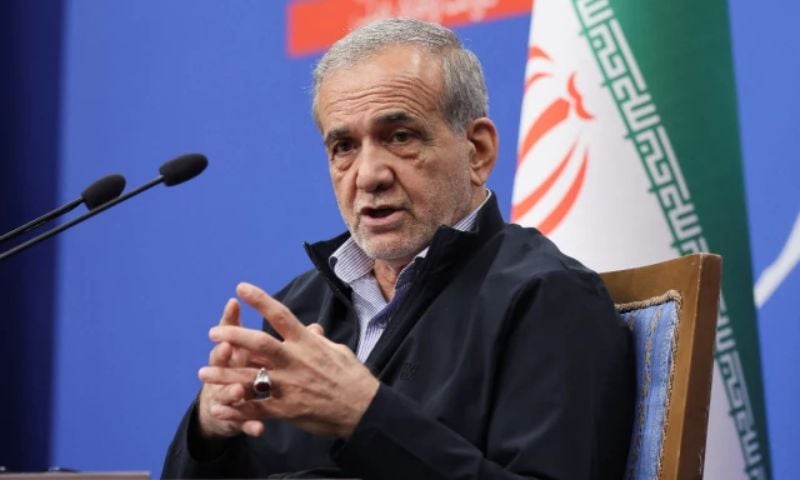
Iranian President Masoud Pezeshkian said on Saturday that Tehran does not initiate pre-emptive attacks but would respond forcefully to any aggression.
“We have said many times that Iran doesn’t carry out preemptive attacks, but we will retaliate strongly if our infrastructure or economic centres are targeted,” he wrote on X.
Addressing regional countries, he added: “If you want development and security, don’t let our enemies run the war from your lands.”
We have said many times that Iran doesn't carry out preemptive attacks, but we will retaliate strongly if our infrastructure or economic centers are targeted.
To the countries of the region:
If you want development and security, don't let our enemies run the war from your lands.— Masoud Pezeshkian (@drpezeshkian) March 28, 2026
His remarks came as Iranian media reported that at least five people were killed and seven injured in a US-Israeli strike on a residential building in the northwestern city of Zanjan early Saturday.
The latest escalation follows a series of coordinated strikes by US and Israeli forces on Iranian territory, including attacks on industrial and nuclear-related facilities.
Iran’s Foreign Minister Abbas Araqchi said on X that Israel, “in coordination with the United States”, had targeted two steel factories and a power plant. He warned that Iran would exact a “heavy price” for what he described as Israeli crimes.
Iranian authorities also reported strikes on two nuclear facilities — the Khondab heavy water complex and a uranium processing plant in Ardakan — but said there had been no radioactive release.
Meanwhile, Israel’s military said Iran launched missiles towards its territory, with one person killed in Tel Aviv and at least four others injured.
Air raid sirens sounded in Jerusalem, while explosions were reported near Jericho in the occupied West Bank.
Syrian state television also reported explosions over Damascus, attributing them to Israeli interception of Iranian missiles.
Regional spillover and Gulf tensions
The conflict has increasingly spilled across the Middle East.
According to Al Jazeera, Bahrain’s military said it had intercepted and destroyed 174 Iranian missiles and 385 drones since the start of the conflict.
The United Arab Emirates and Bahrain also reported missile attacks early Saturday.
Iran has targeted US bases in the region in retaliation, raising fears of a broader regional war.
Yemen’s Houthi group also entered the fray. The group claimed responsibility for a missile launch towards Israel, its first such attack since the current war began.
Houthi military spokesman Yahya Saree said in a statement broadcast by Al-Masirah television that the group had carried out the strike.
BREAKING: Yemen's Houthis:
We carried out our first military operation using ballistic missiles against sensitive Israeli military targets.
Our operations will continue until the declared goals are achieved.
We will continue until the aggression stops on all fronts. pic.twitter.com/Z6bYBbEGJv
— Clash Report (@clashreport) March 28, 2026
The Israeli military said the missile was intercepted near Beer Sheba, with no casualties reported.
The Houthis had earlier warned that their “fingers were on the trigger” and that they would intervene if attacks on Iran continued or expanded.
US deployments and NATO tensions
The United States has increased its military presence in the region, deploying thousands of Marines and preparing to send additional airborne troops, according to US officials.
US Secretary of State Marco Rubio said after meeting G7 counterparts in France that Washington was “on or ahead of schedule” in its operations and expected them to conclude within weeks.
He also urged countries benefiting from trade through the Strait of Hormuz to help ensure maritime security, warning of disruptions to global shipping.
The conflict has strained relations between Washington and its traditional allies. US President Donald Trump questioned NATO support during remarks at an investment forum in Miami.
“We would have always been there for them, but now, based on their actions, I guess we don’t have to be,” he said, suggesting that allies had not backed the United States during the crisis.
Strait of Hormuz and economic shock
The conflict has severely disrupted the Strait of Hormuz, a key global oil transit route, triggering sharp increases in energy prices.
Brent crude rose above $112 per barrel, up more than 50 per cent since the conflict began.
In the United States, diesel prices in California reached a record average of $7.17 per gallon, according to the American Automobile Association.
Trump has pressed Iran to reopen the waterway as part of any potential agreement, even as he signalled ongoing negotiations.
“We’re negotiating now,” Trump said, while insisting Tehran must restore oil flows through the strait.
Earlier, he warned Iran it faced further strikes if it did not reopen the passage within a set deadline.
Diplomatic uncertainty amid continued strikes