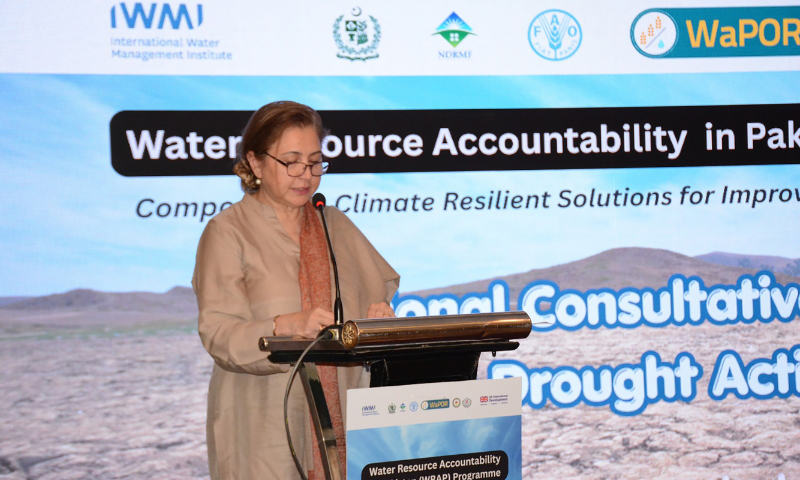
ISLAMABAD: Pakistan has unveiled its first-ever National Drought Action Plan (NDAP), aiming to shift from reactive responses to a proactive, risk-based approach as climate change drives more frequent and severe droughts across the country.
Aisha Humera Moriani, Federal Secretary for Climate Change and Environmental Coordination, said drought is no longer an occasional threat but an increasingly persistent challenge affecting agriculture, water resources, food security, and livelihoods.
Speaking at a national consultative workshop, she stressed that Pakistan must move beyond post-disaster relief toward preparedness and early action, warning that rising temperatures, water scarcity, and climate variability are accelerating the crisis.
“Pakistan is already among the countries facing high water risk, and drought directly affects agriculture, water resources, food security, ecosystems, and livelihoods,” she said, adding that past responses had largely focused on post-impact relief rather than preparedness.
Officials said the new plan, developed with support from the United Nations Convention to Combat Desertification, outlines a comprehensive framework focused on governance, early warning systems, resource mobilisation, local mitigation, and capacity building.
The initiative builds on existing tools such as the Pakistan Drought Management System, developed with partners including the Pakistan Meteorological Department and the International Water Management Institute, which provides real-time monitoring and early warning capabilities.
Participants at the workshop — including representatives from federal and provincial governments and international partners such as the Food and Agriculture Organization and the UK’s Foreign, Commonwealth and Development Office — discussed operationalising the plan, identifying priority sectors, and defining institutional responsibilities.
Pakistan remains among the countries most vulnerable to water stress, with recurring drought risks driven by climate variability, dependence on monsoon rainfall, and increasing pressure on water resources. Officials say past responses have largely been fragmented and reactive.
The NDAP is expected to introduce a unified national framework, including the possible establishment of a National Drought Management Committee and a Technical Advisory Committee, alongside a roadmap for implementation with defined timelines.
Officials emphasised that effective implementation will require strong coordination across federal and provincial governments, technical agencies, and development partners, adopting what they described as a “whole-of-government and whole-of-society” approach.
Mohammad Saleem Shaikh, media spokesperson for the ministry and a climate policy and advocacy specialist, said that Pakistan continues to grapple with recurring and intensifying drought risks due to climate variability, water scarcity, heavy reliance on monsoon rainfall, and growing pressure on surface and groundwater resources.
The adverse impacts of drought cut across multiple sectors, including agriculture, water supply, energy production, and livelihoods, he noted.