Key Points
- Pakistan positioning itself as a neutral mediator in global conflicts
- Shift from security-focused ties to trade and investment priorities
- Concerns over the rising technological capabilities of terrorist groups
WASHINGTON: Pakistan’s recent offer to mediate between the United States and Iran reflects growing diplomatic confidence and a broader ambition to play a stabilising role in regional conflicts, speakers noted during a high-level symposium on Capitol Hill.
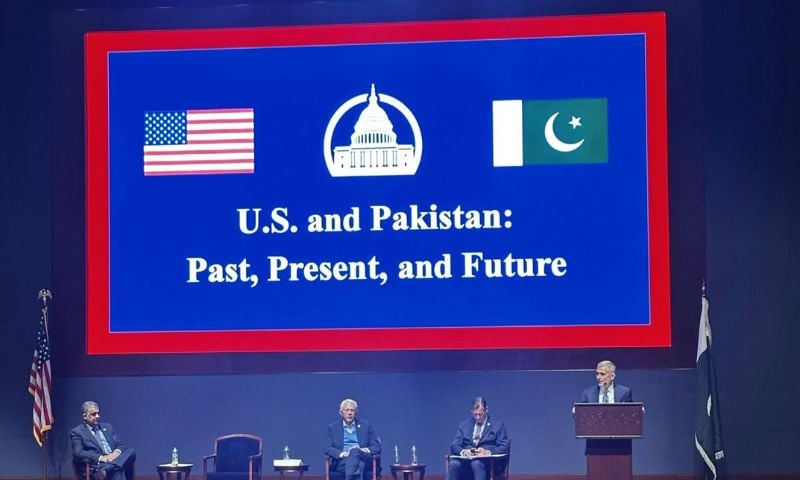
The discussion, titled “US and Pakistan: Past, Present, and Future,” brought together policymakers, diplomats, and experts for an extensive four-hour dialogue under the Chatham House Rule.
Organised by the Congressional Pakistan Caucus in collaboration with the Embassy of Pakistan, the session was chaired by co-chairs Tom Suozzi and Jack Bergman.
Today, we gathered experts from around the world to discuss the U.S.-Pakistani relationship, its history, current security and economic concerns, and how to build a better future. Thank you, Ambassador Rizwan Sheikh, Assistant Secretary of State Dr. Paul Kapur, and my Co-Chair of… pic.twitter.com/FHWgCNdhxN
— Tom Suozzi (@RepTomSuozzi) March 24, 2026
Participants pointed to Islamabad’s outreach amid escalating US–Iran tensions — including direct strikes and retaliatory actions — as a signal that Pakistan is positioning itself as a constructive diplomatic actor in an already volatile region.
They emphasised that Pakistan, with a population exceeding 250 million and a strategic location bordering Afghanistan, Iran, India, and the Gulf, should be viewed beyond a narrow security framework.
Its nuclear capability, expanding middle class, natural resources, and strong diaspora presence in the United States all contribute to its growing regional and global significance.
According to Dawn, speakers highlighted that geography has long shaped Pakistan’s strategic decisions while also constraining its economic development, as instability in neighbouring countries continues to affect its growth and security environment.
Addressing the symposium, Natalie Baker, Chargé d’Affaires at the US Embassy in Pakistan, thanked members of Congress for convening what she described as a timely and important dialogue.
Congressman Suozzi later said the event aimed to examine the historical, security, and economic dimensions of bilateral relations and to help chart a more constructive future.
The US State Department also welcomed the initiative, while Assistant Secretary of State for South and Central Asia Paul Kapur noted that positive developments during President Donald Trump’s tenure helped strengthen economic cooperation, particularly in sectors such as minerals.
Great to join the Pakistan Caucus Symposium. Under @POTUS Trump’s leadership, a positive recalibration in the U.S.-Pakistan relationship is enabling mutually beneficial economic and commercial ties, including in the critical minerals sector. – SPK pic.twitter.com/wxEYvLrbKJ
— Bureau of South and Central Asian Affairs (SCA) (@State_SCA) March 24, 2026
Pakistan’s Ambassador to the United States, Rizwan Saeed Sheikh, underscored the country’s geostrategic importance, describing Pakistan as a key player at both regional and global levels.
He reiterated Islamabad’s longstanding role in counterterrorism efforts and its continued commitment to promoting international peace and stability.
Panel discussions traced the cyclical nature of US-Pakistan relations, marked by periods of close cooperation followed by phases of mistrust.
Participants noted that ties have often been influenced by third-country dynamics, including developments involving India, Afghanistan and China, which have complicated efforts to build a consistent long-term partnership.
There was a broad consensus that the relationship has at times been overly transactional, driven by short-term geopolitical priorities. Speakers called for clearer expectations and a more institutionalised framework that moves beyond crisis-based engagement.
Security discussions focused on Pakistan’s evolving threat landscape, with experts warning that terrorist groups are becoming increasingly fragmented and technologically advanced.
While military operations remain necessary, participants stressed that sustainable counterterrorism efforts require stronger civilian law enforcement and rule-of-law institutions.
Tensions between India and Pakistan were identified as a persistent source of regional risk. Despite ceasefire arrangements, speakers cautioned that a major incident could quickly escalate into a broader crisis between the two nuclear-armed neighbours.
Some warned that excessive focus on military preparedness risks sidelining essential crisis-prevention mechanisms.
The symposium also examined Pakistan’s ties with China, noting that while defence cooperation remains robust, economic outcomes from the China–Pakistan Economic Corridor (CPEC) have been uneven.
Security concerns and inconsistent project delivery have posed additional challenges.
Despite this, participants emphasised that Pakistan does not seek reliance on any single partner and continues to value engagement with the United States.
Economic cooperation emerged as a central theme, with speakers urging a transition from aid-driven relations to trade and investment.
Pakistan was identified as having strong potential in sectors such as critical minerals, renewable energy, information technology, and digital services.
However, concerns persist among investors regarding policy unpredictability, taxation issues, bureaucratic hurdles, and weak dispute resolution systems.
Experts stressed that attracting sustained foreign investment will require regulatory stability, transparent governance, reliable infrastructure, and enforceable contracts.
In concluding remarks, speakers agreed that cooperation between the United States and Pakistan remains essential given their geopolitical importance.
While security collaboration will continue to play a role, they stressed the need to broaden the relationship to include trade, education, institutional development, and long-term economic partnerships.