


ISLAMABAD: India’s strategic crude oil reserves can meet only about 9.5 days of demand at full capacity, but current stock levels indicate that the actual buffer is considerably lower, according to official data and a Right to Information (RTI) response cited by India Today.
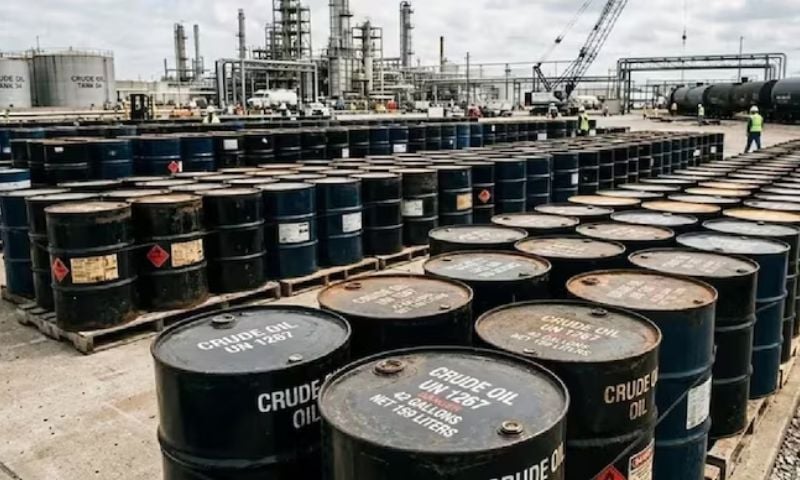
Figures presented in the Rajya Sabha on March 23, 2026, show that India presently holds around 3.372 million metric tonnes of crude oil—about 64% of its total storage capacity of 5.33 million metric tonnes.
This suggests that the effective coverage falls short of the estimated 9.5 days under current conditions.
The Ministry of Petroleum and Natural Gas, in its RTI reply, noted that the 9.5-day coverage applies only when reserves are filled. Strategic reserves are emergency stockpiles maintained by governments to safeguard against supply disruptions or sudden price spikes, ensuring continuity of fuel supply during crises such as conflicts.
The gap between installed capacity and actual reserves has become more significant amid rising tensions in West Asia, a region that supplies a large portion of India’s crude imports.
Supply routes
The ongoing conflict has already triggered volatility in oil markets, with concerns focusing on potential disruptions to supply routes, particularly the Strait of Hormuz, a critical global transit point.
Any escalation could disrupt supply chains and push prices higher, posing risks for India, which imports more than 85% of its crude oil requirements.
India’s Strategic Petroleum Reserve (SPR) programme, approved in January 2004, is implemented by Indian Strategic Petroleum Reserves Limited (ISPRL). Existing storage facilities are located at Visakhapatnam (1.33 million metric tonnes), Mangaluru (1.5 million metric tonnes), and Padur (2.5 million metric tonnes).
An expansion plan approved in July 2021 includes new facilities at Chandikhol in Odisha (4 million metric tonnes) and an additional 2.5 million metric tonnes at Padur, adding 6.5 million metric tonnes in capacity. However, these projects are yet to be operational.
Prime Minister Narendra Modi has said India is diversifying its energy sources to ensure stable supplies and reduce dependence on specific regions.