
LONDON: Global oil prices held above $100 per barrel on Monday as escalating attacks linked to the conflict involving Iran, the United States and Israel disrupted energy infrastructure and shipping in the Gulf, fuelling fears of the most serious global energy crisis in decades.
Futures for Brent crude, the international benchmark, traded above $100 a barrel, while US benchmark West Texas Intermediate remained above $96.50 after briefly crossing the $100 mark late on Sunday.
Markets have surged as the conflict shows little sign of easing, threatening key oil production facilities and shipping routes in the Middle East.
Over the weekend, military strikes from both sides intensified concerns about supply disruptions.
Late on Friday, the United States launched strikes on military assets on Kharg Island, Iran’s primary oil export terminal, and warned it could target oil infrastructure on the island if the conflict continued.
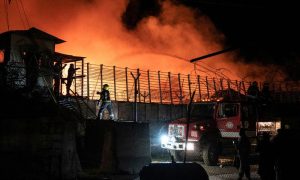
At the same time, Iranian drone strikes on Saturday and Monday halted oil loadings at the port of Fujairah in the United Arab Emirates, a key energy hub in the Gulf region.
The attacks have heightened fears about the security of energy supply routes across the region.
The Strait of Hormuz — the world’s most important oil shipping corridor — remains effectively closed to most commercial traffic.
US President Donald Trump has called on global powers to help reopen the waterway, but governments have so far offered cautious responses and no firm commitments.
Markets react to supply shock
The disruption has pushed oil markets into steeper backwardation, where near-term prices trade significantly higher than future contracts.
Freight rates and insurance costs for vessels operating in the Gulf have also surged, adding to the upward pressure on oil benchmarks.
Analysts say the crisis is creating uncertainty for global energy markets.
In a note to clients on Monday, equity research director Martijn Rats of Morgan Stanley said the bank had raised its average oil price forecast for the second quarter to $110 per barrel, up from $80 previously.
For the third quarter, the bank now expects prices to average $90 per barrel, compared with its earlier forecast of $70.
“The result is a high-stakes stalemate that markets are struggling to price,” Capital analyst Daniela Hathorn said in a client note.
“Energy flows remain significantly constrained, and as long as that persists, the risk of a prolonged global energy shock remains elevated,” she added.
Middle East benchmarks surge
Spot premiums for key Middle Eastern crude benchmarks have also jumped to record levels despite declining trade volumes.
Cash Dubai’s premium to swaps rose to $56 per barrel on Monday, compared with an average of just 90 cents in February, according to data from S&P Global Platts and Reuters.
The premium now accounts for roughly one-third of the grade’s total value, with Platts assessing Dubai crude for May-loading cargoes at $153 per barrel, compared with $111.76 for Murban futures.
Similarly, the premium for Oman crude futures over Dubai swaps reached nearly $51 per barrel last week, far above February’s average of 75 cents.
Some traders say the benchmark has become distorted because supply disruptions have reduced the number of crude grades available for pricing.
One refining source said the price spike reflected thin trading volumes after Platts removed three crude grades that transit the Strait of Hormuz from its pricing methodology.
“It is unnatural and unfair pricing because of thin trading,” the source said.
A spokesperson for S&P Global said Platts Dubai “continues to reflect the value of Middle Eastern sour crude trading in the spot market” and noted that trading activity in the Platts Market on Close process had remained robust.
Platts also said it was seeking feedback from market participants on the deliverability of Middle Eastern crude and the methodology used to assess the Dubai benchmark.
Refiners seek alternative supplies
The disruption has forced Asian refiners to look for alternative sources of crude.
According to shipping analytics firm Kpler, Middle Eastern crude exports to Asia fell to 11.665 million barrels per day in March, down from nearly 19 million barrels per day in February and about 32 percent lower than the same month last year.
Several Asian refineries have already reduced operating rates due to the supply shortage.
Meanwhile, premiums for crude from other regions have risen as buyers scramble to secure supplies.
Traders said spot premiums for Brazilian crude had surged to between $12 and $15 per barrel above ICE Brent prices, while premiums for April-loading West African crude had risen by around $1 per barrel from the previous month.
Strait of Hormuz closure
Oil markets remain focused on the continued disruption to shipping through the Strait of Hormuz, which normally carries about one-fifth of the world’s oil supply.
Brent crude rose as much as three percent on Sunday to exceed $106 per barrel before easing slightly in early Monday trading.
As of 04:30 GMT, Brent was trading at $104.63 per barrel, up nearly 1.5 percent.
Iran has effectively halted most commercial shipping through the strait in retaliation for US and Israeli strikes on Iran.
The International Energy Agency has described the disruption as the largest shock to global energy supplies in history.
According to the United Kingdom Maritime Trade Operations monitoring centre, fewer than five ships per day have passed through the strait since the war began on February 28, compared with a historical average of about 138 daily transits.
At least 16 commercial vessels have been attacked in the region since the start of the conflict, the UKMTO said.