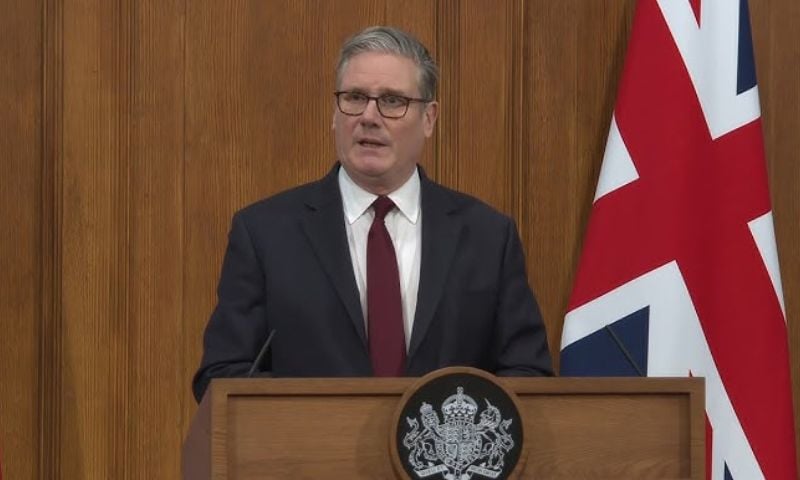



LONDON: British Prime Minister Keir Starmer said on Monday that the United Kingdom would not be drawn into a wider war in the Middle East, amid the ongoing conflict between Iran, the United States and Israel.
Speaking at a Downing Street press conference, Starmer said Britain was working with international partners on options to restore freedom of navigation through the strategically vital Strait of Hormuz but stressed that London would avoid becoming directly involved in the broader conflict.
“We will take the necessary action to defend ourselves and our allies, but we will not be drawn into the wider war,” Starmer said.
The British leader said discussions were under way with the United States, European partners and Gulf states to find a “viable plan” to reopen shipping lanes through the key waterway.
“It’s a discussion; we’re not at the point of decisions yet,” he said. “It’s obviously a difficult question, that goes without saying, in relation to how you safeguard maritime traffic.”
Strait of Hormuz security
The Strait of Hormuz, located between Iran and Oman, carries roughly one-fifth of global oil and significant volumes of liquefied natural gas.
Shipping through the narrow waterway has been severely disrupted amid the ongoing conflict, pushing global energy prices sharply higher.
US President Donald Trump has called on allied countries to deploy naval vessels to escort tankers through the strait and reopen the shipping route.
Starmer said Britain was considering options including sending ships and autonomous mine-hunting systems to the region, but emphasised that the issue was still under discussion.
“We’re working with allies to bring together a viable collective plan that can restore freedom of navigation as quickly as possible and ease the economic impact,” he said.
The prime minister confirmed that he had spoken with Trump by phone on Sunday about the situation in the Gulf.
Asked about his relationship with the US president, Starmer said the two leaders had held “a good discussion”.
“We are strong allies; have been for decades,” he said, adding that he maintained a “good relationship” with Trump.
However, he stressed that decisions would ultimately be taken in Britain’s national interest.
“If you’re prime minister, you don’t get to come back a week later and say: ‘Oops, I made a mistake about that war, can I back out of it now?’,” he said.
De-escalation key to economic stability
The prime minister said the most effective way to reduce economic pressures at home would be to de-escalate the conflict in the Middle East.
“The best way to deal with the cost of living is to de-escalate and reduce the conflict,” he said.
The prolonged disruption of energy supplies has already raised concerns about rising living costs in Europe and other regions dependent on Gulf oil and gas shipments.
Starmer said the crisis underscored the need for Britain to accelerate its transition towards renewable energy to strengthen long-term energy security.
“We should go further and faster in relation to renewables,” he said.
“Let’s get control of our own energy, so that whatever is happening in the world, we control what’s happening in this country.”