KEY POINTS
- Iran warned it would respond “ferociously” to any US military strike.
- President Trump is considering limited strikes if nuclear talks fail.
- Indirect US-Iran nuclear talks are set to resume on Thursday in Geneva.
- Iranian Foreign Minister said draft agreement is ready and expressed hope for quick deal.
- US increased its military presence in Middle East, deploying carriers, jets and air defence systems.
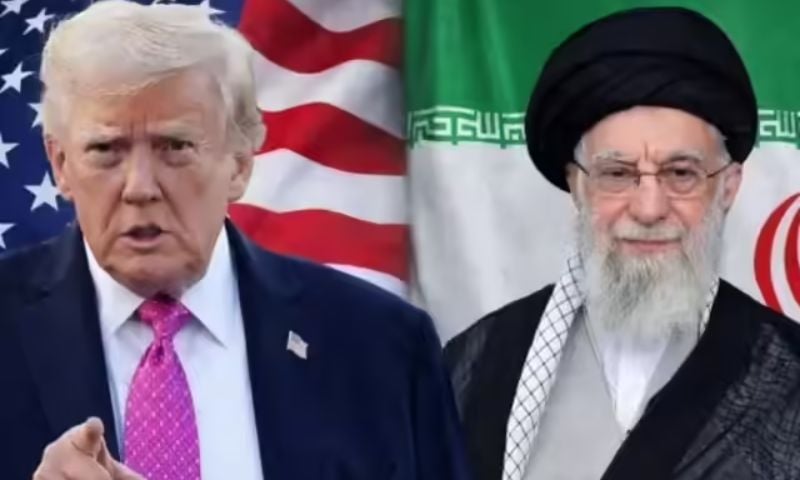
TEHRAN, Iran: Iran warned on Monday that it would respond “ferociously” to any United States military attack, after US President Donald Trump said he was considering limited strikes if nuclear negotiations fail.
The warning came as Tehran and Washington prepare to resume indirect talks on Thursday in Geneva, mediated by Oman, amid heightened regional tensions and a visible US military build-up in the Middle East.
Speaking at a weekly briefing in Tehran, Iranian foreign ministry spokesperson Esmaeil Baqaei said any strike, “even limited”, would be regarded as an act of aggression.
“And any state would react to an act of aggression as part of its inherent right of self-defence ferociously — so that’s what we would do,” Baqaei said.
US-Iran talks on Thursday
Iran and the United States concluded a second round of indirect negotiations in Switzerland last week under Omani mediation.
Further talks are scheduled for Thursday in Geneva. The meetings have been confirmed by Iran and Oman, though not formally by Washington.
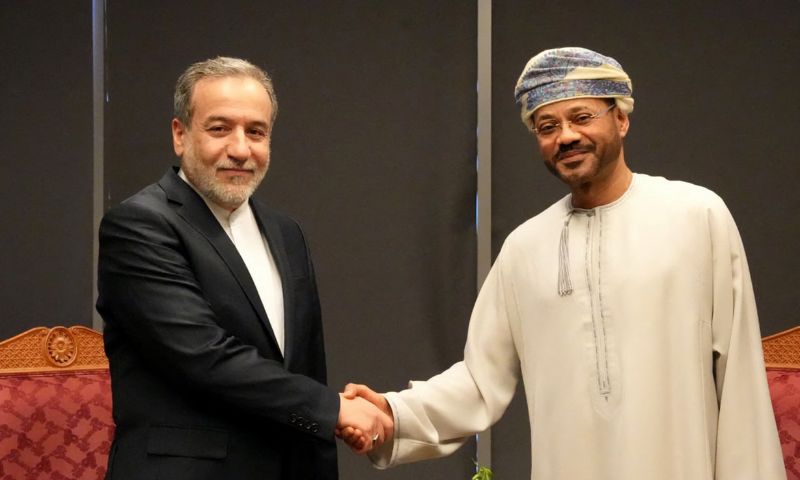
Oman’s Foreign Minister Badr al-Busaidi said the upcoming meeting would proceed with a “positive push” to finalise a deal.
Iran’s Foreign Minister Abbas Araghchi, who is leading Tehran’s delegation, said technical details of a draft agreement were being prepared ahead of the talks.
“I believe that when we meet, probably this Thursday in Geneva again, we can work on those elements and prepare a good text and come to a fast deal,” Araghchi told CBS News on Sunday.
He said there was a “good chance” of reaching a peaceful resolution.
Iranian President Masoud Pezeshkian has also described earlier discussions as having produced “encouraging signals”.
The United States is represented in the talks by envoy Steve Witkoff and Trump’s son-in-law Jared Kushner.
US military build-up
Despite the diplomatic track, Washington has increased its military presence in the region.
Flight tracking data shows a steady movement of aircraft transporting personnel and equipment to the Middle East.
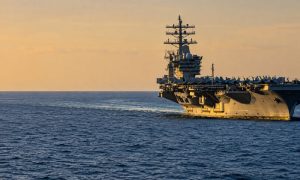
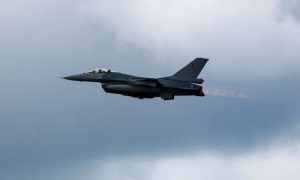
The United States has deployed two aircraft carriers, additional fighter jets and reinforced air defence systems.
Trump has publicly questioned why Iran has not “capitulated” in the face of US pressure, according to remarks by Witkoff in an interview with Fox News.
Baqaei rejected the suggestion on Monday, saying Iranians had “never capitulated” at any point in their history.
Araghchi warned that if attacked, Iran would exercise its right to self-defence and that US interests in the region could become targets.
However, the spokesperson maintained that diplomacy remained possible.
According to Axios, citing a senior US official, Washington indicated it would be prepared to re-engage swiftly if Iran submitted a proposal within 48 hours to begin detailed negotiations.
Nuclear programme at core of dispute
The talks centre on Iran’s nuclear programme. Western governments suspect Tehran is seeking to develop nuclear weapons.
Iran denies the allegation and insists its nuclear activities are for civilian purposes.
On Sunday, Araghchi reiterated that uranium enrichment is Iran’s sovereign right.
Diplomatic efforts last year collapsed after Israel launched strikes on Iranian targets, triggering a 12-day conflict in June.
The United States briefly joined the hostilities, conducting strikes on Iranian nuclear facilities.
In Israel, Prime Minister Benjamin Netanyahu convened high-level security consultations on Sunday to assess developments related to Iran.
Local media reported that Israel’s Security Cabinet was expected to receive briefings on the possibility of a broader regional confrontation.
EU urges de-escalation
The European Union called for restraint ahead of the Geneva talks.
“We don’t need another war in this region. We already have a lot,” EU foreign policy chief Kaja Kallas said before a meeting of EU foreign ministers in Brussels.
She said Iran was “at its weakest point that they have been” in recent years and urged all sides to use the moment to find a diplomatic solution.
“It is the only path that guarantees long-term security for the region and for the international community,” she said.
ALSO READ: Europe Urges ‘Diplomatic Solution’ on Iran as Trump Threatens Military Action
European officials fear a new conflict could trigger wider instability, drive up global energy prices and worsen refugee flows.
Travel advisories
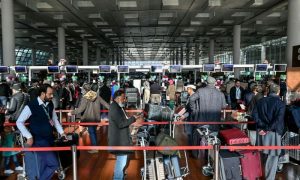
Meanwhile, fears of a new conflict have prompted several countries to urge their nationals to leave Iran.
India joined Sweden, Serbia, Poland and Australia in issuing advisories.
The Indian embassy in Tehran called on its estimated 10,000 nationals — including students, pilgrims and businesspeople — to depart “by available means of transport, including commercial flights”.
The embassy advised citizens to avoid protest areas, remain in contact with the mission and keep travel documents accessible.
Emergency contact numbers were also provided.