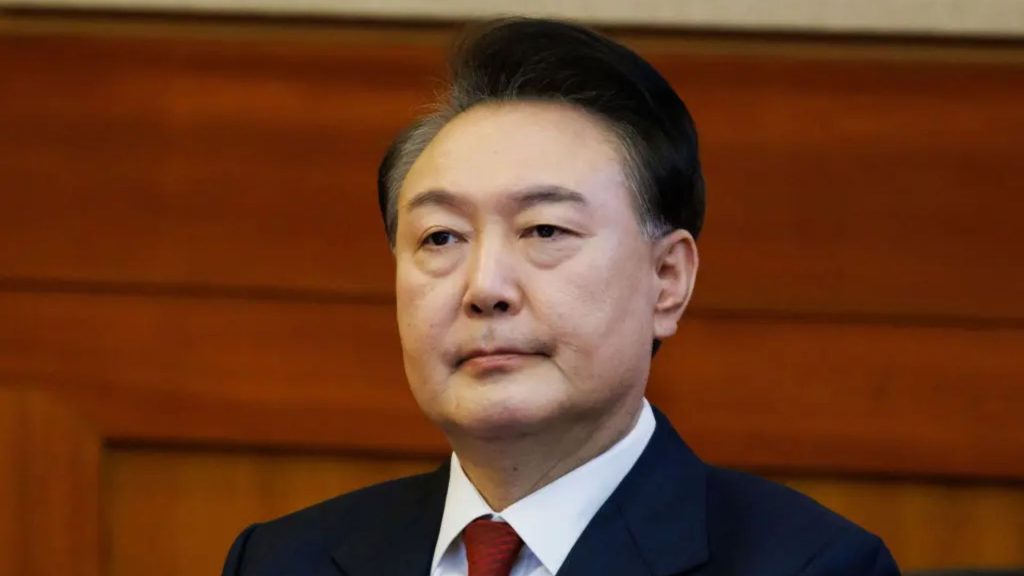



SEOUL, South Korea: A South Korean court on Thursday sentenced former president Yoon Suk Yeol to life imprisonment, declaring that his brief but dramatic attempt to impose martial law in 2024 amounted to insurrection.
The Seoul Central District Court found that Yoon’s December 2024 declaration of martial law was intended to “paralyse” his critics in the National Assembly and undermine the democratic system of the country.
Yoon had abruptly declared martial law in a televised address on December 3, 2024, claiming drastic measures were necessary to root out “anti-state forces.”
According to AFP, although the move lasted only six hours before being overturned, it sparked nationwide panic in a country widely regarded as a democratic beacon in Asia.
Presiding judge Ji Gwi-yeon said the declaration of martial law had resulted in “enormous social costs” and noted that there was little indication the former president had expressed remorse.
“The declaration of martial law resulted in enormous social costs, and it is difficult to find any indication that the defendant has expressed remorse for that,” the judge said.
Prosecutors had sought the death penalty, the harshest punishment available under South Korean law for insurrection. However, South Korea has maintained an unofficial moratorium on capital punishment since 1997, when the last executions were carried out.
At the time of the crisis, Yoon was deeply unpopular. His party was significantly outnumbered in parliament, which had blocked budget measures and impeached key figures in his administration.
With reported support from senior military officials, Yoon ordered troops to move toward the National Assembly building, allegedly aiming to seize control and arrest political opponents.
The court said he had “become fixated” on the belief that the opposition could effectively neutralise the presidency.
Prison term and appeal
Yoon, 65, will now serve his sentence in South Korea’s chronically overcrowded prison system — a stark contrast to the privileged life he led during his rapid rise from star prosecutor to the country’s highest office.
Under South Korean law, individuals sentenced to life imprisonment may typically apply for parole after 20 years, although it remains unclear when Yoon may become eligible.
His lawyer, Yoon Gap-geun, described the verdict as a “pre-determined conclusion set by the prosecutors” and suggested that pursuing an appeal might not be worthwhile.
However, to appeal, Yoon must file notice within seven days. Under South Korean law, insurrection carries only two possible penalties: life imprisonment or death.
Five other former officials were also sentenced in connection with the martial law crisis. Former defence minister Kim Yong-hyun received a 30-year prison term, while former general Noh Sang-won was sentenced to 18 years.
Public reaction divided
Outside the courthouse, thousands of Yoon’s supporters gathered, holding placards reading “Yoon Great Again” and “Drop the charge.”
At a counter-protest, critics voiced disappointment that the former leader had not received the death penalty.
“We, of course, expected the death penalty, so we are very disappointed that a life sentence was handed down,” said protester Lim Choon-hee, 60.
Jung Won-chul, a former marine, said it was “deeply disappointing that someone who should have received an extremely severe punishment for attempting to overthrow the democratic system of the Republic of Korea was instead given life imprisonment.”
A crisis that shook a democracy
Yoon has defended his actions, arguing that he acted to “safeguard freedom” and restore constitutional order against what he described as an opposition-led “legislative dictatorship.”
Prosecutors, however, said he was driven by a “lust for power aimed at dictatorship and long-term rule.”
The failed martial law declaration revived painful memories of the military coups that destabilised South Korea between 1960 and 1980.
Late on December 3, 2024, Yoon interrupted television programming with a surprise address, citing alleged threats from North Korea and unspecified “anti-state forces” as justification for suspending civilian government and initiating military rule.
Within hours, lawmakers rushed to the National Assembly building to hold an emergency vote overturning the order. Staff barricaded entrances with office furniture to block armed troops attempting to secure the premises.
The brief imposition of martial law triggered immediate street protests, rattled financial markets, and reportedly caught key allies — including the United States — off guard.
Yoon had previously been sentenced to five years in prison on lesser charges related to the same crisis.