
KEY POINTS
- Rashid Khan did not bowl a single ball in either Super Over as captain backed pace instead.
- Farooqi’s reckless second-run attempt on last ball turned certain victory into Super Over.
- Darwish Rasooli’s sedate 15 off 18 balls choked Gurbaz’s explosive 84-run knock.
- Rashid remained padded up in second Super Over as Nabi fell for duck.
- ICC regulations permitted Stubbs and Miller to bat twice.
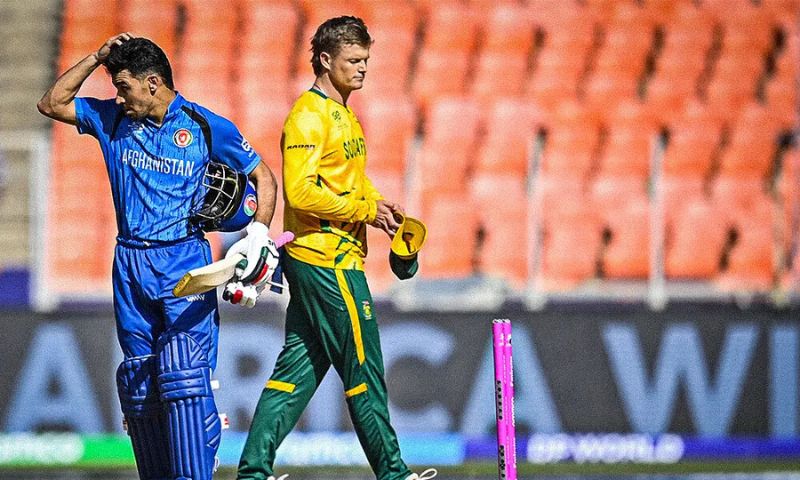
ISLAMABAD: Afghanistan walked off the Narendra Modi Stadium pitch shell-shocked on Wednesday, having come within touching distance of a famous T20 World Cup triumph over South Africa before falling in a second Super Over.
In what will rank as one of the most extraordinary matches in tournament history, both sides finished level on 187, then matched each other with 17 runs in the first Super Over, before the Proteas clinched a four-run victory in the decisive second one.
For Afghanistan, the grief of coming so close will linger. Here are five moments that slipped through their fingers.
South Africa held their nerves in a double Super Over classic against Afghanistan 👌
Watch the full match highlights of the memorable #T20WorldCup encounter 🎥⬇️https://t.co/lvKGzwlh7z
— ICC (@ICC) February 11, 2026
Rashid Khan: The unused asset in super over(s)
Afghanistan entered the contest with just two frontline quicks, Fazalhaq Farooqi and all-rounder Azmatullah Omarzai.
Farooqi conceded at exactly eight per over in a 187-run shootout. Omarzai, however, bled 41 runs from his four overs.
When the first Super Over arrived, Farooqi was entrusted with the ball. Understandable, perhaps. But when the game demanded a second Super Over, Afghanistan faced a choice.
They stuck with the pace. Omarzai ran in, and 23 runs disappeared into the floodlit sky.
Rashid Khan, arguably the finest T20 spinner on the planet, had figures of 2 for 28 from his four overs.
His variations, his composure under lights, his big-match pedigree, all left unused in the dressing room. The skipper did not bowl a single ball in either Super Over.
In a format where wrist-spin so often decides heavyweight contests, Afghanistan opted against their greatest strength. The decision may haunt them long after this tournament ends.
Final Ball Chaos: Farooqi’s Costly Rush
The most astonishing passage of play arrived at the death of Afghanistan’s regulation chase.
Three balls remained. Two runs needed. One wicket standing.
Noor Ahmad clipped the ball into the offside outfield and scampered through for a single with Farooqi. The scores were level. One more run would seal victory. Two deliveries remained.
But instead of settling, Afghanistan went for the second. Farooqi charged, desperate, bat outstretched, but crucially, he did not drag it. He attempted to place it down, a technical lapse that proved fatal as the bails were whipped off in a blur.
The Super Over beckoned. Victory had been stolen from a certain grasp.
In that moment, caution would have been wisdom. Two balls, one run, a wicket to spare. Instead, impulse overruled logic, and Afghanistan’s fate was no longer in their hands.
South Africa versus Afghanistan in Ahmedabad was absolute cinema 🤯
Watch the final over from the #SAvAFG thriller that led to the first #T20WorldCup 2026 Super Over 🙌https://t.co/oX4wWZgjye
— ICC (@ICC) February 11, 2026
Darwish Rasooli’s anchorman act that sank the ship
Rahmanullah Gurbaz produced an innings of rare quality, 84 from 42 deliveries, striking at 200, keeping Afghanistan in a contest that threatened to slip away repeatedly. His blade blazed while those around him flickered and faded.
At No.5, Darwish Rasooli arrived with the asking rate hovering around 10. Afghanistan needed urgency. Instead, they received inertia.
Rasooli scratched and prodded his way to 15 from 18 balls, a strike rate of 83 in a chase demanding 167. The required rate climbed. Pressure compounded. Gurbaz, exhausted, watched precious deliveries evaporate.
Rasooli was eventually run out, a merciful release from his vigil. But by then, the damage was done. Even a modest 25 from 18 would have tilted the equation. Afghanistan were left to lament what might have been.
Rashid held back: Gurbaz not sent
In the first Super Over, Afghanistan sent in Omarzai and Gurbaz. For the second, Omarzai walked out with Mohammad Nabi.
Rashid Khan, who had struck 20 from 12 balls in the regulation chase, remained padded up, watching.
Gurbaz, who was stunning in the regulation match and opened the first super over was also not turned up as an opener but hit three consecutive sixes to Maharaj following the two dots.
Nabi faced two deliveries. He missed one. He was out off the next.
There is no certainty that Rashid would have fared better. But in a contest measured in millimetres and milliseconds, Afghanistan denied themselves an option who had already demonstrated his capability under pressure.
Against a world-class South African attack, every resource matters. One went untapped.
First super over’s final delivery: A missed inch
Off the last ball of Afghanistan’s first Super Over, Omarzai jammed down on a yorker that squirted towards short fine leg.
The batters scrambled through for one, then hesitated. A fumble in the deep. A delay in the return. For a split second, a second run beckoned.
With wickets having no value on the final delivery, Afghanistan should have sprinted until the ball was dead or they were. No risk too great. No gamble unwarranted.
They settled for one. In a game decided by the narrowest of margins, that hesitation, those few feet not gambled, contributed to the arithmetic of heartbreak.
Final reckoning
Lungi Ngidi walked away with the Player of the Match award, his 3 for 26 a deserving recognition. South Africa advanced, their campaign alive.
Afghanistan were left with souvenirs of regret. A captain who did not bowl. A batter who did not accelerate. A tailender who ran when he should have waited, and did not slide when it mattered most.
A brilliant display of bowling from Lungi Ngidi was vital in helping South Africa edge past Afghanistan👏
He is the @aramco POTM🏅
📝: https://t.co/imSDJnHAdr pic.twitter.com/WENxmHwmYz
— ICC (@ICC) February 11, 2026
Why Stubbs Batted Twice and Ngidi Couldn’t Bowl a Second Time
As David Miller and Tristan Stubbs walked out for a second consecutive Super Over, and Keshav Maharaj marked his run-up instead of Player of the Match Lungi Ngidi, one question dominated the aftermath: was this allowed?
The answer, buried deep in the ICC’s T20 World Cup playing conditions, reveals a set of regulations designed for infinite cricket, and infinite fairness.
An instant #T20WorldCup classic sees South Africa beat Afghanistan in a double Super Over thriller 🤯
📝: https://t.co/imSDJnHAdr pic.twitter.com/qj0IhYkAOm
— ICC (@ICC) February 11, 2026
Why Tristan Stubbs Batted Twice
When South Africa scored 23 in the second super over, the Proteas sent the same pair who had successfully equalled 17 in the first super over: David Miller and Tristan Stubbs.
There was no violation. There was no oversight. The regulations simply permit it.
Appendix F of the ICC’s Playing Conditions outlines the procedure for multiple Super Overs with precise language.
Critically, it imposes only one restriction on batting line-ups: “Any batter dismissed in any previous Super Over shall be ineligible to bat in any subsequent Super Over.”
Dewald Brevis, dismissed by Fazalhaq Farooqi in the first Super Over, was therefore barred from participating in the second. But Miller and Stubbs remained unbeaten. Their availability was unrestricted.
South Africa were free to send them out again. And they did.
SUPER OVER TIED! 🤯
Get to your screens now, broadcast details 📲https://t.co/NPykWM7qqY#T20WorldCup #SAvAFG pic.twitter.com/br2g9CEuPF
— ICC (@ICC) February 11, 2026
Why Lungi Ngidi Could Not Bowl the Second Super Over
Ngidi had been South Africa’s hero of regulation time, claiming 3 for 26 before delivering a first Super Over that conceded 17 runs. Yet when the second Super Over beckoned, the ball was handed to Keshav Maharaj.
The playing conditions are unequivocal: “Any bowler who bowled in the previous Super Over shall be ineligible to bowl in the subsequent Super Over.” Ngidi had bowled the first. He could not bowl the second.
In the annals of T20 World Cup classics, this match will be remembered as a masterpiece of tension.
For Afghanistan, it will also be remembered as the one that got away, not in a single catastrophic moment, but in a succession of small, costly decisions that together tipped the balance.
Brief scores:
South Africa 187/6 (20 overs) tied with Afghanistan 187 all out (19.4 overs); Super Over 1: South Africa 17/1, Afghanistan 17/0; Super Over 2: South Africa 23/0, Afghanistan 19/2.
South Africa won the second Super Over by 4 runs.