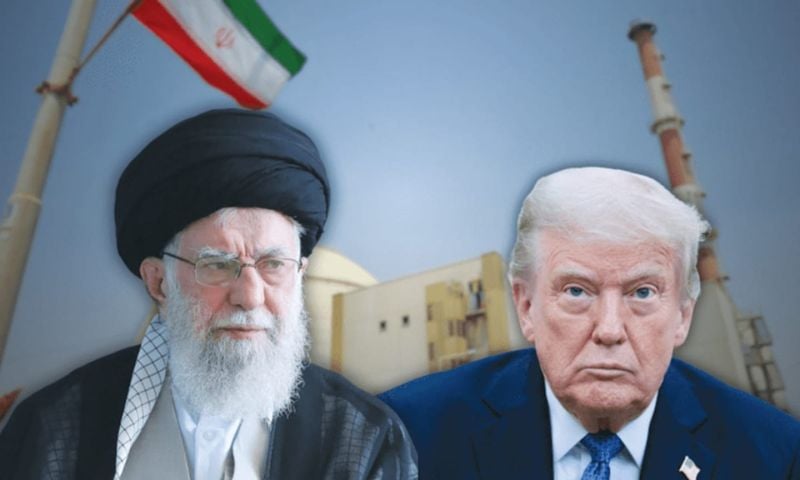



WASHINGTON: The United States and Iran are due to hold nuclear talks in Oman on Friday after Tehran requested a change of venue to limit negotiations strictly to its nuclear programme, a regional official said.
The talks come at a sensitive moment, with heightened military tensions in the Middle East following a US naval build-up and Tuesday’s confrontations at sea, raising fears of a confrontation between the long-time adversaries.
Iran asked that the meeting be moved to Oman as a continuation of earlier nuclear negotiations hosted there, according to a regional official cited by Reuters.
Shift in venue and scope
Tehran also sought to restrict the agenda to the nuclear file, resisting US efforts to broaden talks to include Iran’s ballistic missile programme and defence capabilities.
Iran has repeatedly described its missile programme as a red line. It says it will not negotiate over its defence capabilities and has warned it would use its missiles if its security is threatened.
A regional diplomat, cited by Reuters, said Iran was seeking “to change the format and the scope” of the discussions, favouring strictly bilateral talks with Washington.
White House press secretary Karoline Leavitt said talks were still expected later this week but did not confirm the venue or agenda.
Iran’s foreign ministry said consultations over the location were ongoing, with Turkiye, Oman and other countries expressing readiness to host.
An Arab official, cited by AFP, said a meeting was still likely to take place in Turkiye on Friday following diplomatic efforts by Ankara, Egypt, Oman and Qatar.
Diplomatic sources told Reuters that US Special Envoy Steve Witkoff and Iranian Foreign Minister Abbas Araqchi were expected to meet in Istanbul to try to revive stalled negotiations.
Regional officials said Egypt, Qatar and the United Arab Emirates could attend parallel meetings on the sidelines.
Rising military tensions
The diplomatic manoeuvring follows a sharp rise in regional tensions.
On Tuesday, the US military said it shot down an Iranian drone that had “aggressively” approached the aircraft carrier Abraham Lincoln in the Arabian Sea.
US President Donald Trump said on Tuesday that Washington was “negotiating with them right now”, but warned earlier that “bad things” could happen if a deal was not reached.
The United States has also reinforced its military presence in the region after protests in Iran last month.
Iran’s position and red lines
Iranian officials say any talks must focus solely on the nuclear issue.
Tehran has ruled out negotiations on ballistic missiles or defence matters, calling US demands in those areas unacceptable infringements on its sovereignty.
Iranian sources told Reuters that Washington had set conditions for renewed talks, including zero uranium enrichment on Iranian soil and limits on Iran’s missile programme.
Tehran has rejected these demands, though officials said restrictions on missiles were seen as the biggest obstacle.
Iran says sanctions relief is a priority and that time is running short for diplomacy.
Iranian Foreign Minister Araqchi said Tehran had lost trust in Washington but that a deal remained possible if talks were fair and equitable.
Nuclear negotiations collapsed last year after Israel launched strikes on Iranian nuclear and military sites, triggering a 12-day conflict.
The United States briefly joined the fighting, striking Iranian nuclear facilities, while Iran responded with missile and drone attacks.
Since returning to office, Trump has reinstated a policy of “maximum pressure” sanctions against Iran and ordered a renewed US naval build-up in the region.
Iran’s Supreme Leader Ayatollah Ali Khamenei warned on Sunday that any US attack would spark a “regional war”.