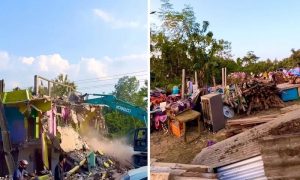
HERAT: A series of powerful earthquakes struck western Afghanistan on Saturday, with the main quake measuring a magnitude of 6.3, followed by eight strong aftershocks. The affected areas, located 30 kilometers (19 miles) northwest of the provincial capital of Herat, suffered significant devastation, leading to a sharp increase in the death toll, which has now surpassed 1,000 lives lost. The extent of the damage became more apparent as rescuers worked tirelessly to find survivors among the ruins of villages that were completely flattened by the tremors.
Deputy government spokesman Bilal Karimi expressed the gravity of the situation, stating, “Unfortunately, the casualties are practically very high. The death toll is more than 1,000 people. We are waiting to see how the final figures will turn out.”
"We came home and saw that actually there was nothing left. Everything had turned to sand."
Nek Mohammad told AFP he was at work when the first quake struck.
➡️https://t.co/rL5NkK84NC pic.twitter.com/GW2TeMnq7m— AFP News Agency (@AFP) October 8, 2023
In Sarboland village of Zinda Jan district, near the epicenter of the quakes, numerous homes were reduced to rubble. Men engaged in the arduous task of clearing away debris while women and children sought refuge in the open, with their devastated homes displaying personal belongings fluttering in the harsh wind.
The World Health Organization (WHO) reported that over 600 houses were either destroyed or partially damaged across at least 12 villages in Herat province, affecting approximately 4,200 people.
Bashir Ahmad, a 42-year-old resident, recounted, “In the very first shake, all the houses collapsed. Those who were inside the houses were buried. There are families we have heard no news from.”
Nek Mohammad, another local resident, shared his harrowing experience, saying, “We came home and saw that actually there was nothing left. Everything had turned to sand.” He added that about 30 bodies had been recovered so far.
#UPDATE The death toll from a series of earthquakes in remote western Afghanistan rises sharply to "more than 1,000", a government spokesman tells AFP of Saturday's magnitude 6.3 quake in Herat which was followed by a series of powerful aftershocks.
— AFP News Agency (@AFP) October 8, 2023
As night fell, residents faced dire conditions with little shelter and supplies. The WHO warned that the number of casualties is expected to rise as search and rescue operations continue.
In Herat city, residents fled their homes, and schools, hospitals, and offices were evacuated as the first quake struck. However, there were relatively few reports of casualties in the city.
Afghanistan is already grappling with a severe humanitarian crisis, exacerbated by the withdrawal of foreign aid following the return of the Taliban to power in 2021. Herat province, home to approximately 1.9 million people and situated on the border with Iran, has also endured a prolonged drought that has further strained already impoverished agricultural communities.
Afghanistan is prone to earthquakes, particularly in the Hindu Kush mountain range, located near the convergence of the Eurasian and Indian tectonic plates. Just last year, in June, a 5.9-magnitude quake, the deadliest in nearly a quarter of a century, struck the impoverished province of Paktika, resulting in over 1,000 fatalities and leaving tens of thousands homeless.