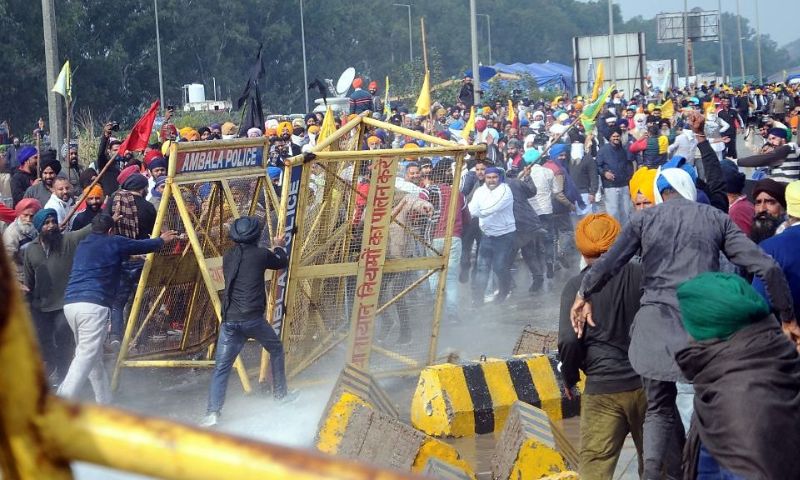
NEW DELHI: In a country where over 60 percent of its 1.3 billion people rely primarily on agriculture for their livelihoods, the 2020–2021 Indian farmers’ protest stands as a stark symbol of betrayal.
This protest unfolded in response to three farm acts passed by Parliament in September 2020, collectively dubbed the ‘Farm Bills.’ These laws sparked outrage among farmer unions and opposition politicians, who denounced them as “anti-farmer,” foreseeing a future where farmers would be left vulnerable to corporate interests.
Remarkably, the protests remained largely non-violent, with protestors also demanding the creation of a minimum support price (MSP) bill to safeguard against corporate manipulation of prices.
In the first week of June 2020, the Central Government of India promulgated three ordinances, temporary laws addressing various aspects of agricultural produce, sales, hoarding, agricultural marketing, and contract farming reforms.
Farmers passionately called for the repeal of laws enacted in September 2020, which aimed to reduce the government’s role in agriculture and open more space for private investors. In contrast, the government contended that these new laws would unburden farmers and foster private investment, thereby promoting economic growth.
Farmers expressed deep-seated fears that the removal of existing state protections, which they already considered insufficient, would render them vulnerable to profit-driven corporations. They argued that the laws would enable private players to enter farming, ultimately undermining their income.
After a year of enduring harsh conditions, including extreme weather and the COVID-19 pandemic, Prime Minister Modi announced the repeal of the contentious farm laws.
In November 2021, the Indian parliament voted to repeal these laws, a significant shift driven, in part, by electoral considerations, as the ruling party faced potential losses in state and national elections. Consequently, Modi’s relationship with farmers and farm unions had political ramifications, with the government making efforts to appease the tens of thousands of protesting farmers.
The government asserted that the laws, passed in September of the previous year, were aimed at deregulating farm produce markets. However, protesting farmers believed that these laws could have paved the way for corporate dominance in the vast agriculture sector, which constitutes the primary source of livelihood for about 70% of India’s rural households. A multitude of farm unions, whose names are provided in the document, actively protested against the Farm Laws, with the protests continuing for nearly a year.
Rising Trends of Suicides in Farmers
Data from the National Crime Records Bureau (NCRB) reveals a distressing trend of farmer suicides remaining consistently high over a six-year period spanning from 2014 to 2020.
In 2014, 5,600 farmers tragically took their own lives, and this harrowing figure remained almost unchanged in 2020, with 5,500 farmer suicides reported. When agricultural laborers are included in the 2020 figures, the total number of suicides surpasses a staggering 10,600.
The situation for India’s more than 260 million agricultural workers is dire, with nearly 30 individuals in the farming sector succumbing to suicide daily, primarily due to insurmountable debt.
The year 2020 saw over 10,000 individuals in the agricultural sector ending their own lives, according to NCRB data.
The reasons behind these tragic statistics are multifaceted. Indian farmers find themselves entangled in a complex web of challenges, including longstanding battles against multinational corporations.
Furthermore, the policies implemented during the Modi regime often resulted in lower harvest and market values for their produce, exacerbating the financial pressures on farmers. These pressures manifest as insurmountable debt, environmental degradation, and alarmingly high rates of cancer linked to pesticide exposure.