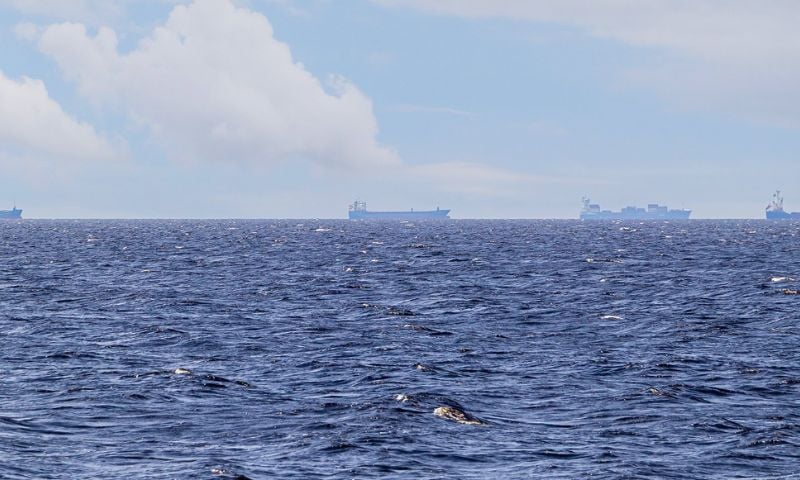
LONDON: Around 115 vessels carrying approximately 2,500 seafarers have been safely evacuated from the Strait of Hormuz since Tuesday, the head of the UN maritime agency said on Friday.
International Maritime Organisation (IMO) Secretary-General Arsenio Dominguez provided the update after the organisation suspended its evacuation efforts on Thursday following an attack on a vessel in the Gulf of Oman. The operation had been aimed at assisting around 600 ships and 11,000 seafarers.
Speaking at an online press briefing, Dominguez said, “115 vessels have evacuated in the last three and a half days, representing around 2,500 seafarers who have now safely left the Strait of Hormuz.”
The Strait of Hormuz is a key global energy route through which around one-fifth of the world’s crude oil and liquefied natural gas supplies were transported before Israel and the United States launched military action against Iran at the end of February.
In response, Tehran closed the waterway to shipping, triggering significant economic disruption worldwide.
Iran and the United States signed an initial agreement earlier this month, brokered by Pakistan, aimed at ending the conflict. The memorandum of understanding allows commercial vessels to transit the strait without charges for a 60-day period while negotiations continue toward a final peace agreement.
Also Read: Vessel Hit by Unknown Projectile off Oman Coast: Maritime Agency
Ships use Oman passage to cross Hormuz
Traffic through the Strait of Hormuz declined from Wednesday’s peak levels, but vessels continued to use a southern passage along Oman’s coast despite a ship being struck by a projectile while travelling through the route, according to vessel-tracking data on Friday.
Kpler’s tracking platform showed that at least 42 commodity vessels, including oil tankers, gas carriers and dry bulk ships transporting goods such as fertilisers, crossed the strait on Thursday, down from 57 vessels the previous day. Of those, 10 entered the Gulf while 32 departed, with half using the Omani coastal route.
Hormuz traffic stays elevated
Strait of Hormuz traffic remained resilient on 25 June, with 54 verified crossings across a broad mix of commercial and energy-linked vessels. West-to-East movements dominated, while the Omani Route accounted for the largest share of identified… pic.twitter.com/UOtJE35wjd
— Kpler (@Kpler) June 26, 2026
By Friday afternoon, another 29 commodity vessels had passed through the strait, including 10 heading into the Gulf and 19 exiting. Seventeen of those vessels used the same Omani route despite a Singapore-flagged container ship reporting that it had been hit while travelling through the passage on Thursday, according to the United Kingdom Maritime Trade Operations (UKMTO) centre.
Hormuz transits hit 54
Strait of Hormuz traffic continued on 25 June, with 54 verified crossings across a broad mix of commercial and energy-linked vessels. Traffic data, supported by #MarineTraffic tracking, showed 39 West-to-East movements and 15 East-to-West movements, with… pic.twitter.com/Uzi317Jcdn
— MarineTraffic (@MarineTraffic) June 26, 2026
MarineTraffic data showed that around 15 tankers and cargo vessels crossed the strait between the time of the incident at 1410 GMT on Thursday and midnight.
The Islamic Revolutionary Guard Corps (IRGC) said on Thursday that Oman and the International Maritime Organisation (IMO) had introduced the new corridor without consulting Tehran, warning vessels against using the route.
“The only authorised transit routes through the Strait of Hormuz are those designated by the Islamic Republic of Iran,” it said.
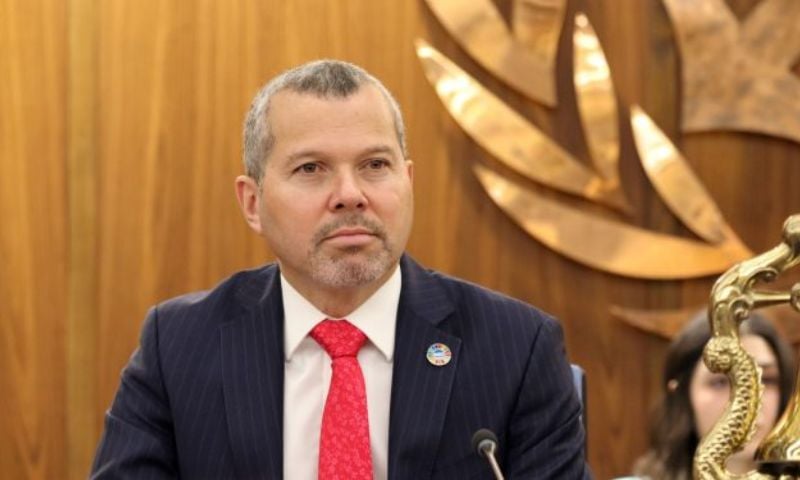
“I have decided to temporarily pause (the evacuation plan’s) implementation in order to reconfirm that the necessary safety guarantees continue to be in place for the ships on our evacuation list and all those in the region,” IMO Secretary-General Arsenio Dominguez said in a statement.
“The sudden surge in shipping through the Strait of Hormuz has been greeted in some quarters as evidence that the region is snapping back to normal. It isn’t,” shipping journal Lloyd’s List editor-in-chief Richard Meade said Friday.
“What we are witnessing is a ceasefire‑driven release of pent‑up demand — a ketchup‑bottle burst of tonnage.
“The Strait of Hormuz may be busier, but it is not safer. Until the terms of any post‑ceasefire regime are known —- and respected —- the idea of a return to normality remains more hope than forecast,” he added.