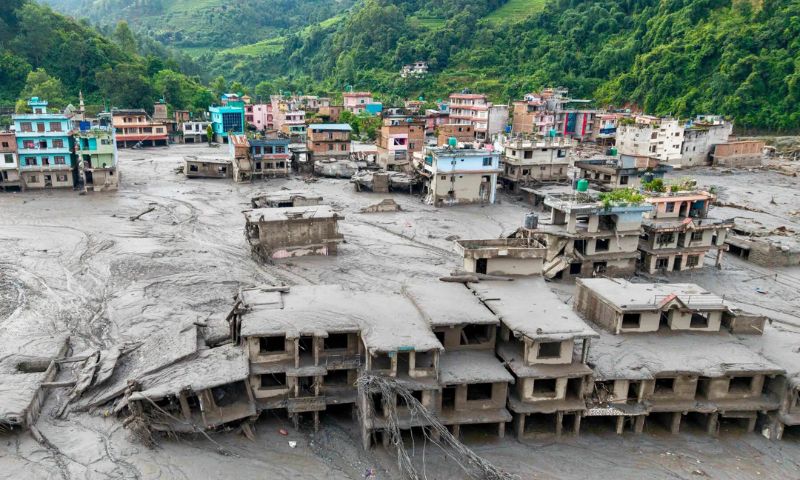
RISHULI, Nepal: Rescuers on Thursday searched debris-covered valleys and hillsides in Nepal as more than 1,000 people remained missing in Nepal and neighbouring China after an ice, mud and rock collapse triggered a devastating flash flood in the Himalayan region.
Authorities deployed helicopters to search for survivors and deliver emergency supplies to thousands stranded in towns and valleys following Wednesday’s disaster. The flood swept through a route heavily used by trekkers and pilgrims travelling between Kathmandu and Lhasa in Tibet.
Nepali Police said at least 359 people had died, with dozens of bodies carried downstream into the plains, where recovery operations were under way.
The death toll from devastating floods in Nepal has risen to 95, while 403 tourists remain missing.
The missing include 200 women and 203 men, with foreign nationals from 26 countries among those unaccounted for.
🇮🇳 India: 133 missing
🇺🇸 US: 47 missing
🇬🇧 UK: 33 missingThe… pic.twitter.com/POwg2vmN2J
— Sajjad Tarakzai (@SajjadTarakzai) August 26, 2026
Nepal’s disaster management authority warned of a fresh flood threat along the Bhotekoshi River after satellite imagery and preliminary assessments suggested that the river had been blocked by debris, creating a growing lake at the disaster site.
Officials said the lake was continuing to rise and could burst its banks, prompting authorities to urge residents and rescue workers living or operating along the lower riverbanks to move to safer areas.
Floods in Nepal wreak havoc, sweeping away several villages and leaving over 1,000 people missing. Bridges and power plants destroyed. Army deployed.
horrific helicopter view of the Trishuli River corridor after the flood.#NepalFloods #Nepal #Rasuwa #FlashFlood #Floods pic.twitter.com/Gdj3JyAVrX
— Ravi Pandey🇮🇳 (@ravipandey2643) August 26, 2026
Nepal’s Home Minister Sudhan Gurung said rescue teams were concentrating on locating survivors. Authorities had accounted for around 100 missing Indian visitors, mostly pilgrims, and 25 Chinese workers in the worst-hit area around Trishuli. Nearly 550 foreign nationals remained unaccounted for, while officials were still assessing the number of missing Nepali citizens.
Full scale of disaster remains unclear
The Red Cross said entire villages had been destroyed, while damaged roads and bridges had left several communities isolated. It warned that the full extent of the disaster was still unclear.
Survivor Keshav Prasad Baral, 68, described the moment the flood struck, saying a massive surge of mud swept towards his home and carried away his wife.
Baral was rescued by helicopter about four hours later, but said his wife remained buried beneath the mud.
In China’s Tibet region, 558 people were reported missing in Gyirong County, including 260 foreign nationals, state broadcaster CCTV reported. China said its death toll remained at three.
The missing foreign nationals in Nepal included people from more than two dozen countries, among them 288 Indians, 63 Americans, 51 Malaysians, 34 Australians, 33 Britons and 25 Canadians.
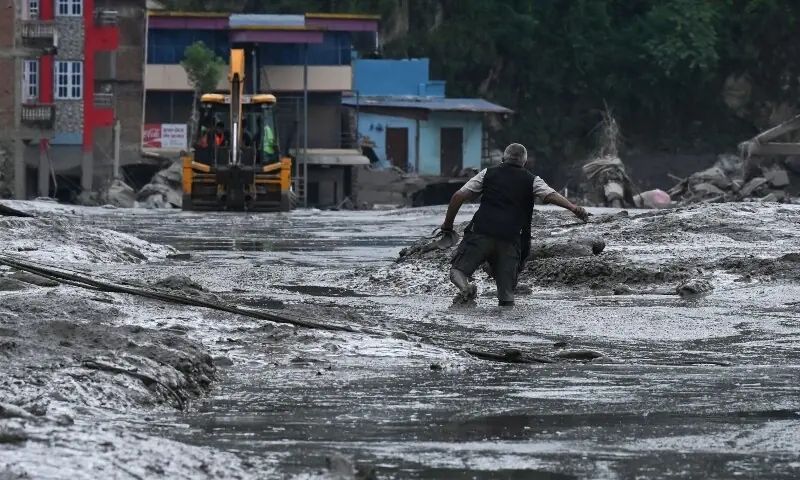
Bodies recovered downstream
China said it was maintaining close contact with Nepal over search and rescue operations, with nearly 100 Chinese nationals among those affected on the Nepalese side of the border.
Chinese Premier Li Qiang visited the disaster-hit area of Gyirong on Thursday afternoon, according to state-run Xinhua news agency, underscoring the significance of the disaster for Beijing.
111 emergency rescuers, equipped for search and rescue, rushed to the mudslide-stricken Gyirong Port in Xizang. Entrusted by President Xi Jinping, Premier Li Qiang has also arrived in the disaster-hit area. All-out efforts are underway to save lives and support those affected. pic.twitter.com/dVr7PweV5o
— FU Cong 傅聪 (@ChinaAmbUN) August 27, 2026
The Gyirong border port is an important link in China’s Belt and Road network connecting the country with South Asia. The area has undergone major development in recent years, including the construction of logistics facilities, yards and parking areas.
Chinese government geologist Guo Zhaocheng said the ice-avalanche debris flow that triggered the disaster travelled at around 50 metres per second and stretched for more than 20 kilometres, giving people little time to escape.
According to Guo, a high-altitude ice avalanche set off the debris flow, which gathered glacial moraine as it moved downhill before developing into a powerful mudslide that struck facilities and settlements on both sides of the China-Nepal border.
Ganesh Aryal, administrator of Nepal’s Chitwan district, said 103 bodies had been recovered from the river system about 100 kilometres downstream from the worst-hit area around Trishuli.
With local hospitals unable to accommodate all the recovered bodies, authorities were setting up tents and making arrangements for families to identify and collect the remains of their relatives.
Nepal’s Prime Minister Balendra Shah travelled by road to assess the flood situation in Nuwakot, one of the worst-affected districts, his office said.
The disaster poses a major challenge for Shah’s five-month-old government, although officials said Nepal had experienced emergency teams and disaster-response systems capable of handling large-scale tragedies, including the 2015 earthquake that killed nearly 9,000 people.
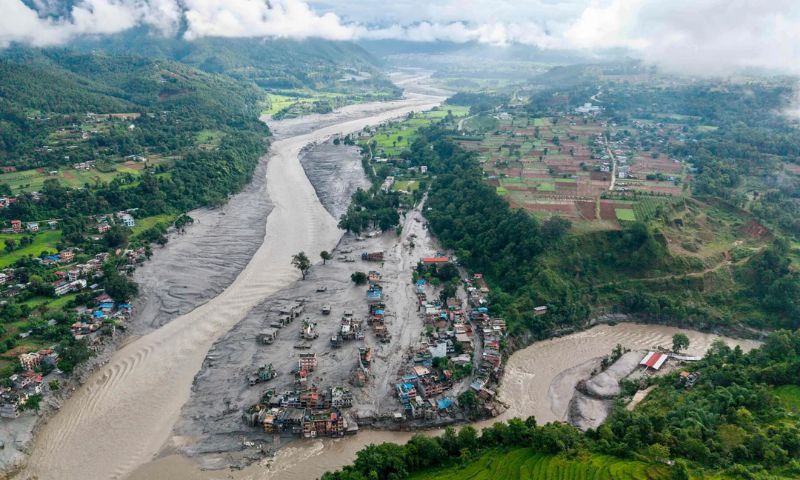
Landslide, not earthquake, generated seismic energy
Authorities initially considered whether an earthquake had triggered the flooding. However, the US Geological Survey said the seismic energy detected during the disaster was instead generated by a landslide.
ALSO READ: Rescuers Race To Find Hundreds Missing In Nepal-China Border Disaster
The finding adds to evidence that the sudden ground movement and subsequent release of mud and water played a central role in the disaster.
With more rain forecast and unstable slopes threatening further collapses, rescuers face a race against time to reach those still trapped or missing across the rugged China-Nepal border region. On Thursday morning, the dammed lake was estimated at 2 million cubic metres in volume and was already overflowing, state media said citing the Chinese water resources ministry.
Another 3 million cubic metres of water — roughly 1,200 Olympic-size swimming pools — is expected to enter the lake over the next three days, posing a high risk of a breach, with peak flow expected around September 1, it said.