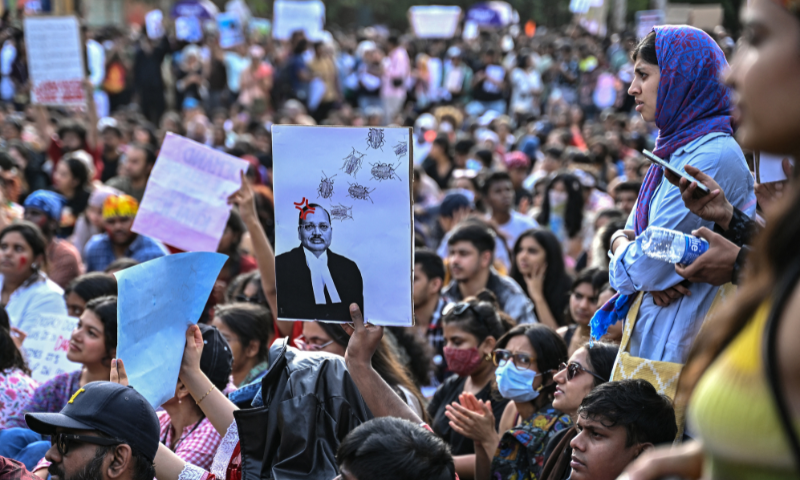
NEW DELHI: A large number of young Indian women who participated in the Cockroach Janta Party (CJP) protests against Prime Minister Narendra Modi’s government say they have faced online harassment, threats and targeted abuse after their videos and social media posts from the demonstrations went viral.
Speaking to the media, the women said they faced a wave of misogynistic attacks, including rape threats, sexual insults, manipulated images and attempts to expose their personal information online, after participating in a major anti-government protest movement in India.
The youth-led CJP used social media platforms, particularly Instagram, as a key tool to organise supporters and share satirical videos, protest songs and footage of demonstrations.
The movement gained widespread attention after protests that included a march towards India’s Parliament on July 20, during which police used tear gas and baton charges to disperse demonstrators.
According to Delhi police, at least 60 protesters and 118 police personnel were injured during the clashes, while the CJP disputed the official figures and claimed that the number of injured protesters was higher.
Women targeted after viral protest content
The protests turned several young participants into prominent online figures after their videos and posts attracted hundreds of thousands of views. However, after the demonstrations ended, some women involved in the movement alleged that they became targets of coordinated online attacks at the behest of the Modi government.
According to the BBC, one content creator in her mid-20s said she began posting about the protests from the start and attended her first demonstration on July 20.
After police action and an internet shutdown around the protest site, she shared her experiences online and helped organise food, aid and volunteers. She said the backlash began almost immediately. “I was slut-shamed and attacked for questioning the prime minister’s comments after the protest,” she said.
She added that she had received countless abusive messages and had blocked numerous accounts, but the harassment continued. The woman said online abuse had created a sense of constant surveillance, particularly for female content creators.
“My mother stopped reading the comments on my posts long ago. She said she couldn’t bear the things strangers were saying about her daughter,” she said.
Student protesters report threats
A 20-year-old college student who attended her first protest said she recorded short videos before and during the demonstration without expecting them to spread widely.
One of her videos was later shown on a national television channel, after which she said her identity began circulating on social media. She said online users attempted to identify her college and personal details, filling her inbox with threatening messages.
She said some users threatened to report her to police, while others made sexually explicit comments, used degrading language and warned her that she would face consequences.
The student said the most disturbing part was not only the online abuse but the pressure placed on her family. “Relatives and acquaintances called my parents, urging them to make me delete my videos,” she said. Following the harassment, she removed or archived most of her protest-related content.
Activist says abuse intensified after identity revealed
Another student activist said she had long expressed her views online but faced a dramatic increase in harassment after participating in the CJP protests.
She said she had made satirical videos criticising Prime Minister Narendra Modi and sharing scenes from demonstrations, but the content later spread far beyond her own followers.
According to her account, social media users edited her photographs, accused her of being “anti-national” and labelled her a supporter of extremist causes. She also said she faced religiously targeted abuse after users identified her as a Muslim.
Her father, a journalist, became concerned after reading the comments, fearing that she could face legal action similar to other activists. Despite the threats, she said she remained committed to speaking out. “I still believe I was right to go to that protest,” she said.
READ ALSO: Cockroach Janta Party’ Swarms Instagram, Leaves Modi’s BJP Behind in Under a Week
Fear of doxxing forces protesters offline
A student from West Bengal said she had supported the movement online before attending a protest in Kolkata on July 20. She helped organise supplies and launched an Instagram fundraiser to support demonstrators.
However, she said harassment increased after police began detaining protesters in the state. She said people posted abusive comments on her fundraiser page and sent private messages containing sexual insults.
Fearing that her personal information could be exposed, she changed her social media name, made her account private and restricted messages from unknown users.
She said the attacks were particularly painful because male protesters expressing similar views did not face the same level of sexualised abuse.
Growing concerns over online harassment
The allegations highlight wider concerns about online intimidation of women activists and protesters in India, where social media has increasingly become a key battleground for political debate.
The women said that while they expected criticism for their views, the scale of threats, gender-based abuse and attempts to expose their personal details had gone beyond ordinary political disagreement.
Many have since reduced their online presence, but some say they remain determined to continue expressing their views despite the risks.