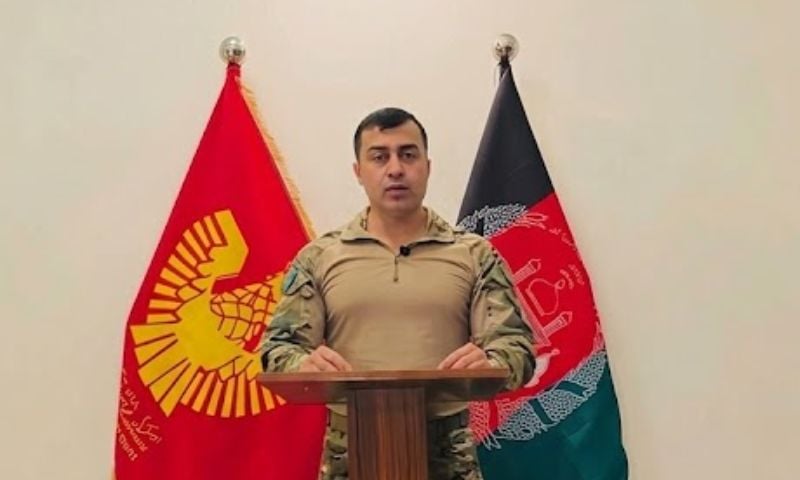
KABUL: Nearly five years after the Taliban returned to power, former Afghan army general Sami Sadat has announced the start of military operations by the Afghanistan United Front, arguing that armed resistance, political mobilisation and public pressure are weakening the group’s control over the country.
Appearing in an Afghan National Army uniform and holding the former republic’s tricolour flag, Sadat said the front had authorised operations against Taliban fighters, bases and senior leaders from 5am Kabul time.
“The first phase of military operations targeting Taliban members, bases and leadership has begun; subsequent phases will follow,” he said in a video message.
Sadat described the campaign as a “war of liberation”, claiming that negotiations with the Taliban had failed and that the international community had ignored appeals from Afghan civil society for almost five years.
He said Afghanistan’s freedom would require a combination of military action and political, diplomatic and public efforts.
The announcement comes amid growing reports of armed opposition activity in provinces including Badakhshan, Herat and Kandahar, the Taliban’s ideological heartland.
Resistance groups have sought to capitalise on local grievances linked to ethnic divisions, restrictions on women, political exclusion and disputes over resources.
Sadat accused the Taliban of allowing international terrorist groups to operate from Afghanistan and said the country’s natural resources were being exploited for the benefit of armed organisations.
ALSO READ: 14 Afghans Die While Attempting to Illegally Enter Iran
“With the Taliban, international terrorism has returned to Afghanistan,” he said.
He called on Afghans inside and outside the country to unite under the tricolour flag and urged former political and military leaders to support the campaign.
Sadat said the Afghanistan United Front considered itself the continuation of the former Afghan National Army and was led by professional Afghan officers.
“We do not want foreign troops or foreign bases,” he said. “We only need political and material support.”
He added that the front intended to fight the Taliban, Al-Qaeda, Islamic State, Tehreek-e-Taliban Pakistan and other terrorist organisations.
Sadat also stressed that the movement was not directed against Afghanistan’s neighbours, arguing that stable relations with regional countries, particularly Pakistan, were essential.
According to Sadat, the front’s ultimate objective is to restore a free and constitutional Afghanistan under the 2004 Constitution, international humanitarian law and a representative Loya Jirga.
Taliban believed they could abandon their responsibilities, manufacture a false façade of stability, harbour terrorists, and simultaneously take on Pakistan without consequences. That illusion is now collapsing.
By providing safe haven to TTP—their ideological comrades in the misuse of Islam—they institutionalised terrorism as a state policy to preserve their stranglehold over Afghanistan. Today, that very strategy is consuming them from within.
Years of ethnic persecution, minority marginalisation, systematic deprivation of women, and an arrogant belief that Afghanistan is forever the “graveyard of empires” have only driven the country deeper into chaos and isolation.
India has relentlessly exploited their strategic blindness and myopic worldview. The deadly trade in innocent lives across Afghanistan and Pakistan, fuelled by proxy terrorism and calculated misadventures, has now come full circle. The architects of this policy are beginning to pay the price themselves.
The Afghan people deserve a genuinely representative government—not another unelected militia of armed power grabbers repeating Afghanistan’s tragic cycle of violence and repression.
Good neighbourly relations with Pakistan are paramount, indispensable and irreplaceable. Instead of exporting instability, the Afghan Taliban must confront the strategic disaster they have created for themselves.
Once again, Afghanistan is being turned into a playground of competing powers—not because of geography, but because of the Taliban’s strategic miscalculations, ideological rigidity and catastrophic failure of governance.