
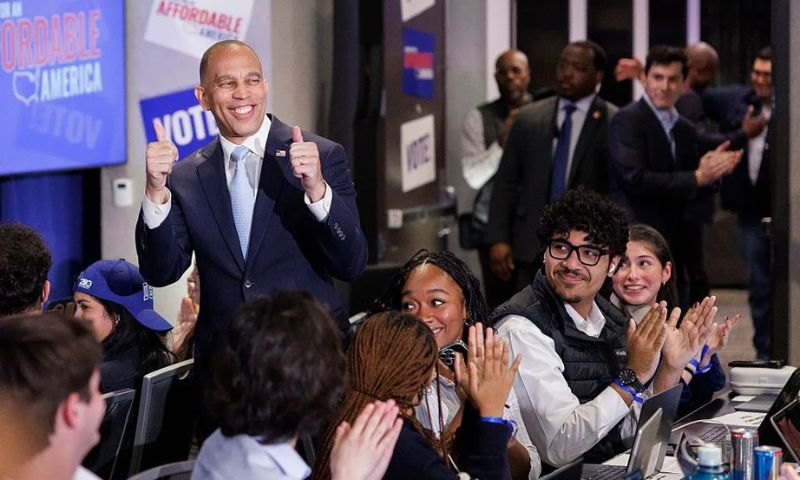
WASHINGTON: The celebrations were electric on election night. Democratic supporters cheered as one Republican stronghold after another fell, Senate seats changed hands, and the party secured control of both chambers of Congress.
House Democratic leader Hakeem Jeffries captured the mood with an emphatic declaration: “Today begins the great American comeback.”
But the morning after the political triumph brought a more complicated reality.
Democrats have won the power to challenge President Donald Trump, investigate his administration and block many of his nominees.
They can put his policies under congressional scrutiny and force the White House to negotiate legislation and government spending. They cannot govern without obstacles.
Trump remains in the White House, retains his presidential veto and continues to exercise substantial executive authority over immigration, trade and military operations.
For Democrats, the challenge is no longer simply to defeat Republicans at the ballot box. It is to demonstrate that they can deliver on the promises that helped bring voters to their side.
Those promises include reducing the cost of healthcare, groceries and petrol, reversing cuts to social programmes, investigating alleged corruption and seeking greater congressional control over the war with Iran.
The warning from within the Democratic Party is already clear: an election victory is not a licence to overreach.
US Senator Chris Coons told the BBC that Democrats should not interpret the result as an automatic mandate for their entire political agenda, pointing out that the party remained deeply unpopular.
“We need to prove we can get stuff done, actually deliver answers to their concerns and questions about low wages and rising costs in particular,” he said.
The Power To Investigate
One of the Democrats’ most immediate opportunities will come through congressional oversight.
Robert Garcia, the California Democrat expected to lead the powerful House Oversight Committee, could make the final two years of Trump’s presidency considerably more difficult.
As Democratic victories poured in on election night, Garcia delivered a blunt warning to Republicans:
“Lawyer up.”
Congressional committees in both chambers have powers to investigate government conduct, summon officials, demand documents, and hold public hearings.
Democrats have already identified several potential areas of scrutiny, including the business and cryptocurrency dealings of Trump’s family, alleged corporate corruption, government contracts involving powerful business figures, immigration enforcement and the conduct of the Department of Homeland Security and Immigration and Customs Enforcement.
The handling of files relating to convicted sex offender Jeffrey Epstein could also come under renewed examination.
Such investigations could place senior administration officials under sustained pressure, expose internal disagreements and generate demands for explanations from the White House.
However, investigations do not automatically lead to criminal charges or the removal of officials. The administration could challenge congressional demands, setting up legal battles over access to documents and testimony.
Impeachment Returns?
Democratic control of the House also reopens the possibility of another impeachment effort against Trump.
The House has the constitutional authority to impeach a president through a simple majority vote. However, conviction and removal require a two-thirds majority in the Senate — 67 votes — a threshold Democrats are unlikely to reach.
Trump was impeached twice during his first presidency, but the Republican-controlled Senate acquitted him on both occasions.
There is also a political calculation. Some Democrats fear that another impeachment campaign could deepen partisan divisions and allow Trump to portray himself as the target of political persecution.
Jeffries, who is expected to become the first Black speaker of the House when the new Congress convenes in January, has avoided committing to an impeachment strategy.
“We haven’t ruled anything in. And we haven’t ruled anything out,” he told CNN in August.
For now, investigations and oversight may offer Democrats a more immediate way to challenge the administration.
The Healthcare Battle
Democrats have identified the cost of living and healthcare as central priorities for their first legislative push.
Jeffries has promised an ambitious programme for the House’s opening 100 hours, with particular attention to reversing Republican cuts to healthcare programmes.
His priorities include restoring significant Medicaid funding and extending tax credits that help Americans purchase health insurance through the Affordable Care Act, commonly known as Obamacare.
“We’re committed as a top priority as House Democrats to reversing these Medicaid cuts and extending the Affordable Care Act tax credits,” Jeffries said at a September event for healthcare workers.
Democrats also want to address rising grocery and fuel costs, roll back tariffs and challenge the economic consequences of the war with Iran.
With control of both chambers, they can bring legislation to the floor and shape congressional spending negotiations.
But passing a bill through Congress and turning it into law are two different things.
Trump’s Veto Wall
The biggest obstacle to the Democratic legislative agenda remains the president himself.
Even with majorities in both chambers, Democrats cannot automatically enact their proposals. Most legislation must be signed by the president to become law.
Trump can veto bills passed by Congress, and overriding a presidential veto requires a two-thirds majority in both the House and Senate, support Democrats do not possess.
The Senate’s procedural rules create another challenge. Most major legislation faces a 60-vote threshold to overcome a filibuster, meaning Democrats may need Republican support even when they control the chamber.
The result could be another period of legislative deadlock in Washington.
Casey Burgat, a professor of legislative affairs at George Washington University, warned that governing could become more complicated.
“If you thought legislating was hard in the last Congress with unified Republican control, that will get much more complicated,” he said.
The contrast between Democratic control of Congress and a Republican presidency could leave ordinary Americans waiting for progress on the very issues that shaped their votes.
Trump Offers A Deal — Then A Warning
Trump initially struck a conciliatory tone after the Republican defeats.
In an interview with The New York Times, he said he was prepared to work with Democrats and suggested the two sides could find common ground.
“We’ll work with the Democrats, and we’ll, you know, look forward to working with them. We’ll probably work something out,” he said.
But the president quickly reminded Democrats that he still had the power to block their legislative ambitions.
He posted an image of his familiar red campaign cap on Truth Social, this time bearing a single word in bold letters:
“VETO.”
That image captured the political dilemma facing Washington: Democrats have control of Congress, but Trump has no intention of surrendering the powers of the presidency.
Divisions Within Democrats
The party’s own internal differences could prove just as difficult to manage as its confrontation with Trump.
Democrats may agree on opposing the president, but they do not necessarily share the same positions on every major policy issue.
The question of US military support for Israel has already exposed deep divisions, with some Democratic candidates campaigning for legislation to restrict or reduce military assistance.
Incoming Michigan Senator Abdul El-Sayed and other newly elected lawmakers have indicated that they would support measures to curb aid to Israel.
Such positions could put them at odds with more moderate Democrats and party leaders, making it harder to maintain unity on foreign policy.
The Iran war presents another challenge.
Congress has previously attempted to restrict Trump’s ability to continue military operations. Both chambers passed a resolution in June seeking to halt hostilities with Iran, but the administration continued to defend the president’s authority to conduct the campaign.
The extent to which Congress can legally compel the president to change course remains contested.
Scott Anderson, a senior fellow in governance studies at the Brookings Institution, described congressional authority to force Trump’s hand as an open legal question.
“Congress can try to litigate this out, and force the courts to tell us,” he said.
The 2028 Shadow
The political stakes extend beyond the next two years.
Republicans will be looking towards the 2028 presidential election, giving them an incentive to deny Democrats major legislative victories that could strengthen their position.
At the same time, Democrats must show voters that their return to congressional power can produce tangible improvements rather than simply a prolonged confrontation with Trump.
The warning from Senator Coons reflects the dilemma.
“It is overwhelmingly a rejection of Donald Trump, and his agenda and policies,” he told the BBC.
“But if we overreach, or if we fight too much internally, we could miss this moment.”
The Democratic victory has changed the balance of power in Washington, but it has not ended the political battle.
In January, the party will take control of Congress. Trump will still occupy the White House. And the real test will begin when election-night promises meet the hard limits of American political power.