Key points
- GBU-57 is engineered to bore as deep as 200 feet
- Sole aircraft capable of deploying GBU-57 is B-2 Spirit
- The B-2 was first unveiled publicly in 1988
- It is designed to penetrate most advanced enemy defences
- Fordow is capable of housing around 3,000 centrifuges
ISLAMABAD: The United States has carried out airstrikes on Iranian nuclear facilities, with President Donald Trump declaring on Saturday that it was a “highly successful attack” and confirming that all American aircraft were safely en route back to base.
Trump had spent several weeks trying to negotiate a new diplomatic accord to replace the nuclear agreement with Tehran, which he withdrew from in 2018. However, he has now thrown his support behind Israel’s military offensive against Iran’s nuclear infrastructure and senior military figures, which commenced just over a week ago, according to The Guardian.
The targets
Trump confirmed that the United States struck three of Iran’s key nuclear sites: Fordow, Natanz, and Isfahan. He noted that Fordow was hit with a “full payload of bombs”, reports Reuters.
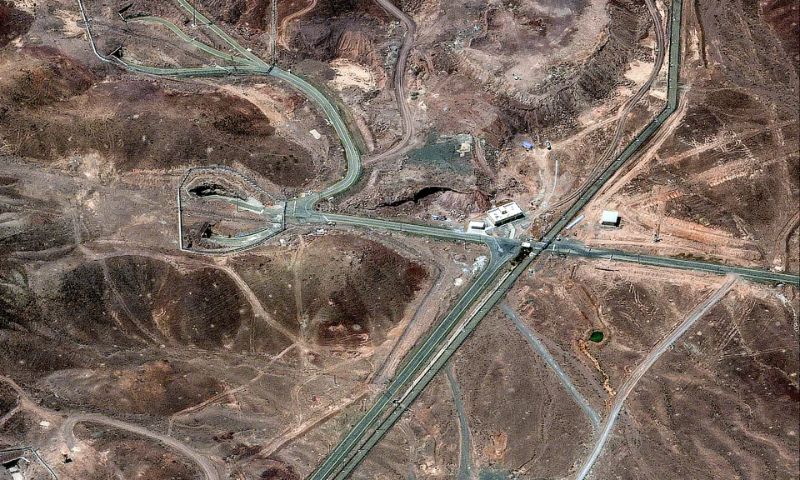
Fordow is located beneath a mountain near the holy city of Qom and served as a significant uranium enrichment site, capable of housing around 3,000 centrifuges, according to AFP. Centrifuges are used to enrich uranium.
Due to its deep underground positioning, Fordow has long posed a challenge for Israeli forces, who lack the bunker-busting weaponry necessary to effectively target it.
Weapons used
Natanz is Iran’s primary site for uranium enrichment, hosting nearly 70 cascades of centrifuges across two main facilities. Isfahan contains a uranium conversion centre and a plant for fabricating nuclear fuel.
Trump did not disclose the precise weapons used in the strikes, but defence analysts believe the GBU-57 — a 30,000-pound (13,600-kilogram) American bunker-busting bomb — was likely employed to destroy the Fordow site.
Officially known as the Massive Ordnance Penetrator, the GBU-57 is engineered to bore as deep as 200 feet (60 metres) underground before detonation, unlike standard munitions that explode on or shortly after impact, according to the BBC.
Testing for the GBU-57 began in 2004, and Boeing was awarded a contract in 2009 to finalise its integration with compatible aircraft.
B-2 Spirit
The sole aircraft capable of deploying the GBU-57 is the B-2 Spirit — a US long-range stealth bomber that can carry two of these massive weapons.
In the lead-up to the attack, flight-tracking platforms and American media reported the movement of several B-2 bombers departing from a base in Missouri.
With a range of 6,000 nautical miles (9,600 kilometres) without needing to refuel, the B-2 is designed to “penetrate the most advanced enemy defences and strike the most valuable and fortified targets,” according to the US military.
The B-2 was first unveiled publicly in 1988 and made its maiden flight in 1989. Its first operational deployment came in 1993. It has been utilised in military campaigns in Kosovo, Afghanistan, and Iraq.
What happens next?
Trump has urged Iran to “agree to end this war,” stating that “now is the time for peace.”
Nevertheless, it remains uncertain whether the strikes will prompt Iran to de-escalate or further inflame the conflict.
Should Iran opt to retaliate, it may target American military personnel stationed across the Middle East or attempt to disrupt the Strait of Hormuz — a critical maritime route through which around one-fifth of the world’s oil supply flows.