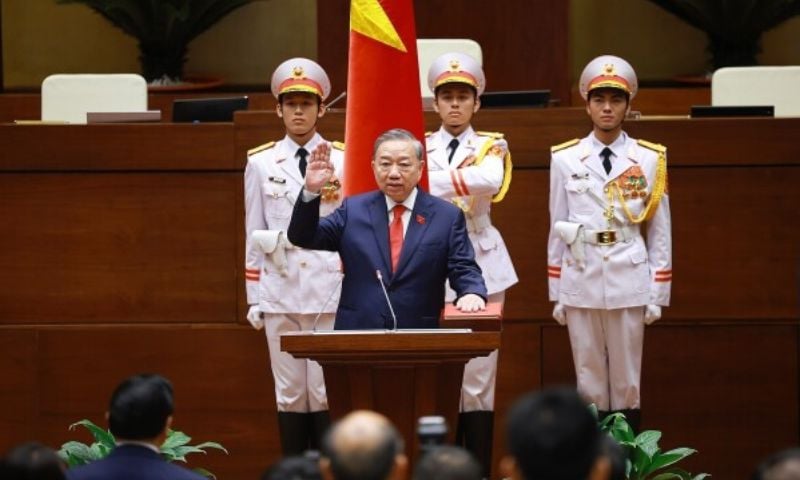



HANOI, Vietnam: In a landmark political development, To Lam has been unanimously elected as Vietnam’s state president, further consolidating his authority after already serving as General Secretary of the Communist Party.
The move marks a significant departure from the country’s long-standing tradition of collective leadership, placing unprecedented power in the hands of a single figure.
According to Reuters, the National Assembly confirmed that all 495 lawmakers present endorsed Lam’s nomination during Tuesday’s session, with only a handful absent. The appointment grants the 68-year-old leader a dual mandate for the next five years, positioning him as the most influential Vietnamese figure in decades.
Analysts say the development mirrors governance structures seen in neighbouring China, where top leadership roles are often unified. While some experts believe this concentration of authority could streamline decision-making and accelerate reforms, others warn it may tilt the political system towards greater authoritarianism.
In his address following the vote, Lam described his appointment as a profound honour and outlined an ambitious vision centred on innovation, science, and digital transformation. He pledged to prioritise economic modernisation, national defence self-reliance, and improvements in living standards, while maintaining political stability.
Lam’s rise comes amid broader leadership changes, with the National Assembly expected to appoint a successor to outgoing Prime Minister Pham Minh Chinh later the same day.
Having previously served as head of public security, Lam has built a reputation as a decisive and pragmatic leader. His earlier tenure saw the introduction of sweeping economic reforms aimed at enhancing Vietnam’s global competitiveness. These measures drew mixed reactions, with praise for their ambition but concern over their impact on businesses and governance.
Despite stepping down from the presidency after briefly holding both roles following the death of Nguyen Phu Trong in 2024, Lam continued to exert considerable influence, frequently representing Vietnam in high-level international engagements.
Economically, Lam has advocated a shift away from reliance on low-cost manufacturing towards a more innovation-driven growth model. He has supported the expansion of private conglomerates while simultaneously reaffirming the central role of state-owned enterprises to maintain ideological balance within the party.
Foreign investors—long attracted by Vietnam’s political stability—generally view Lam as business-friendly. However, his emphasis on rapid growth and national champions has prompted concerns about potential favouritism, corruption risks, and economic imbalances.
On the international stage, Lam is expected to continue Vietnam’s “Bamboo Diplomacy”, a flexible foreign policy approach that balances relations among major powers while expanding global partnerships.
Experts suggest that while Lam’s dual leadership may redefine domestic political norms, it is unlikely to significantly alter Vietnam’s external relations in the near term.