WASHINGTON: US Vice President JD Vance said on Thursday that Israel would need to respect the peace process launched under the Islamabad Memorandum of Understanding between the United States and Iran, while criticising a “weird panic” and “freak out” among some Israeli officials over the agreement.
The Islamabad Memorandum of Understanding was signed by US President Donald Trump, Iran’s President Masoud Pezeshkian and mediator Pakistan’s Prime Minister Shehbaz Sharif.
Vance, in an interview with the New York Times, defended the US-Iran deal amid criticism from Israeli politicians who argue that the agreement fails to address concerns over Iran’s nuclear and ballistic missile programmes and could restrict Israel’s military operations against Hezbollah in Lebanon.
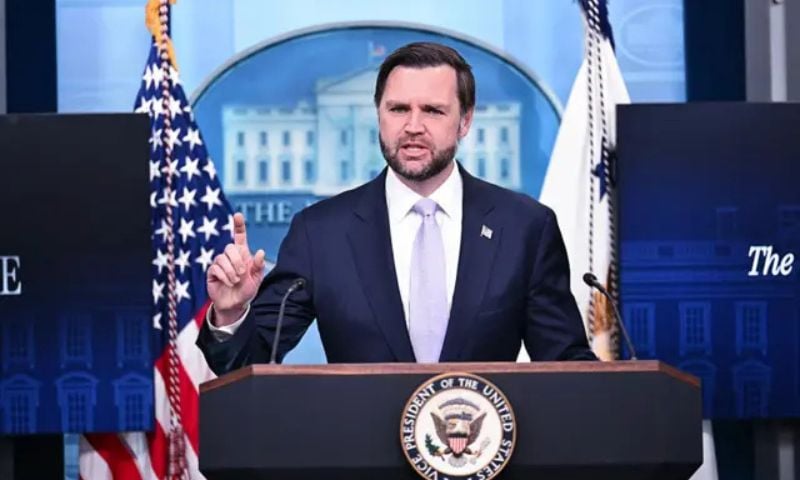
Speaking at a press briefing at the White House, Vance said Israel will have to respect the peace process with Iran, which he said was good for them, adding that attacks in Beirut that kill civilians were “not acceptable”.
Vance rebuked members of Israeli Prime Minister Benjamin Netanyahu’s cabinet, criticising the Iran deal, saying they should “wake up and smell the reality.”
“If I was in the cabinet of the Israeli government, I might not be attacking the only powerful ally that I have anywhere left in the entire world,” Vance said.
The US Vice President said that the Islamabad Memorandum of Understanding between the US and Iran was “bearing real fruit”, citing increased oil flows through the Strait of Hormuz, falling energy prices and early signs of compliance by Tehran.
Vance said 12.5 million barrels of oil passed through the Strait of Hormuz overnight, describing it as the highest level since the start of the conflict.
“Last night, 12.5 million barrels of oil went through the Strait of Hormuz, which is a high since the beginning of the conflict,” Vance told reporters.
He said global energy prices were declining as a result of the agreement.
“Oil prices are down, nearly at their level from pre-war … gas prices dropped below $4 a gallon today for the first time since the conflict, and importantly, they’re going to keep falling further given how low oil prices,” he said.
Vice President JD Vance Briefs Members of the Media, Jun. 18, 2026 https://t.co/XxhTlbCrfC
— The White House (@WhiteHouse) June 18, 2026
Vance says US sanctions on Iran can be temporarily lifted
JD Vance said that the Trump administration would soon brief the US Congress on the Iran deal, but added that the administration was confident that it could temporarily lift sanctions on Tehran without needing congressional approval.
“We feel quite confident that we can temporarily lift those sanctions without going to Congress and seeking their approval on that,” Vance told reporters at the White House.
The US Vice President said “pragmatists” within Iran’s leadership want to transform Tehran’s relationship with the world and those people “are winning the argument”.
“The United States wants to have a better relationship, but in order for that to happen, the Iranians have to perform,” he said, referring to Tehran honouring its end of the US-Iran agreement.
“If they don’t perform, as we’ve said before, they don’t get any of the benefits of the bargain,” he adds.
US-Iran technical talks to begin this weekend
JD Vance said that technical talks on the Iran deal were scheduled to begin this weekend, provided the Iranian team can get to the talks.
“We think these technical negotiations are going to start sometime this weekend. That’s still the plan, but that could change,” Vance said, adding that Iran is a hard country to get out of.
The US Vice President said he plans to go to Switzerland for talks with Iran this weekend, but that the plan could change.
Nuclear programme claims
Vance also said Iran was honouring its commitments under the agreement and had not carried out attacks on vessels for two consecutive nights.
He said Iran’s nuclear programme had been “completely destroyed”.
“Their nuclear programme has been completely destroyed. Their capacity for enrichment, the facilities that they were using to develop enrichment and develop potential nuclear weapons, those facilities are still destroyed,” he said.
He added that Iran’s conventional military capability had been significantly weakened.
Reconstruction fund and compliance
About the $300 billion reconstruction fund for Iran under the agreement, the US Vice President said Washington would not provide direct financial assistance.
“The simple fact is that the only way the Iranians get those resources — not a single penny from the United States of America under any circumstances — but the only way that they would ever get any benefit of the bargain is if they comply fully and change their behaviour,” he said.
Vance said compliance by Iran would determine whether it benefits from the deal.
“If they don’t perform, as we’ve said before, they don’t get any of the benefits of the bargain,” he said.
He added that the agreement represented a “win-win situation” for the United States regardless of Iran’s future actions.
60-day negotiation period
Vance said the 60-day negotiation period between the United States and Iran had formally begun, noting that the agreement had taken effect a day earlier.
“I would say the 60 day period officially started today,” he said, adding that “the deal started yesterday.”
He also defended the agreement against scepticism, saying it was important to test whether diplomatic pressure would lead to behavioural change in Tehran.
“Isn’t it worth trying? Isn’t it worth seeing whether this incredibly weakened position that the president has put the Iranians under, whether that motivates them to change their behaviour?” he said.