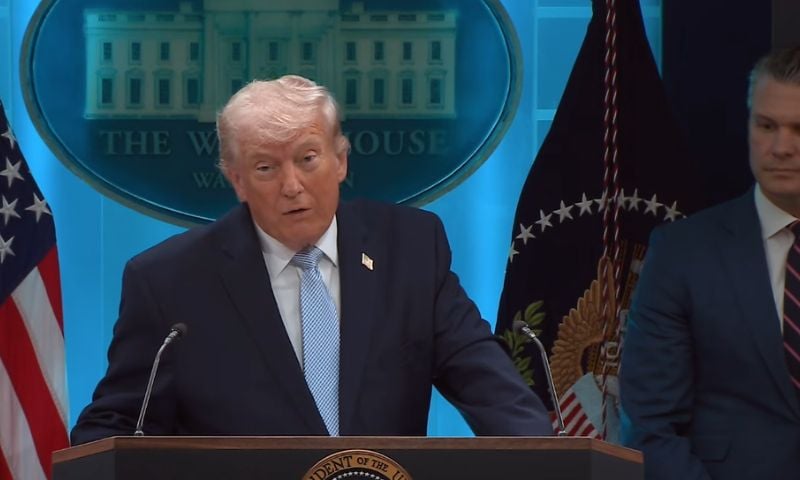



WASHINGTON: US President Donald Trump on Monday said that Vice President JD Vance, US Envoy to the Middle East Steve Witkoff and his son-in-law, Jared Kushner, are talking with intermediaries in Pakistan to end the ongoing war with Iran.
During a news conference at the White House, the US President was asked by a reporter whether he expected Vance to continue talks with intermediaries in Pakistan, to which Trump replied: “Well, he is, and we have Steve Witkoff and Jared Kushner talking. They’re all unified, and they’re all talking.”
Asked about the possibility of Vance being part of an in-person meeting, Trump said, “Could be.”
Ceasefire proposal ‘very significant step’
Earlier today, while talking to reporters at the White House, Trump said the US has studied a proposal for a 45-day ceasefire in the Iran war, a move he called a “very significant step” in the conflict.
“It’s a significant proposal, it’s a significant step. It’s not good enough, but it’s a very significant step,” Trump said, adding that intermediaries “are negotiating now.”
Earlier, Pakistan shared proposals for an immediate ceasefire with Washington and Tehran in an attempt to halt the five-week-old war between Iran and the United States.
A proposal for a 45-day ceasefire is “one of many things being discussed,” a senior White House official told NBC News.
Mediators want both sides to agree to suspend hostilities and reopen the Strait of Hormuz, to be followed by a period of detailed negotiations intended to reach a more complete peace agreement.
Trump demanded on Sunday that Iran open the strait by Tuesday evening or else he would target the country’s power plants and bridges.
US, Iran receive ‘Islamabad Accord’
Earlier today, Iran and the US received a proposed plan to halt hostilities, several international media outlets reported, citing sources familiar with the discussions.
Pakistan’s Foreign Office confirmed that the peace process is ongoing.
The proposed Islamabad Accord is structured in two phases. The immediate phase calls for a ceasefire to begin straight away and the reopening of the Strait of Hormuz without delay.
This would be followed by a final, comprehensive peace deal to be negotiated over 15–20 days.
Named the “Islamabad Accord,” the final agreement may include Iran agreeing to limits on its nuclear programme, specifically refraining from developing weapons.
In return, Tehran would receive sanctions relief, the release of frozen assets, and a broader regional framework to ensure the security of the Strait of Hormuz.
Earlier, Axios reported that the US, Iran, and regional mediators were considering a 45-day ceasefire as part of a deal that could ultimately bring a permanent end to the conflict, citing US, Israeli, and regional sources.
Pakistan has been in continuous contact with US Vice President JD Vance, special envoy Steve Witkoff, and Iranian Foreign Minister Abbas Araqchi.
Under the proposal, the ceasefire would take immediate effect, reopening the Strait of Hormuz, with 15–20 days allocated to finalise a broader settlement, reports Reuters, a news agency.
The Islamabad Accord would include a regional framework for the Strait of Hormuz, with final in-person negotiations in Islamabad.
Iran could be ‘taken out’ if Strait of Hormuz not reopened
Trump warned that all of Iran could be “taken out” on Tuesday at the expiry of a deadline he issued for the Islamic republic to reopen the key Strait of Hormuz waterway.
“The entire country could be taken out in one night and that night might be tomorrow night,” Trump told a news conference at the White House on Monday.
Trump has given tomorrow at 8 p.m. ET as the deadline for Iran to reopen the Strait of Hormuz, a major shipping route for oil, or suffer the widespread destruction of its infrastructure.
Iranians ‘willing to suffer’ destruction
A reporter has asked Trump whether threatening to hit Iran’s infrastructure and cut off their power would punish the people.
“They would be willing to suffer that for their freedom,” Trump said, and that Iranians want the US strikes to continue and that Iranians “want freedom.”
“They have lived in a world that you know nothing about,” he added. “It’s a violent, horrible world, where if you protest, you are shot.”
More than 170 US aircraft used in crew rescue
The US President started his remarks by discussing the rescue missions for the two US service members in the F-15 fighter jet that was shot down in Iran.
“This is a rescue that is very historic,” he said.
Trump said that more than 170 US military aircraft were used in the rescue of the crew of a fighter plane downed in Iran.
He said that 21 aircraft were used in the operation to recover the first crew member and another 155 in the second rescue mission.
Two transport planes got stuck in sand and had to be blown up, he added.
Trump said that someone leaked information about the rescue of the first service member before the second one had been brought to safety, adding, “We’re looking very hard to find that leaker.”
He also threatened an unspecified media outlet with jail time if it did not reveal the person who leaked information about a US military pilot who was missing in Iran.
“We’re going to go to the media company that released it, and we’re going to say, ‘National security. Give it up or go to jail,'” Trump told a news conference.
Trump said Iran did not know that a second service member was missing until the leaker shared information.
“All of a sudden, they know that there’s somebody out there,” he said of the Iranians.
“They see all these planes coming in. It became a much more difficult operation because a leaker leaked that we have one, we’ve rescued one, but there’s another one out there that we’re trying to get.
“So actually, the country Iran, put out a major notice — you all saw it — offering a very big award for anybody that captures the pilot,” Trump said.
Trump did not specify which media company he was referring to.
CIA ran deception operation to confuse Iran
CIA Director John Radcliffe, Defence Secretary Pete Hegseth and Joint Chiefs of Staff Chairman Gen. Dan Caine all recounted the rescue operation at the press conference — Trump’s first since the U.S. and Israel launched a war with Iran more than a month ago.
Speaking on the occasion, CIA director John Ratcliffe said that the US foreign intelligence service ran a deception effort to misdirect Iranian authorities looking for the crew of the fighter plane downed in the country.
“The CIA executed a deception campaign to confuse the Iranians who were desperately hunting for our airmen,” Ratcliffe said, adding one airman hid in a mountain crevice until he was rescued.
Pakistan calls for ‘urgent de-escalation’
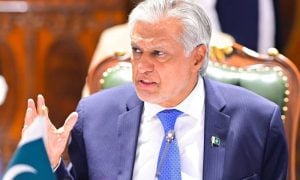
Pakistan’s Deputy Prime Minister and Foreign Minister Ishaq Dar on Monday called for “urgent de-escalation,” as his country has played a key role as mediator between Tehran and Washington.
Pakistan’s Foreign Ministry, in a statement, said Dar “reaffirmed Pakistan’s commitment to supporting all initiatives aimed at de-escalation and the achievement of lasting peace and stability” in a phone call with his Japanese counterpart, Toshimitsu Motegi.
Motegi appreciated and supported Pakistan’s “constructive role” in facilitating dialogue and diplomacy for regional peace and stability, the ministry said, adding that the leaders agreed to maintain contact.
‘Good chance’ for a deal
Earlier on Sunday, Trump hoped that there was a “good chance” of making a deal with Iran on Monday.
“I think there is a good chance tomorrow, they are negotiating now,” the president told a Fox News journalist.
“If they don’t make a deal and fast, I’m considering blowing everything up and taking over the oil,” he added.
Iranian officials have indicated that Tehran seeks a permanent ceasefire with guarantees against future attacks by the US and Israel, while messages have also come from mediators, including Pakistan, Turkiye, and Egypt.
The final deal is expected to involve Iranian commitments to halt nuclear weapons development in exchange for sanctions relief and the release of frozen assets.
The renewed diplomatic push comes amid rising tensions threatening the security of shipping lanes through the Strait of Hormuz, a key conduit for global oil supplies.
US President Donald Trump has called for a swift end to hostilities, warning of consequences if a ceasefire is not achieved promptly.
Pakistan is playing a prominent role in the talks, leveraging its long-standing diplomatic ties with both Washington and Tehran.
Islamabad has engaged in back-channel communications with US and Iranian officials, alongside coordination with other regional partners such as Egypt and Turkiye.
Analysts suggest Pakistan’s mediation reflects a strategic effort to stabilise the region and reduce spill-over effects from the conflict, which has already disrupted global energy markets.
The ceasefire period could be extended if additional time is required to negotiate security guarantees, trade routes, and other critical issues.
Pakistan’s diplomatic outreach
Pakistan has intensified its diplomatic efforts to bring an end to the US-Israel war involving Iran.
Islamabad hosted key regional ministers from Saudi Arabia, Turkiye, and Egypt, while also facilitating the exchange of messages between Washington and Tehran.
Pakistan and China jointly called on the United States, Israel, and Iran to halt ongoing strikes and begin “peace talks as soon as possible.”
The appeal followed a high-level meeting in Beijing between Deputy Prime Minister and Foreign Minister Ishaq Dar and Chinese Foreign Minister Wang Yi.
Bahrain has lauded Pakistan’s diplomatic efforts to promote dialogue and stability in the region, with Foreign Minister Dr. Abdullatif bin Rashid Al Zayani praising the Pakistan–China five-point initiative during a call with Minister Ishaq Dar.
The framework, calling for an immediate ceasefire, dialogue, civilian protection, and the security of key maritime routes including the Strait of Hormuz, has received broad regional and international support, including from the US.