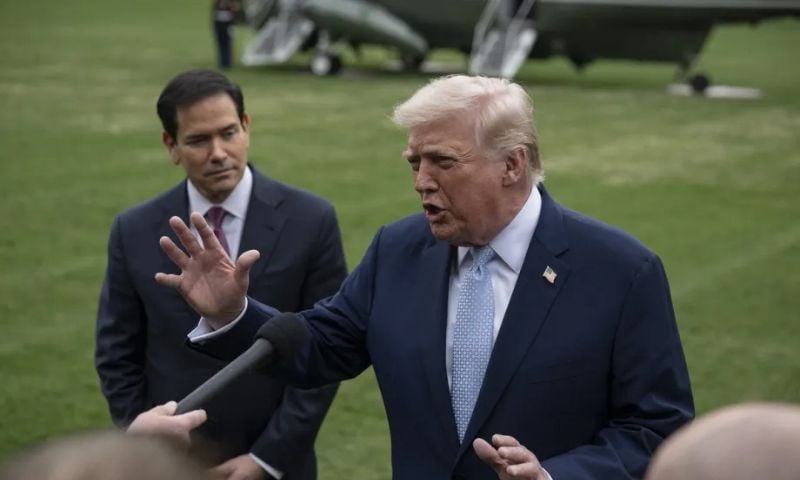



WASHINGTON: US President Donald Trump said on Wednesday that negotiations between the United States and Iran could take place “at some point”, leaving the door open to diplomatic engagement despite his statement a day earlier that no talks were taking place or scheduled.
Asked whether the United States would return to negotiations with Tehran, Trump said: “Maybe at some point. But right now, I think the situation is so good. Maybe at some point.”
Reporter: Will you reopen negotiations with Iran?
Trump: Maybe at some point, but right now the situation is so good. But maybe at some point. pic.twitter.com/cuqKmHhqzf
— Clash Report (@clashreport) August 19, 2026
Talking to reporters outside the White House, Trump did not give details on when talks could resume or what conditions would be required for Washington to return to the negotiating table.
Trump insists on Iran nuclear demands
Trump again made clear that preventing Iran from obtaining a nuclear weapon remained a central US demand.
“Look, it’s very simple,” Trump said. “They have to get rid of completely — no nuclear weapons. Iran cannot have a nuclear weapon.”
He added that Washington would not allow Iran to possess a nuclear weapon.
Trump on Iran:
Iran cannot have a nuclear weapon. You know why? Cause they would use it.
We are not gonna let them use it. pic.twitter.com/v0imXbEtAd
— Clash Report (@clashreport) August 19, 2026
Trump’s comments came a day after he said there were no negotiations or conversations with Iran and that none were scheduled.
Trump also said US forces had “complete control” of the Strait of Hormuz, apart from what he described as the “nuisance” of occasional Iranian drone attacks.
“Last night, we had a lot of boats come through,” Trump told reporters, adding that a significant amount of oil had moved through the waterway in recent weeks.
Trump said the US has a lot of boats coming through the Strait of Hormuz. “We have possession, complete control of the strait, I mean, outside of nuisance value,” he said. “There has been nuisance value when they shoot a drone every once in a while.”
President Trump told reporters outside the White House that the U.S. has a lot of boats coming through the Strait of Hormuz, apparently referring to reports the U.S. Navy has been assisting in getting some oil safely through the strait.
“We have possession, complete control of… pic.twitter.com/OHmy5K40Aa
— CBS News (@CBSNews) August 19, 2026
Also Read: No Talks Ongoing with Iran, All Mines Removed from Hormuz: Trump
The New York Times reported on Wednesday that about five million barrels of oil were moving through the strait each day, down sharply from around 15 million barrels before the war.
Trump said the flow of oil had helped prevent prices from reaching the levels of $300 or $350 a barrel that he had previously warned about.
Brent crude was trading around $92 a barrel on Wednesday after remaining above $90 for much of the week.
The Strait of Hormuz normally carries about one-fifth of global oil and liquefied natural gas shipments.
Kushner touts unprecedented US-Iran contacts
Trump’s comments came as senior adviser Jared Kushner said communications between Washington and Tehran were “more robust” than ever.
In an interview with Fox News on Monday, Kushner said Trump remained committed to reaching a deal with Iran but acknowledged that major obstacles remained.
Kushner said Iran needed to take negotiations seriously and accused Iranian officials of attempting to mislead Washington with false concessions.
On Tuesday, Trump said that there are currently no talks or negotiations with Iran and that the US naval blockade of Iranian ports remains in force.
“The Hormuz Strait is open and operating. All water mines have been removed or detonated,” the US President said in a post on his Truth Social platform.
“There are no talks or conversations going on, or scheduled, with the Islamic Republic of Iran. The Naval Blockade remains in full force and effect. The Hormuz Strait is open and operating. All water mines have been removed or detonated,” Trump stated.
— Rapid Response 47 (@RapidResponse47) August 18, 2026
Meanwhile, Iranian Foreign Minister Abbas Araghchi said the US has failed to force Iran to surrender and that “America is now begging to negotiate with us according to our conditions,” Al Jazeera reported.
Araghchi accused Israel of doing everything it can to sabotage the memorandum of understanding between the US and Iran and prevent its implementation.
After war broke out between the United States and Iran in late February, Tehran shut the strait, which normally carries one-fifth of the world’s energy supplies during peacetime.
NATO vows to defend allies after Iranian threat
NATO said Wednesday it is prepared to defend all of its members against possible attacks by Iran after reports suggested Tehran was considering striking US military targets in Europe.
“NATO is prepared to address any threat and will always do what is necessary to defend all Allies,” a NATO official said in a written statement.
The official also pointed to NATO air defences intercepting Iranian ballistic missiles heading towards Turkiye on four separate occasions earlier this year.
Also Read: NATO Vows to Defend Allies After Reported Iranian Threat to Target US Military Assets in Europe
“As demonstrated earlier this year when NATO air defences successfully intercepted ballistic missiles heading to Turkiye from Iran on four separate occasions, our deterrence and defence posture is strong and effective,” the official said.
NATO’s comments followed a report by the Financial Times that Iranian officials had considered possible attacks on US military installations in Europe if Trump decides to escalate the conflict.
The report, citing two unnamed officials, said Iran had assessed potential targets including the Bezmer Air Base in Bulgaria and military infrastructure in Cyprus.
Iran eyes military targets in Europe if Trump escalates war, insiders say https://t.co/fZgSQ0omxj
— Financial Times (@FT) August 19, 2026
Mediators making efforts to resume US-Iran talks
Qatar said Tuesday that mediators were awaiting a bilateral agreement between Iran and Oman over shipping through the Strait of Hormuz before returning to broader negotiations between Washington and Tehran.
Iran and Oman, both coastal states bordering the strait, have for weeks been discussing the future of navigation through Hormuz, with Tehran saying the geographical coordinates of the route envisaged by both countries “have been agreed upon.”
Qatari foreign ministry spokesman Majed Al Ansari told reporters that an agreement over Hormuz would make it much easier to resume negotiations between the US and Iran.
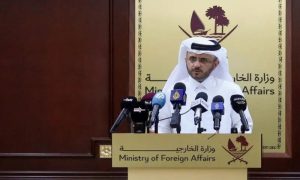
“We are also awaiting an agreement between the Sultanate of Oman and Iran regarding the Strait, which would enable us to return to the framework of negotiations,” Al Ansari said.
“The agreement over the Strait of Hormuz would make it much easier for us to resume the talks between the United States and Iran,” the spokesperson added.
Islamabad MoU framework for US-Iran talks
The US and Iran signed the Pakistan-brokered Islamabad memorandum of understanding in June to halt fighting and start technical-level negotiations for a comprehensive agreement between Washington and Tehran.
Under the Islamabad MoU, the US and Iran committed to halt military operations, reopen the Strait of Hormuz to commercial shipping and negotiate a comprehensive agreement covering Iran’s nuclear programme, US sanctions and a permanent ceasefire within 60 days.
Pakistan and Qatar are mediating between Tehran and Washington under the framework of the Islamabad MoU to permanently end the conflict.
Pakistan is mediating talks between Iran and the United States after helping secure a ceasefire on April 8 and hosting high-level talks between the two sides in Islamabad on April 12 and 13.
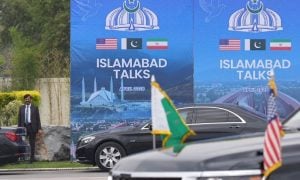
Pakistan and Qatar later co-mediated the first round of high-level talks in Lucerne, Switzerland, on June 21. The meeting was attended by US Vice President JD Vance and Iranian Parliament Speaker Mohammad Bagher Ghalibaf.
Following the meeting, Pakistan and Qatar said significant progress had been made in diplomatic efforts between Washington and Tehran.
The 60-day negotiating window created by the Islamabad MoU between the US and Iran expired on Monday with no final peace agreement.
The text of the June agreement, however, gives Washington and Tehran up to 60 days to negotiate and reach a final deal, with an extension possible by mutual consent.
The US position has been considerably tougher. President Donald Trump declared the agreement over on July 7 after renewed fighting.
Secretary of State Marco Rubio subsequently said an MoU could not remain alive if Iran was violating its provisions, particularly those concerning shipping through the Strait of Hormuz. At the same time, Rubio said Washington remained open to genuine diplomacy.
Iran-Oman talks over Hormuz
On Monday, Iran’s Foreign Ministry spokesperson Esmaeil Baghaei said that talks with Oman over shipping through Strait of Hormuz are long overdue due to the complexity of the subject, and the involvement of multiple actors.
Meanwhile, Iran’s foreign ministry spokesman Esmaeil Baghaei said that in the Islamabad MoU between the US and Iran, “there is no subject titled a 60-day deadline”.
“What was envisioned in the memorandum was merely a 60-day period for discussions regarding ‘lifting sanctions’ and the ‘nuclear issue,’ which, in the event of failure to reach a result, had the capability of extension.”
Baghaei said that the “flagrant violation of the memorandum” by the US halted discussions.
Iran's FM Spox. Esmail Baghaei:
There is no provision titled “60-day deadline” in the text of the memorandum of understanding.
The Islamic Republic of Iran never formulates its policies under pressure, ultimatums, or time deadlines.
What was stipulated in the memorandum was… pic.twitter.com/VMtKbOG9D7
— Clash Report (@clashreport) August 17, 2026
On Monday, US President Donald Trump said that Iran wants to reach a deal with Washington but is unwilling to accept the terms he considers necessary.
“They want to make a deal, but they are not going to make the kind of a deal that I feel is necessary,” Trump told reporters in the Oval Office.
Trump said Washington was not seeking to extend the June memorandum of understanding with Iran, which was reached with Pakistani mediation and provided a framework for negotiations towards a comprehensive agreement. Asked whether he wanted to extend the arrangement, Trump replied: “No.”