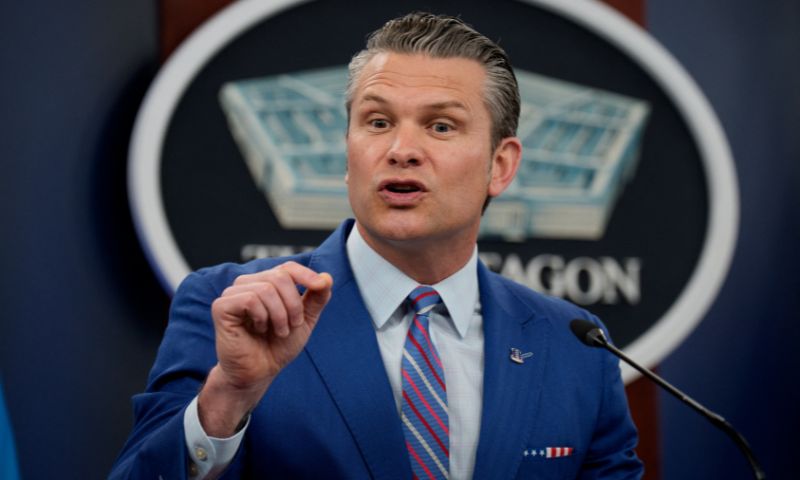
PANAMA CITY: The United States has sufficient military assets to sustain a naval blockade of Iran indefinitely, Defence Secretary Pete Hegseth said on Thursday, signaling that Washington could maintain pressure on Tehran for as long as necessary.
Hegseth said US naval forces could be rotated in and out of the region as needed, allowing the military to maintain a prolonged blockade without exhausting its available resources.
His comments indicate that the Trump administration is prepared to sustain its pressure campaign against Iran for an extended period if necessary, while leaving the door open to continued negotiations aimed at ending the conflict.
“Indefinitely the United States Navy can maintain a blockade like that because we’ll rotate ships in and out, as we have, and we’ll continue to,” Hegseth told reporters.
NEW: Secretary of War Hegseth on Iran:
“We can hold [the blockade] as long as we need to. Indefinitely the U.S. Navy can maintain a blockade like that because we’ll rotate ships in and out like we have and will continue to do.” pic.twitter.com/xPU9nWbYV3
— Alex Salvi (@alexsalvinews) August 13, 2026
Hegseth made the remarks in Panama after addressing the crew of the USS Gridley, a guided-missile destroyer that had previously been deployed to the Middle East.
United States in control of Strait of Hormuz
The comments came a day after President Donald Trump said the United States was in control of the Strait of Hormuz, a strategically vital waterway through which a significant share of global energy supplies passes.
“The U.S.A. has total control over the Strait of Hormuz. I THINK WE WILL KEEP IT! Our Naval Blockade is being called, by everyone, “A WALL OF STEEL,” and there is nothing Iran can do about it,” he wrote on his Truth Social platform.
Following the outbreak of the war, which began with US and Israeli strikes on Iran on February 28, Tehran effectively closed the Strait of Hormuz, a critical global energy route that had previously carried around one-fifth of the world’s oil and liquefied natural gas shipments.
The United States subsequently imposed a naval blockade targeting Iranian shipping and ports, while maintaining that it would protect freedom of navigation for vessels traveling to and from non-Iranian ports.
Since the conflict began, Washington has deployed tens of thousands of additional troops to the Middle East, along with more than 20 warships, as part of its military operations in the region.
The US military says it has intercepted or redirected more than 55 commercial vessels attempting to breach the blockade. Three vessels were disabled, while two others were boarded by US forces.
Earlier this week, a US Navy MH-60 helicopter fired two Hellfire missiles at the engine room of a Panama-flagged ship after it ignored warnings issued by US forces, according to the US military.
US to deploy new aircraft carrier to Middle East: report
The US is preparing to deploy another aircraft carrier, the USS George Washington, to replace the USS Abraham Lincoln already in theatre as part of a prior rotation plan, The Wall Street Journal reports citing officials familiar with the matter.
WSJ notes that the Abraham Lincoln has undergone an extended deployment with few port calls.
Iranian military rejects US claims of ships transiting Strait of Hormuz
The Iranian military has rejected US claims that commercial shipping is continuing to transit the Strait of Hormuz normally, insisting that vessels cannot pass through the strategic waterway without Tehran’s permission.
“The Strait of Hormuz, as in the past, remains under the full management and control of the Islamic Republic of Iran,” says Khatam al-Anbiya Central Headquarters spokesperson Ebrahim Zolfghari, according to state media.
“No commercial vessel or oil tanker can or will have safe passage through the Strait without the permission and supervision of Iran’s powerful Armed Forces.”