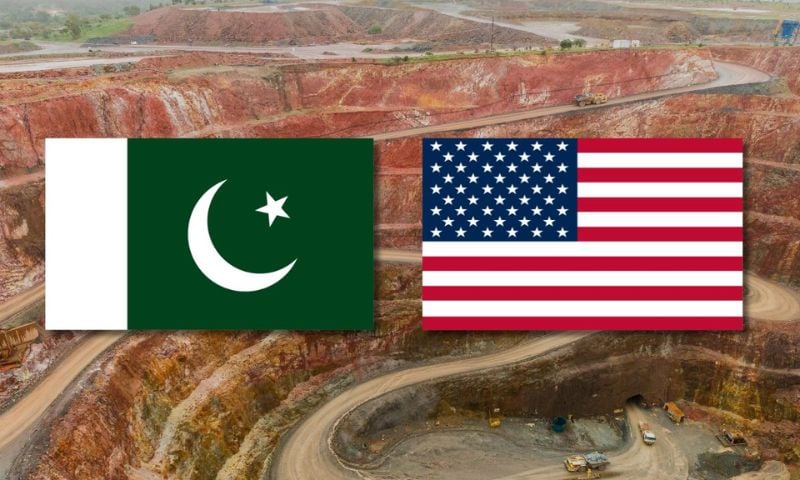
ISLAMABAD: American companies are exploring opportunities to invest in Pakistan’s critical mineral sector as the United States seeks to diversify global supply chains for strategic resources and reduce dependence on concentrated sources of minerals.
A US Embassy official said Washington was encouraging American firms to participate in Pakistan’s mining sector, including the development of smaller mines and potential investments in major projects involving copper and other critical minerals such as antimony.
Speaking during a background briefing with journalists, the official said the Trump administration had placed a strong focus on securing reliable critical mineral supply chains worldwide, including through cooperation with Pakistan.
The official said US institutions, including the US International Development Finance Corporation and the Export-Import Bank of the United States, were supporting efforts to expand mineral-related cooperation with Pakistan.
The US Export-Import Bank has committed $1.25 billion for the Reko Diq copper-gold project in Balochistan, although financing arrangements are still being finalised, the official added.
Reko Diq project moving ahead
Addressing concerns over delays in the multibillion-dollar Reko Diq project, the US official said the development was progressing, although at a slower pace than initially expected.
He said the scale and complexity of the project meant that timelines could change, while international financial institutions, including the International Finance Corporation, continued discussions on financing.
“The project is so large that it cannot be expected to move according to the original plan and not to change,” the official said. Reko Diq, one of the world’s largest undeveloped copper and gold deposits, is considered a key component of Pakistan’s strategy to attract foreign investment in the mining sector.
Pakistan’s mineral potential
The US official said Pakistan possessed significant deposits of several critical minerals, including antimony, which is considered important for defence, technology and industrial applications.
He said some of the approximately 60 minerals classified as critical by the United States were found in Pakistan and could support supply chains linked to aircraft manufacturing, semiconductors, defence equipment and advanced technologies.
Pakistan’s mineral sector currently contributes around 3 per cent to national GDP, while Reko Diq alone could potentially add another 0.5 per cent, according to the official.
He said several US companies were in discussions with Pakistani authorities and local firms to explore mining opportunities, including arrangements to purchase mineral output from smaller mines for processing in the United States.
Some minerals could also be supplied through US companies to industrial supply chains in countries including Germany and South Korea, he added.
READ ALSO: Pakistan Joins US Critical Minerals Ministerial to Seek Investment
Call for investment reforms
The US official urged Pakistan to create a more favourable environment for foreign investors by reducing bureaucratic hurdles and strengthening institutions such as the Geological Survey of Pakistan.
He said improved geological surveys and feasibility studies would help international companies identify viable investment opportunities.
While acknowledging that the Pakistani government was taking steps to facilitate foreign investment, he stressed that removing administrative barriers was essential for attracting greater capital inflows.
The official also said US Strategic Metals had exported a mineral consignment supplied by the Frontier Works Organisation, which was being processed in the United States, describing it as an example of expanding cooperation.
US-China competition over minerals
Asked whether mineral-sector investment in Pakistan had become part of US-China competition, the official said Islamabad’s priority was attracting investment from around the world.
He said Pakistan offered opportunities not only for American and Chinese companies but also for investors from Australia, Canada and other countries, while international participation could also contribute to workforce development and technical training. The comments came as Pakistan and the United States continued discussions on strengthening bilateral trade ties.
During a virtual meeting, Finance Minister Muhammad Aurangzeb and US Trade Representative Jamieson Greer reviewed progress on negotiations for a proposed reciprocal trade framework.
Pakistan’s Ministry of Finance said both sides noted significant progress in talks and reaffirmed their commitment to agreeing the earliest.
Security challenges in Balochistan
The US official acknowledged security challenges in mineral-rich areas, particularly Balochistan, but said the potential economic returns from mining remained significant.
He said investors were aware of such challenges and had experience operating in difficult environments because of the value of mineral resources.
The official highlighted potential opportunities in areas including Chitral, which has antimony deposits, Waziristan, where copper resources have been identified, as well as Gilgit-Baltistan and Balochistan.
The United States has increasingly focused on building secure and transparent mineral supply chains amid concerns over China’s dominant position in global rare earth and critical mineral markets.
Washington views critical minerals as essential for modern economies and national security, with applications ranging from fighter aircraft and defence systems to electric vehicle batteries and advanced technologies.
Pakistan, meanwhile, is seeking to expand economic cooperation with the United States while maintaining its longstanding strategic relationship with China, one of its largest investment partners.