WASHINGTON: The United States on Tuesday confirmed for the first time that Washington has deployed weapons in space, prompting a warning from China against turning outer space into a “battlefield”, and Russia saying space must be “free from any weapon”.
The announcement marked a new stage in the major powers’ rush for military space capabilities, driven by rapid technological advancements but lacking a comprehensive legal framework.
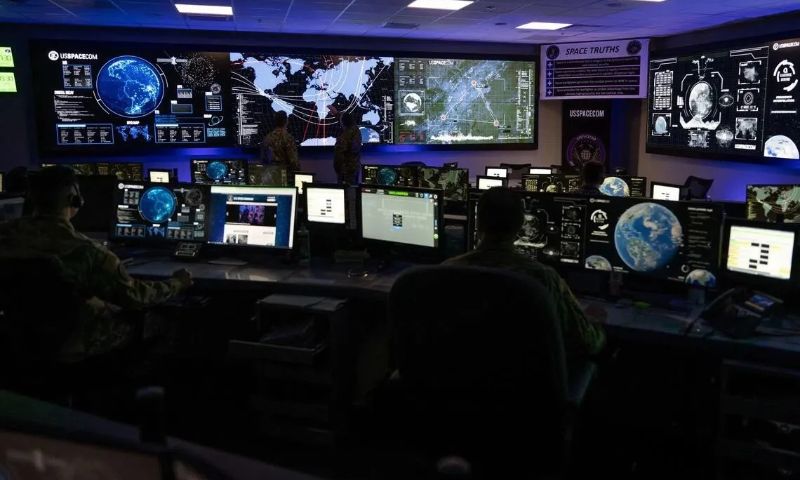
“The US has on-orbit space control weapons capable of defending the Joint Force against hostile adversary action,” a US Space Force spokesperson said in a statement that did not provide specifics on the weapons.
China’s foreign ministry opposed the move, warning against the “weaponisation of outer space, turning it into a battlefield, as well as an arms race there”.
“We urge the US side to stop expanding its military capabilities and preparing for war in outer space,” foreign ministry spokesman Guo Jiakun told a news briefing.
MFA Spokesperson’s response to U.S. deployment of weapons in space:
China stands for peaceful use of the outer space and keeping it safe, and opposes any arms race in outer space or any attempt to weaponize it and turn it into a warzone. We urge the U.S. to stop its military… pic.twitter.com/KPAhSW4khH
— CHINA MFA Spokesperson 中国外交部发言人 (@MFA_China) September 15, 2026
Russia called on Tuesday for space to be kept “free of any weapons”.
“We are counting on broad international consolidation to continue working toward the complete demilitarisation of space,” said Kremlin spokesman Dmitry Peskov.
What weapons are deployed in space?
The US statement did not provide concrete details about what weapons are deployed in space and how many.
“Space control encapsulates the mission areas required to contest and control the space domain — employing kinetic and non-kinetic means to affect adversary capabilities,” the statement said. “These capabilities can be employed for offensive and defensive purposes.”
Non-kinetic means could include lasers to blind satellites, or even electromagnetic or cyber jamming of their data links.
China “develops and operates space and counterspace capabilities as part of a military modernisation strategy”, according to the US Space Force.
Russia, meanwhile, “views space as a warfighting domain and believes space supremacy will be a decisive factor in future conflicts”, it said.
The militarisation of space is as old as the space race itself — as soon as the USSR’s Sputnik was launched into orbit as the first probe in space in 1957, Washington and Moscow began exploring ways to both arm and destroy satellites.
China and Russia warn against weapons deployment in space
China’s foreign ministry opposed the move, warning against the “weaponisation of outer space, turning it into a battlefield, as well as an arms race there”.
“We urge the US side to stop expanding its military capabilities and preparing for war in outer space,” ministry spokesman Guo Jiakun told a news briefing.
Russia called Tuesday for space to be kept “free of any weapons”.
“We are counting on broad international consolidation to continue working toward the complete demilitarisation of space,” said Kremlin spokesman Dmitry Peskov.
Can weapons in outer space be regulated?
The biggest worry was once about nuclear weapons in space, but the superpowers and other countries signed the Outer Space Treaty in 1967, banning weapons of mass destruction in orbit.
Since then, Russia, the United States, China and India have explored ways to fight in space outside of that treaty, including by targeting rivals’ satellites, which are key for military communications, surveillance and navigation.
“There is a regulatory vacuum because Article 4 of the 1967 treaty only forbids weapons of mass destruction and nuclear weapons in orbit,” space law expert Laetitia Cesari told AFP. He said that the topic would likely be on the agenda at the next UN disarmament meeting in November.
“Moscow and Beijing have been wanting to work for about twenty years on a treaty to prevent the placement of weapons in space,” while “Western states are trying instead to work on the notion of responsible behaviour,” Cesari said.
The US announcement “will likely give impetus to the restrictive approach that Moscow and Beijing are pushing for,” she added.