
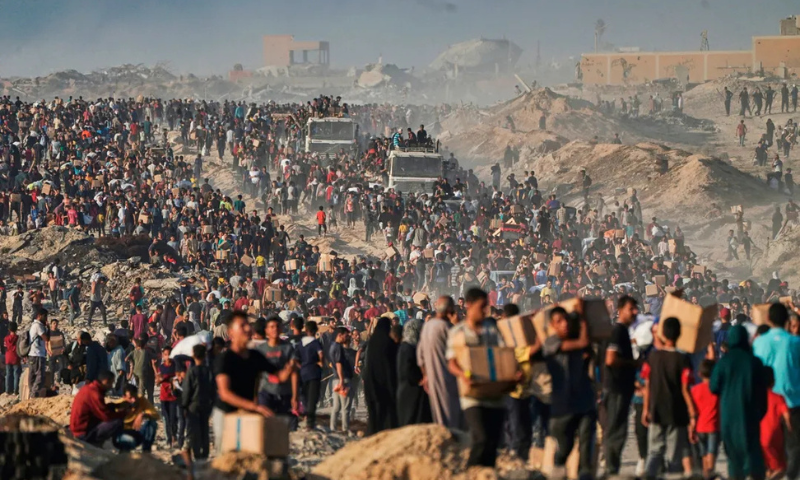
UNITED NATIONS: The United Nations has warned that Israeli military attacks across Gaza continue to put Palestinians at risk and deepen the humanitarian crisis in the enclave.
“The United Nations Office for the Coordination of Humanitarian Affairs (OCHA) warns that military attacks across Gaza continue to put Palestinians at risk and increase humanitarian needs,” deputy spokesman Farhan Haq told reporters.
Haq told reporters that the UN Office for the Coordination of Humanitarian Affairs (OCHA) had recorded multiple security incidents since Friday, several of which reportedly resulted in civilian casualties.
Civilians Remain At Risk
OCHA reiterated that civilians and civilian infrastructure must be protected under international humanitarian law, Haq said.
Humanitarian teams working to address explosive hazards in Gaza have identified and marked more than 1,000 items of explosive ordnance across the enclave since hostilities began in October 2023.
Their work has helped facilitate the removal of debris, access to critical infrastructure and the restoration of water and sanitation services, Haq said.
Humanitarian organisations have called for a wider range of essential supplies and specialised equipment to be allowed into Gaza to expand life-saving operations and reduce risks to civilians, including children and humanitarian workers.
Humanitarian Needs Remain Severe
The UN warning comes amid continuing efforts to implement a ceasefire agreement in Gaza following months of conflict and extensive destruction.
According to the figures cited in the report, more than 73,000 Palestinians have been killed and over 174,000 wounded since October 2023.
The conflict has caused widespread destruction across the enclave, with UN assessments indicating that around 90% of civilian infrastructure has been affected. Reconstruction costs have been estimated at $70 billion.
Humanitarian agencies continue to warn that the scale of destruction, unexploded ordnance and shortages of essential supplies pose serious risks to Gaza’s civilian population and complicate efforts to restore basic services.