The United Nations said on Tuesday that the number of civilians displaced by the conflict between Sudan’s generals had doubled in the past week.
So far, hundreds of people have been killed. At least 16 people have been killed in separate ethnic skirmishes in the country’s southern regions, while a major group in the east, which has been relatively unscathed by the war, has demonstrated in favor of the army, causing new concerns to arise.
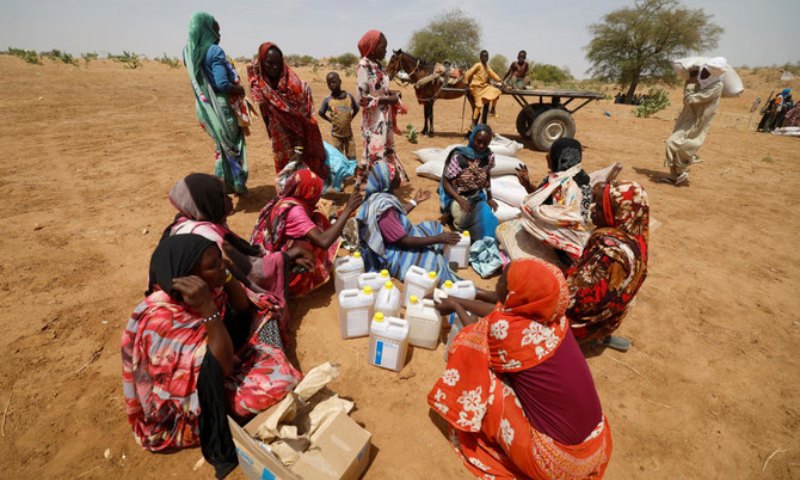
Since April 15, fighting has displaced almost 700,000 people within their own country, according to the International Organization for Migration.
UN agency spokesman Paul Dillon said in Geneva on Tuesday that the number had risen to 340,000 from the previous week. To get away from the fighting between supporters of army leader Abdel Fattah Al-Burhan and those of his former deputy Mohamed Hamdan Daglo, who now leads the paramilitary Rapid Support Forces (RSF), more and more people are taking to the borders.
Heavy violence has occurred all around the country, but it has been especially intense in the western Darfur region, which borders Chad.
On Monday, the United Nations refugee agency said that 150,000 people had fled to neighboring nations from Sudan.
In a country where, prior to the conflict, the United Nations estimated that one-third of the population required humanitarian aid, those still residing in the battle zones are now facing severe shortages of water, energy, food, and medical care.
Thousands more have fled the country thanks to foreign-led evacuations on land, sea, and air, with many using the relatively quiet port of Port Sudan on the Red Sea.
There has been a history of ethnic instability in the country, and on Monday there was a demonstration in support of the army, at which some called on the government to arm people.
Hundreds of Beja demonstrators chanted, “One army, one people.” They yelled, “No to negotiations,” a reference to the ceasefire talks between Burhan and Daglo representatives taking place in Jeddah, Saudi Arabia, across the ocean.
Even with American support, such talks have failed to stop the ongoing conflict. Having “proposed a declaration of commitments for the two parties to guarantee the safe passage of humanitarian relief,” UN aid chief Martin Griffiths has left Jeddah, according to a spokeswoman in New York.
Experts predict a drawn-out confrontation between the generals, which might escalate into a wider war. Magdi el-Gizouli of the Rift Valley Institute told AFP that as the battle carries on, “there is a growing risk that people might start arming themselves locally” or that the army might resort to creating a counter-militia against the RSF.
Approximately 900 individuals were killed in isolated clashes in Sudan last year, and that was before this war broke out. These wars represent a collapse in security after Burhan and Daglo conducted a coup in October 2021, halting the transition to democracy following the overthrow of longstanding despot Omar Al-Bashir.
Fighting broke out after a power struggle between the two generals. On Tuesday, state media reported violent fighting in Kosti, the seat of White Nile state and the final major town before reaching South Sudan through the road from Khartoum.
On Sunday, state-run media reported that 16 people were killed and dozens more were injured due to fighting between members of the Hausa and Nuba ethnic groups. According to SUNA news.
The United Nations has declared the humanitarian crisis in Sudan to be “catastrophic.” A UN spokesperson stated on Monday that assistance facilities have been the target of “large-scale looting,” most recently at the World Food Programme in Khartoum over the weekend.
Sudan’s banking federation announced on Tuesday that “certain banks in Khartoum” had also been plundered, but that citizens’ savings were safe.
A resident in the Shambat neighborhood in northern Khartoum told reporters on Tuesday that “various types of weapons were fired” as representatives in Saudi Arabia appeared no closer to an agreement.
Another eyewitness stated that fighting had persisted in the southern part of the capital. According to the Sudanese foreign ministry, army chief Burhan spoke with Turkish President Recep Tayyip Erdogan and Comoros’ Azali Assoumani, the current chairman of the African Union, on Tuesday.
From what we can gather from the ministry’s announcement, Assoumani “will send a special envoy to Jeddah to help reach an agreement to end the crisis and restore stability in Sudan.”
East African regional bloc IGAD and the African Union, which suspended Sudan after the 2021 coup, have urged for talks to be mediated by South Sudan’s President Salva Kiir.
The oil-rich South Sudan is worried about the crisis since its oil is exported through its northern neighbor. The United Nations’ special envoy for the Horn of Africa, Hanna Tetteh, recently warned the Security Council that more than 200,000 South Sudanese refugees currently living in Sudan may be forced to return south “if we do not see stability returning soon.”