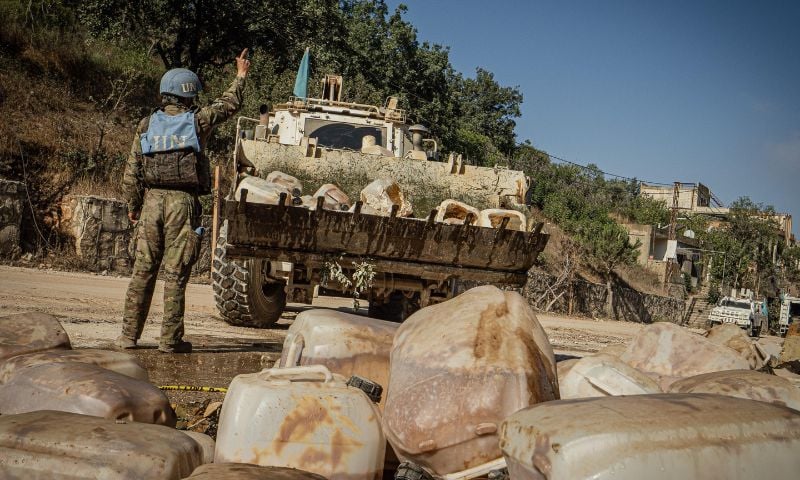



BEIRUT, Lebanon: UN peacekeepers said Tuesday they had found around four tonnes of mainly ammonium nitrate explosives this month in a south Lebanon border village under Israeli occupation.
On July 2, during a “routine route check” near Hula, “peacekeepers found 385 containers abandoned inside a building, containing approximately 4,000 kilograms of explosive material, consisting mainly of ammonium nitrate compounds”, the United Nations Interim Force in Lebanon (UNIFIL) said in a statement.
UNIFIL specialists “later carried out on-site procedures to render the material inert, making it safe and removing the risk it posed”.
Although violence has decreased, explosive hazards still pose risks in parts of southern Lebanon. EOD teams help reduce those risks, while contributing to safer conditions for communities returning to their villages, farms and daily activities.
🔗More: https://t.co/eBPFwNAfzj pic.twitter.com/dKxqz40v6P
— UNIFIL (@UNIFIL_) July 28, 2026
A source with knowledge of the matter told AFP on condition of anonymity that the containers had Hebrew writing on them and were “likely used for demolitions”.
Hula is part of a strip of territory running around 10 kilometres (six miles) deep inside Lebanon along the border where Israeli forces, who invaded during the latest war with Hezbollah, have been operating and have warned residents not to return.
🧵Before peacekeepers movement, Explosive Ordnance Disposal (EOD) specialists go first to assess the area.
They identify and safely neutralize explosive hazards, helping make routes safer for peacekeepers to carry out their tasks and reducing risks. ⬇️ pic.twitter.com/QN7FTyCR9y
— UNIFIL (@UNIFIL_) July 28, 2026
Hezbollah drew Lebanon into the Middle East war on March 2 with rocket fire at Israel in support of Iran, triggering major Israeli airstrikes and a ground invasion.
While violence has declined since last month’s US-Iran memorandum on the regional conflict, and a separate framework deal between Lebanon and Israel, Lebanon has reported ongoing Israeli demolitions and detonations of buildings in border villages and towns.
Also Read: Amnesty International Calls for War Crimes Investigation into Israeli Strikes in Lebanon
Lebanon’s state-run National News Agency has reported Israeli detonations in Hula on four occasions this month.
On July 8, the Hula municipality condemned “in the strongest terms the crimes the Israeli enemy is carrying out of burning, blowing up and destroying homes, public buildings and private property”.
Ammonium nitrate, used in fertilisers as well as in explosives, triggers grim memories in Lebanon.
On August 4, 2020, a stockpile of the chemical exploded at Beirut’s port, after being stored haphazardly for years.
The blast killed more than 220 people, injured over 6,500 others and laid waste to swathes of the capital.