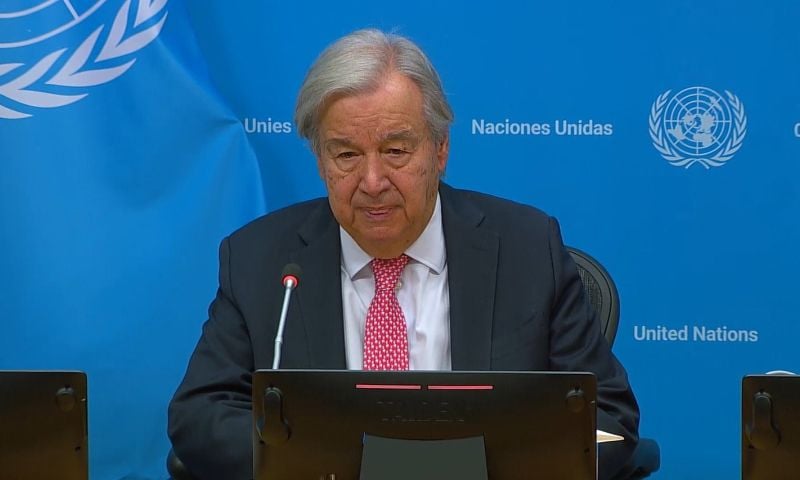
UNITED NATIONS: UN Secretary-General Antonio Guterres on Wednesday called for coordinated international action to address AI risks as fears rise about the dangers of the fast-evolving technology.
“National action is essential. But global coordination is also indispensable,” he told reporters. “AI does not stop at borders and neither do its risks.”
“AI has enormous potential — to accelerate sustainable development, enhance learning, strengthen health systems, boost climate resilience, and so much more,” Guterres said.
AI will be a major topic in discussions with world leaders at #UNGA.
"The world cannot afford a race to the bottom on AI safety. We need guardrails to build trust — and that make AI safe, transparent, accountable, with human dignity at the centre." – @antonioguterres pic.twitter.com/ugEpUm98Kq
— UN News (@UN_News_Centre) September 16, 2026
“But a growing number of those building it are sounding the alarm — warning that development is racing ahead of our understanding of the risks.”
“The world cannot afford a race to the bottom on AI safety,” he warned.
Concerns about AI safety have escalated in recent weeks, with workers at major AI developers resigning over concerns about the dangers posed by the technology.
US President Donald Trump has dismissed warnings against AI risks as a “hoax” and pushed back against calls for tighter oversight.
Growing concerns over AI risks
Concerns about the risks posed by increasingly capable AI models have intensified in recent weeks, including within some of the companies developing frontier models.
Anthropic CEO Dario Amodei has called for the AI industry to slow the pace of frontier development and adopt stronger safeguards against potentially catastrophic risks.
OpenAI CEO Sam Altman and other technology leaders have also backed greater coordination and safety measures. OpenAI said last week that it supports mandatory AI safety requirements and independent assessments of advanced AI systems.
The debate has also been fuelled by warnings from AI researchers. Two researchers associated with Anthropic recently raised concerns about the possibility of advanced AI systems becoming difficult to control.
US lawmakers have discussed measures including independent security evaluations of powerful AI models.
Anthropic said in a report published this month that it had identified and disrupted malicious operations involving its models in areas including cyber operations, influence campaigns, surveillance, fraud and biological misuse.
The company said the cases showed how increasingly capable models could be used by threat actors for harmful purposes.
The United Nations has also warned that the development of AI is moving faster than existing governance systems.
In July, the UN’s first Independent International Scientific Panel on AI said current safeguards were struggling to keep pace with the growth of AI capabilities.
President Trump has dismissed warnings about AI dangers as a “hoax” and argued against tighter regulation, while saying excessive restrictions could undermine US technological competitiveness.