
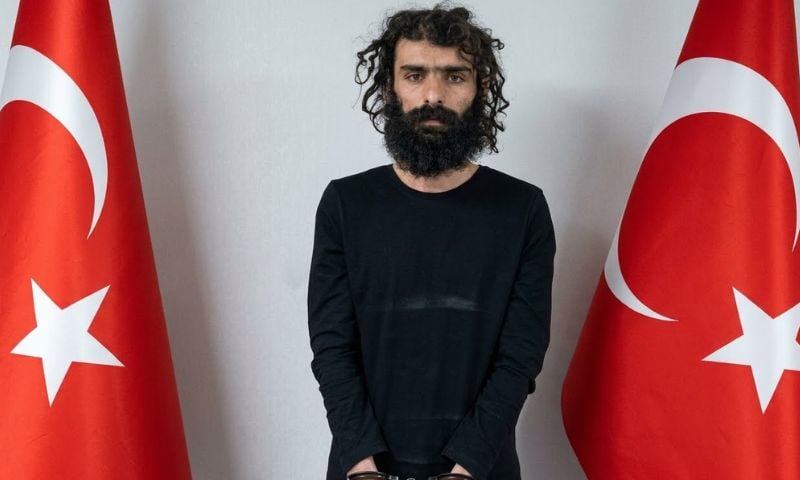
ANKARA: Turkey’s National Intelligence Organisation (MIT) has arrested an Islamic State Khorasan Province (ISIS-K) operative in the Afghanistan-Pakistan border region and transferred him to Turkey, Turkish media reported.
The Turkish newspaper Aksam identified the suspect as Ugur Bahadir, also known as Abdullah. According to the report, he travelled from Turkey to the Afghanistan-Pakistan border region in 2024, where he joined ISIS-K and became involved in the group’s operations.
Bahadir operated in several ISIS-K camps in the region, carrying out assignments for the militant organisation.
ISIS-K Network
During questioning, Bahadir provided information about his links with Ozgur Altun, also known as Abu Yasir al-Turki, the newspaper reported.
Altun facilitated the movement of ISIS members from Turkey to the Afghanistan-Pakistan border region.
MIT said its latest operation disrupted ISIS-K plans to carry out attacks in Turkey, exposed recruitment networks and uncovered operational preparations.
However, the report did not disclose the specific targets, timing or location of the alleged plots, nor did it provide details about when or where Bahadir was arrested.
Regional Security
The arrest comes amid continuing tensions between Pakistan and Afghanistan over militant activity along their shared border.
Taliban authorities have repeatedly claimed that security operations have significantly weakened ISIS-K in Afghanistan, forcing some members to relocate to border areas.
Islamabad, meanwhile, has repeatedly raised concerns about militant groups operating from Afghan territory and accused the Taliban authorities of allowing armed groups to use Afghanistan as a base for cross-border attacks.
ISIS-K Threat
Since the Taliban returned to power in August 2021 following the withdrawal of US and NATO forces, ISIS-K has continued to operate in Afghanistan and the wider region.
The group has claimed responsibility for several high-profile attacks targeting officials, foreign nationals and religious minorities, particularly Shia Hazaras and Sufi communities.
United Nations assessments have repeatedly warned that ISIS-K retains operational networks in parts of eastern and northern Afghanistan, including Nangarhar, Kunar and Badakhshan provinces.
The assessments have also highlighted the group’s recruitment activities, cross-border connections and use of online platforms to spread propaganda and coordinate with supporters in different countries.