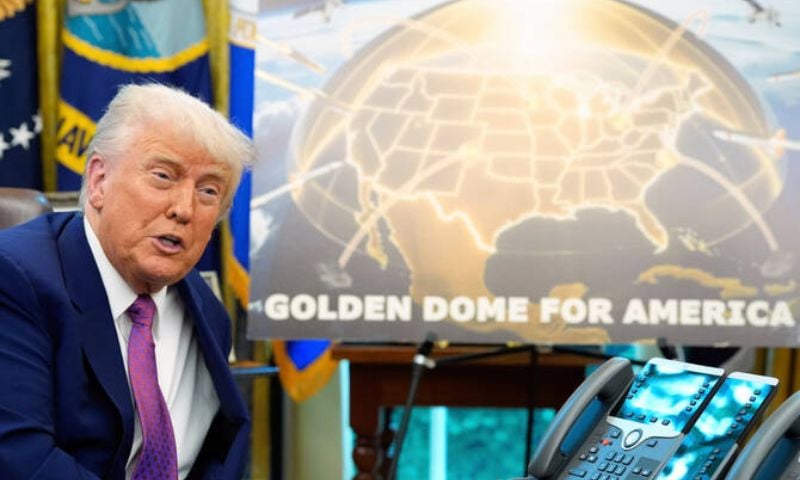
WASHINGTON: President Donald Trump’s ambitious “Golden Dome for America” missile defence initiative could cost the United States as much as $1.2 trillion over the next two decades, according to a new assessment by the Congressional Budget Office (CBO), dramatically exceeding the $175 billion figure previously cited by the president.
The estimate, released in a report by the nonpartisan CBO on Tuesday, underscores the potentially enormous financial burden of a futuristic defence system designed to detect and intercept incoming missile threats using both ground-based and space-based technologies.
The report clarified that the analysis represents “one illustrative approach rather than an estimate of a specific Administration proposal”, as the Pentagon has yet to provide detailed plans regarding the number, type and deployment of systems expected to form part of the project.
According to AP, Trump first announced the Golden Dome programme through an executive order signed during the opening week of his current term in office. At the time, he pledged that the missile shield would be “fully operational before the end of my term”, which concludes in January 2029.
Defending the initiative, Trump argued that global security threats had evolved significantly over recent decades.
“Over the past 40 years, rather than lessening, the threat from next-generation strategic weapons has become more intense and complex,” Trump stated in the executive order, citing the rapid development of advanced missile systems by rival powers and hostile states.
The proposed Golden Dome system is expected to combine an array of technologies capable of identifying, tracking and intercepting ballistic and hypersonic missiles during various stages of flight. The project would integrate satellites, space-based sensors and interceptor systems with existing US missile defence infrastructure.
The concept has drawn comparisons to Israel’s multilayered missile defence network, commonly referred to as the “Iron Dome”, which has played a major role in shielding Israeli territory from rocket and missile attacks during regional conflicts involving Iran and allied armed groups.
However, experts note that the US version would operate on a vastly larger scale and involve significantly more advanced space-based capabilities, making it far more expensive and technologically demanding.
The CBO report stressed that uncertainty surrounding the Pentagon’s plans made it difficult to determine the exact long-term cost of the programme.
Analysts said the absence of clear details regarding system architecture, operational requirements and deployment timelines created major challenges for accurate budgeting.
Congress has already allocated approximately $24 billion towards the missile defence project through a sweeping Republican-backed tax and spending package approved last summer. The funding is expected to support initial research, development and infrastructure planning.
General Michael A. Guetlein, the senior US Space Force official overseeing the Golden Dome project, defended the programme during testimony before lawmakers last month, rejecting claims that the initiative would inevitably become prohibitively expensive.
He argued that many cost projections relied on outdated assumptions linked to legacy military systems. “That is not what Golden Dome is doing,” Guetlein told legislators. “We are laser focused on affordability.”
Despite those assurances, critics have continued to question both the practicality and the cost-effectiveness of the programme.
Senator Jeff Merkley of Oregon, who requested the CBO analysis, sharply criticised the project following publication of the report. He described the proposed missile shield as “nothing more than a massive giveaway to defence contractors paid for entirely by working Americans.”
The latest estimate significantly expands upon an earlier CBO assessment issued last year, which projected that the space-based elements alone of the Golden Dome programme could cost up to $542 billion over a 20-year period.
The report is likely to intensify debate in Washington over the future of large-scale missile defence spending, particularly as lawmakers face growing concerns over rising federal debt, military expenditure and long-term national security priorities.