Key Points
- Trump’s “fantastic deals” appear to reflect partial sector understandings rather than a comprehensive trade pact
- Boeing aircraft purchases and limited technology-related easing dominate confirmed and reported developments
- US business leaders remain engaged in Beijing as negotiations and follow-ups continue
ISLAMABAD: President Donald Trump’s claim that the United States secured “fantastic trade deals” with China has prompted scrutiny, as the emerging outcomes from Beijing point more toward fragmented, sector-specific understandings than a single formal trade agreement.
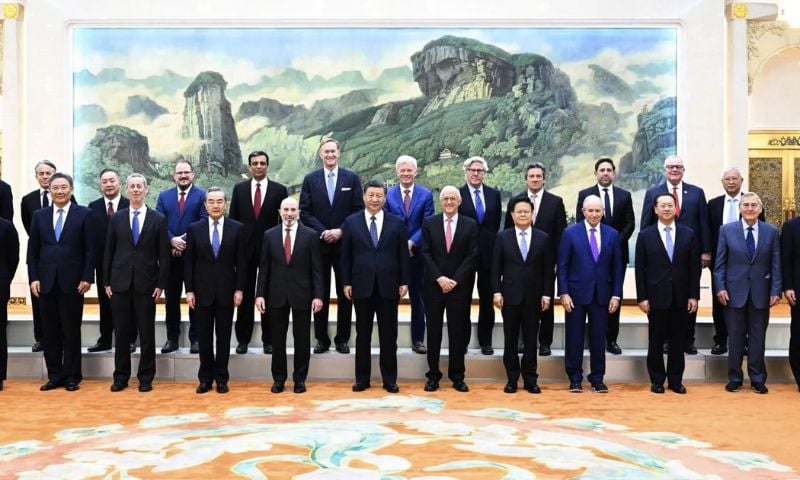
The visit officially concluded after Trump’s wrapping up meetings in Beijing on Friday, having discussions with Chinese President Xi Jinping and a working lunch at the Zhongnanhai leadership compound, according to international reporting.
So far, the most concrete outcome is a large aviation purchase commitment.
China has agreed to buy around 200 Boeing aircraft, one of the most significant commercial jet orders in recent years, signalling renewed Chinese demand for US aerospace exports after years of uneven relations.
Beyond aviation, other elements described in political remarks remain less clearly defined or formally confirmed.
Attention has now shifted to technology, particularly semiconductors and artificial intelligence hardware.
Reports indicate that Washington is considering or has moved toward limited, conditional approvals for certain advanced chip sales to Chinese firms. However, an announcement on easing of US export controls is still awaited.
The presence of leading US executives in Beijing has added weight to speculation that the talks extend well beyond government diplomacy.
Elon Musk of Tesla, Jensen Huang of Nvidia, Tim Cook of Apple and David Solomon of Goldman Sachs were among the business leaders accompanying Trump, highlighting the commercial dimension of the visit alongside strategic negotiations.
For Nvidia, the focus remains on access to China’s AI market, which continues to represent a significant share of global demand despite tightening restrictions on advanced chip exports from the United States.
Tesla’s operations in China, anchored by its Shanghai Gigafactory, remain central to its global production strategy, making regulatory continuity and market stability a key interest during the visit.
Apple is working to safeguard supply chain resilience and maintain its strong market position in China amid intensifying competition from domestic technology firms.
Goldman Sachs’ participation reflects continued interest in Chinese financial markets and the potential for cross-border investment activity, even as capital flows remain politically sensitive.
Chinese authorities appear to be signalling selective economic opening, focusing on strategic and high-value sectors such as aviation and advanced manufacturing, rather than broad-based trade liberalisation.
Importantly, no comprehensive written trade agreement has been publicly released or formally confirmed following the Beijing meetings. The developments instead point to a series of parallel understandings involving state commitments and corporate positioning.
Analysts describe the outcome as managed economic engagement. Both countries have agreed to maintain strategic competition while allowing limited commercial cooperation in areas of mutual interest.
Other than key geopolitical issues between the US and China, technology controls and mutual market access remained unresolved.
In this context, Trump’s “fantastic deals” appear to reflect incremental breakthroughs and commercial signals rather than a single, overarching trade accord.