


WASHINGTON: US President Donald Trump has warned of “strong military action” if ongoing talks with Iran fail to produce an agreement as mediators Pakistan and Qatar intensified diplomatic efforts to revive the US-Iran talks under the Islamabad Memorandum of Understanding (MoU) framework to permanently end the conflict.
The Islamabad MoU, brokered by Pakistan, was signed in June to end hostilities between the two countries and pave the way for a lasting peace agreement to permanently end the conflict.
The Islamabad MoU was signed on June 18 by President Trump, Iranian President Masoud Pezeshkian, and Pakistan’s Prime Minister Shehbaz Sharif, following Islamabad brokered a ceasefire between Washington and Tehran.
Under the Islamabad MoU, the US and Iran committed to halt military operations, reopen the Strait of Hormuz to commercial shipping, and negotiate a comprehensive agreement covering Iran’s nuclear programme, US sanctions, and a permanent ceasefire within 60 days.
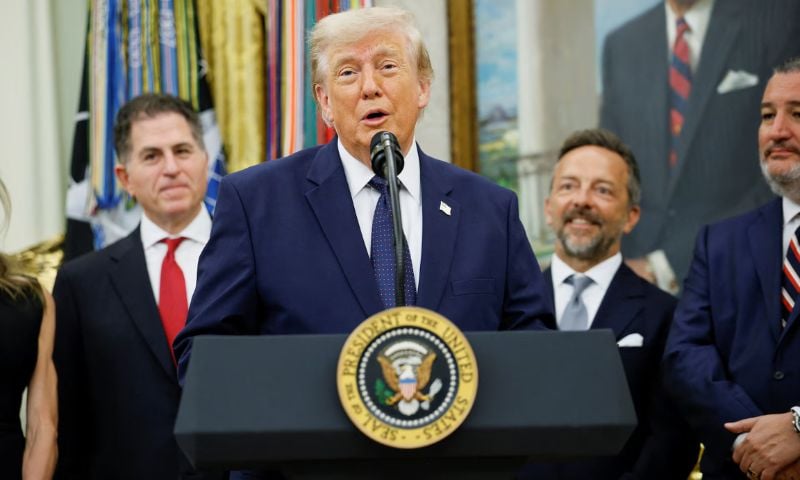
Speaking with Axios, the US President said he was unwilling to give diplomacy much time. He said that Washington is in “very deep talks with Iran” and warned that he is ready for “strong military action” if diplomacy fails.
“Not much time. Either it goes fast or not at all,” Trump told Axios when asked how long he was willing to give for talks.
BREAKING: Trump tells Axios: I'm ready for "strong military action" if Iran talks failhttps://t.co/skxnWMjCtQ
— Axios (@axios) July 27, 2026
US, Iran pause strikes
The US and Iran refrained from launching new strikes on Monday, easing tensions across the Gulf and offering a reprieve to global shipping and oil markets.
Iran said it had suspended retaliatory attacks against US allies in the Middle East, while US Ambassador to the United Nations Mike Waltz said President Trump was “giving talks some space”.

The pause follows weeks of escalating hostilities that spread beyond the two countries to key maritime routes and Gulf countries.
According to Iranian army spokesman Mohammad Akraminia, Tehran halted retaliatory operations after suspending attacks against Washington’s regional partners.
The US also refrained from conducting air strikes for a third consecutive night. Before Friday, US forces had carried out strikes on Iran for 13 straight nights, marking the most intense escalation since an April ceasefire.
US, Iran respond to proposal to resume talks
The US and Iran have submitted their responses to a joint proposal by mediators Pakistan and Qatar to resume peace talks under the Islamabad MoU framework, Al Arabiya reported on Sunday, citing sources.
Meanwhile, sources cited by Anadolu Agency said that the US and Iran had communicated their willingness to pursue dialogue and diplomacy to end the renewed hostilities and return to negotiations.
The reported diplomatic progress came after US President Donald Trump ordered a pause in military strikes against Iran following nearly two weeks of consecutive attacks, while Tehran also announced it had suspended attacks after no new US strikes occurred for two nights.
Pakistan, Qatar intensify mediation
Sources cited by Anadolu said that Pakistan and Qatar had intensified exchanges of messages between Washington and Tehran after receiving their responses to the joint de-escalation proposal.
Earlier this week, Pakistan and Qatar proposed that both countries return to their pre-July 9 positions as an initial step towards reviving stalled negotiations aimed at permanently ending the conflict, Anadolu reported, citing official sources.
Also Read: US, Iran Respond to Pakistan-Qatar Proposal to Resume Peace Talks
Although the sources did not disclose details of the responses, they said both sides had expressed support for dialogue and diplomacy to resolve the conflict.
The current pause in military operations had strengthened hopes that negotiations could resume after being derailed by fighting around the Strait of Hormuz and subsequent regional escalation, sources cited by Anadolu said.
A source, cited by Al Arabiya, said that Iran had not withdrawn from negotiations but had merely suspended them while remaining prepared to continue dialogue in accordance with the US-Iran Islamabad Memorandum of Understanding.
Talks with Iran ‘happening at every level’
US Ambassador to the United Nations Mike Waltz said that talks between Washington and Tehran are “happening at every level”.
Speaking to NBC News, he said, “What we are constantly seeing though, is on the Iranian regime’s side, they are divided; there is internal fighting”
“The president is keeping all options on the table,” says @USAmbUN on Iran.
“Talks are ongoing. They’re happening at every level… what we are constantly seeing though, is on the Iranian regime’s side, they are divided, there is internal fighting…” pic.twitter.com/vfyKKdAsAm
— Rapid Response 47 (@RapidResponse47) July 26, 2026
Earlier, Mike Waltz told “Fox News Sunday” that President Trump is giving negotiations with Iran “some space”.
Mike Waltz said that the United States remained “locked and loaded” for more attacks and that “more assets have gone into the region,” but that Trump is “giving talks some space — he’s giving it a little bit of room.”
Also Read: US-Iran Talks ‘Happening at Every Level’ as Trump Wants to Pursue Diplomacy: US Envoy
Prior to Friday, the US military had announced strikes on Iran for 13 consecutive nights, in the largest rekindling of the war since an April ceasefire.
Trump says diplomacy offers better path
The diplomatic developments followed President Trump’s decision to halt further strikes against Iran.
According to Axios, Trump declined on Friday to approve a proposed military operation after receiving another strike plan from Pentagon officials, instructing the military not to launch fresh attacks.
The report said Trump had approved strike plans daily for 13 consecutive days before deciding to pause the campaign.
Speaking to reporters at the White House on Saturday, Trump said he still retained the option of continuing or escalating military action but believed diplomacy offered a better path.
“We’re talking to [the Iranians] right now. I think they’re getting more and more serious as the days go by. We’re locked and loaded and ready to go, but we’re talking to them,” Trump said.
Axios reported that the president believed the military campaign had achieved as much as it reasonably could at this stage.
CNN, quoting an unidentified Pentagon source, separately reported that US operations against Iran were “on hold”, despite Trump’s warning on Friday that Washington retained the option of launching strikes “at a much higher level”.
The New York Times reported, citing two people briefed on the matter, that proposals for further escalation had also been shelved partly because of concerns over diminishing supplies of Patriot interceptor missiles and other defensive munitions.
According to CNN, Vice President JD Vance and Chairman of the Joint Chiefs of Staff General Dan Caine expressed concerns during a White House meeting on Friday about the potential consequences of expanding the conflict.
CNN reported that Caine told Trump that available military options remained viable but warned of their broader implications.
Pakistan urges de-escalation and return to talks
On Tuesday, Prime Minister Shehbaz Sharif reaffirmed Pakistan’s commitment to promoting peace and stability in the Middle East.
He assured Iranian Interior Minister Eskandar Momeni that Islamabad would continue to play the role of an “honest and sincere mediator and facilitator” to de-escalate regional tensions and encourage dialogue.
Expressing deep concern over the recent escalation in the Gulf region, the prime minister urged all sides to exercise restraint and avoid actions that could further destabilise the region.
He reiterated Pakistan’s unwavering commitment to regional peace and stability, stressing that Islamabad would continue supporting dialogue and diplomatic engagement.
Pakistan-backed Islamabad MoU framework
Washington and Tehran have been testing the limits of escalation since Trump announced last week that the ceasefire agreement with Iran is over.
The US military’s Central Command said it concluded its latest round of attacks by hitting surveillance sites, military logistics infrastructure, underground weapons storage and maritime capabilities.
Under the Islamabad MoU, the US and Iran committed to halt military operations, reopen the Strait of Hormuz to commercial shipping and negotiate a comprehensive agreement covering Iran’s nuclear programme, US sanctions and a permanent ceasefire within 60 days.
Pakistan and Qatar subsequently co-mediated the first round of high-level negotiations in Lucerne, Switzerland, on June 21.
The talks were attended by US Vice President JD Vance and Iranian Parliament Speaker Mohammad Bagher Ghalibaf.
Pakistan’s diplomatic efforts
Pakistan is the principal mediator between the US and Iran after it secured a ceasefire on April 08 and hosted the highest level of talks between the two nations on April 12 and 13 in Islamabad.
Pakistan, which brokered the ceasefire and has continued to mediate between Washington and Tehran, has urged all parties to honour the agreement.
The first round of Pakistan and Qatar mediated US-Iran talks, led by US Vice President JD Vance and Iran’s Parliament Speaker Mohammad Baqer Ghalibaf, was held in Switzerland a week ago, and Washington waived sanctions on Tehran.
After the talks, Pakistan and Qatar announced significant progress in diplomatic efforts between the US and Iran following the conclusion of the first round of high-level talks in Switzerland.