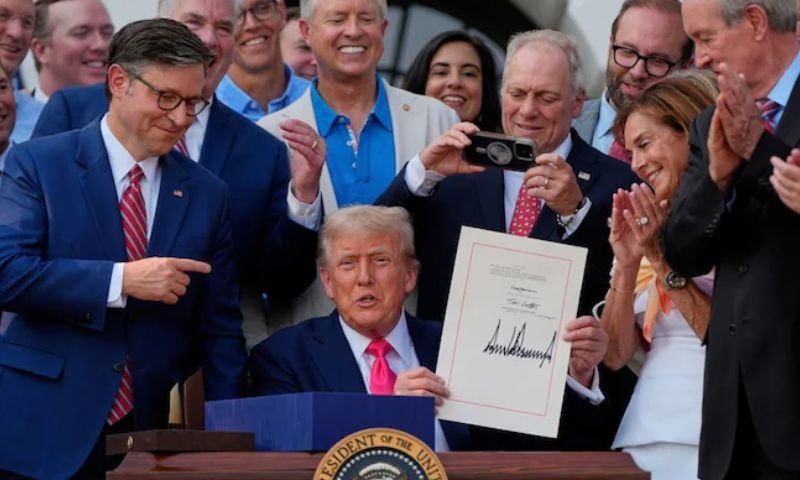



WASHINGTON: In a landmark shift to a 165-year-old tradition, the United States will introduce paper currency bearing President Donald Trump’s signature starting this summer, the Treasury Department confirmed on Thursday.
The move marks the first time a sitting U.S. president’s signature will appear on federal banknotes. Alongside this change, the long-standing practice of including the U.S. treasurer’s signature will be discontinued — ending a continuous feature that has existed since the nation began issuing federal currency in 1861.
According to Treasury officials, the first redesigned $100 bills featuring Trump’s signature and that of Treasury Secretary Scott Bessent will be printed in June. These notes are expected to enter circulation gradually over the following weeks, with additional denominations updated in phases.
The redesign is part of broader commemorations planned for the United States’ 250th anniversary of independence. Despite the signature change, officials emphasized that the overall design and visual elements of the banknotes will remain largely unchanged to preserve continuity and security standards.
The outgoing treasurer, Lynn Malerba — whose signature still appears on currently circulating notes — will be the last in a historical line of treasurers represented on U.S. currency. Her successors will no longer have their signatures included.
According to Reuters, Treasury Secretary Bessent described the initiative as a fitting tribute to both the nation’s milestone anniversary and what he characterized as strong economic performance during Trump’s second term. He framed the new currency as a symbolic recognition of national achievements.
The decision is also seen as part of a broader effort by the Trump administration to associate the president’s name with prominent national symbols and institutions. Recent initiatives have included proposals for commemorative coins and naming federal assets, although legal restrictions continue to prohibit the depiction of living individuals on circulating U.S. coins.
Under existing law, the Treasury retains authority to modify certain aspects of currency design, particularly to enhance anti-counterfeiting measures. However, statutory requirements still mandate elements such as the national motto “In God We Trust” and restrict portrait imagery to deceased individuals.
While some current and former officials have expressed support for the change, others have refrained from public comment. The transition is expected to unfold gradually, with older notes continuing to circulate alongside the new series.
As the United States approaches its semiquincentennial, the introduction of presidentially signed currency represents a notable departure from tradition — one that blends symbolism, politics and history into the nation’s most widely used financial instrument.