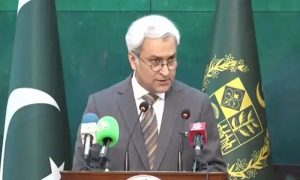



Power has a strange obsession with convincing its holders that their ascent is a destiny rather than a phase of a professional journey replete with hard work, sincerity, and commitment to professional obligations. Few figures in Pakistan’s recent history embodied this illusion more profoundly; Lieutenant General (Retired) Faiz Hameed emerges as one who once remained an invisible force shaping political transitions, calibrating alliances, and defining the pace of national narratives. His presence alone used to ignite speculation about the direction of the state. His confident appearance, his Kabul snapshot with a teacup, and the certainty with which he moved through political corridors forged an aura that even overshadowed institutional decorum. Yet power that grows without boundaries eventually runs up against those very boundaries. The fall of Faiz Hameed, culminating in 14 years of rigorous imprisonment, is not merely the downfall of one man but a defining moment for an institution trying to reclaim its balance.
His journey to the apex of influence was not abrupt but carefully layered through sensitive postings and professional milestones. Before becoming DG ISI, he served as the head of the Counter-Intelligence Wing, an assignment that broadened his political visibility and operational reach. In June 2019, he assumed charge as Director-General ISI, replacing Lt Gen Asim Munir, who had a stint of only eight months as spy master. That transition, initiated through a manipulative drive, shaped the very future of the country manifold. It was widely perceived as the moment when Faiz stepped beyond the conventional professional profile of an intelligence chief and entered the realm of political centrality.
Reports later suggested that his proximity to the Prime Minister’s Office took a sinister turn when he manipulated the then Prime Minister’s spouse in furthering his agenda, having dire consequences for the country. This informal channel magnified his influence and blurred the institutional hierarchy, creating an impression that the power of intelligence was being personalized rather than institutionalized. International outlets, including the Financial Times, highlighted these unusual dynamics and noted how the fallout of this alliance remained central to the environment in which he is now being prosecuted, marking Pakistan’s first conviction of a former spymaster of this stature.
But power built on informal leverage rarely endures without resistance. By late 2021, when a broader institutional recalibration began, Faiz was moved to the Peshawar Corps, a change many interpreted as the beginning of his gradual detachment from the political matrix. The army leadership was keen to rebuild the distance between intelligence roles and political mediation, a distance that had thinned dangerously during Faiz Hameed’s tenure. As debates over the next Army Chief intensified, his name, lower in the seniority list, was associated with both expectation and apprehension. The phase of appointing a new COAS is badly marred by political intrigues by Imran Khan, with Faiz acting as the prime mover to attain the slot.
The appointment of Field Marshal Syed Asim Munir as Army Chief left Faiz Hameed with no other option but to resign, ending a career that had once seemed destined for the highest office. Yet retirement did not bring an end to Faiz Hameed’s proactive role, and he kept operating beyond his mandate to achieve his political ambitions. A fact manifested in the ISPR Press Release issued on 11 December 2025. Faiz Hameed’s activities did not only encompass political wheeling and dealing, but he indulged in practices causing harm to persons, as alluded to in the ISPR Press Release. Misuse of his authority echoed in the Supreme Court even which forced the institution to hold a formal Inquiry under Rule 169 of the Pakistan Army Rules. This marked the beginning of a fall of one of the most effective people in the Pakistan military fraternity. This inquiry was followed by a rigorous legal process that would last fifteen months.
The charges against him were vast in scope and serious in consequence. They included political interference, a violation of the code governing military conduct; breach of the Official Secrets Act, involving handling of classified information; misuse of authority and state resources; and causing wrongful loss to individuals and the state. The Summary of Evidence was compiled with precision, documenting testimonies, classified material, and operational records. The Field General Court Martial, conducted under the Pakistan Army Act 1952 and the Pakistan Army Rules 1954, ensured that he retained every right afforded to any officer: counsel of choice, cross-examination, and full access to the evidence.
The concluding paragraph of the ISPR Press Release contains highly serious assertions that may have dangerous implications for Faiz Hameed’s compatriot Imran Khan in fomenting agitational politics in connection with the 9th May events.
For decades, powerful offices shaped politics without being held to account. The Faiz Hameed case is a direct repudiation of that pattern. It asserts that no individual is larger than principle, no office immune from scrutiny, and no past service a shield against legal consequence. The gravity of the verdict does not lie in its length alone, but in its symbolism: a reaffirmation that the state’s authority flows from law, not personalities.
His right to appeal remains intact, and the layered review process from the Chief of Army Staff to constitutional remedy will determine the next phase of his legal journey. But regardless of what lies ahead, the message already stands immutable: Pakistan has entered a period where institutional recalibration is reshaping the contours of power. The story of a man who once appeared indispensable has now become a testament to the essential truth that the state endures, but the individuals who overstep it do not.