
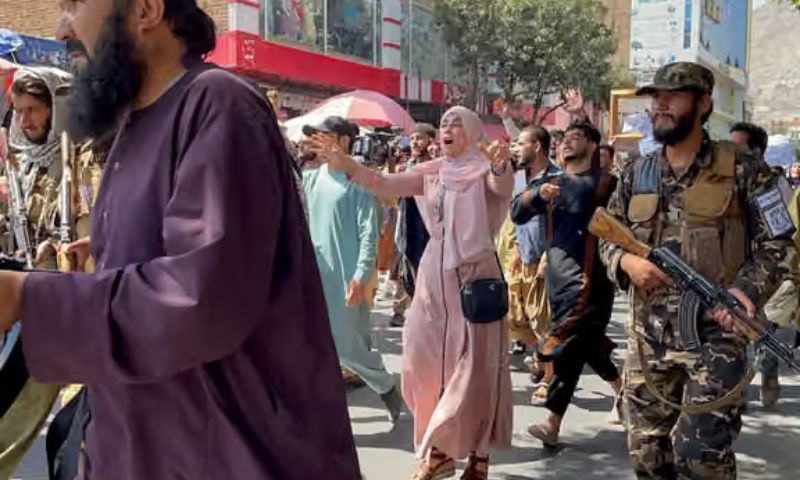



KABUL: The Taliban administration in Afghanistan has defended its newly imposed nationwide ban on demonstrations, saying public protests are incompatible with Islamic law and that grievances should instead be submitted to the relevant authorities.
Taliban spokesperson Zabihullah Mujahid made the remarks at a press conference on Wednesday while explaining the recently approved police law, which prohibits demonstrations across the country.
The Taliban’s comments on the protest ban and prison population come amid continuing international scrutiny of its governance, legal system and restrictions on civil and political freedoms.
Mujahid said demonstrations were associated with democratic political systems governed by laws different from those applied under an Islamic system. He argued that people with complaints or grievances should raise them through the authorities rather than taking to the streets.
According to the Taliban spokesperson, demonstrations were also liable to cause disorder, damage property and contribute to lawlessness. He said the new police legislation had been drafted in accordance with Islamic Sharia.
The Taliban’s Justice Ministry recently published the Shurta Law, under which Article 50 states that all demonstrations across Afghanistan are prohibited.
The blanket ban further restricts public assembly under the Taliban administration, which returned to power in Afghanistan in August 2021.
Taliban highlights diplomatic outreach
While defending restrictions on domestic dissent, Mujahid claimed the Taliban had made progress in expanding its diplomatic and political relations with other countries.
READ ALSO: Afghan Women Recount Torture and Abuse in Taliban Regime Prisons: Report
Although Russia remains the only country to have formally recognised the Taliban administration, Mujahid said Kabul had strengthened contacts with several governments during the past year.
He said senior Taliban officials and representatives of various institutions had undertaken numerous foreign visits aimed at broadening Afghanistan’s political and economic engagement with other countries.
Mujahid also highlighted the transfer of Afghan prisoners from several neighbouring and regional countries. He said 1,020 Afghan prisoners had been transferred from Iran to Afghanistan, while around 120 others had been transferred from Uzbekistan and the United Arab Emirates.