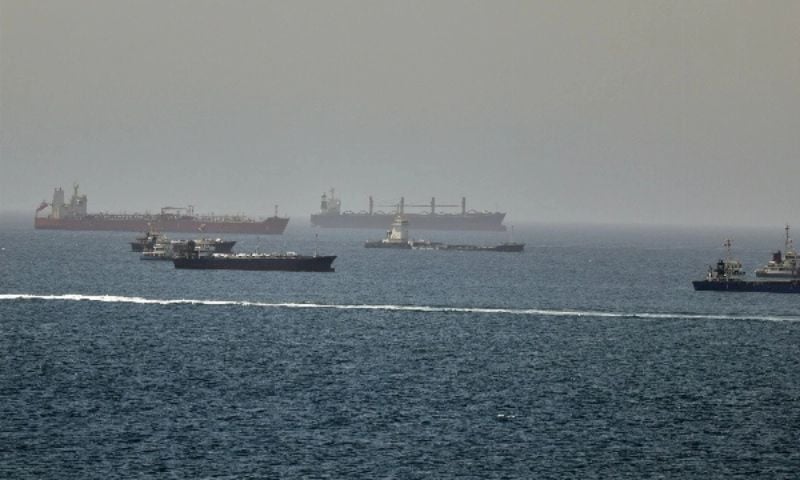
PARIS: Ship traffic through the Strait of Hormuz on Monday reached its highest level since the start of the Middle East war, according to maritime monitoring firms, signalling a gradual recovery in commercial shipping activity through the strategic waterway.
Traffic through the strategic waterway rebounded after the United States and Iran signed the Islamabad Memorandum of Understanding and held the first round of Pakistan and Qatar mediated talks in Switzerland.
Analytics platform Kpler recorded at least 37 crossings on Monday, one week after the Islamabad Memorandum of Understanding was reached between the United States and Iran.
AXSMarine, another shipping data provider which tracks transits by commercial vessels, including container ships, counted 42 crossings on Monday — also a record.
According to AFP, 51 different vessels are transiting by cross-referencing the two lists.
This represents 42.5 percent of normal peacetime traffic (around 120 vessels per day) through the strategic waterway, which normally carries around a fifth of the world’s oil and gas exports.
Total figures are likely to rise further, as the platforms often identify additional crossings retrospectively, notably through satellite imagery.
Five empty liquefied natural gas (LNG) tankers were among the ships crossing on Monday, according to Kpler.
“This may be one of the clearest signs so far of a tentative normalisation in traffic,” Mihail Todorov of AXSMarine told AFP.
LNG operators had previously been very cautious about transiting the strait.
Hormuz traffic rebounds after Islamabad MoU
Overall commodities traffic through the strait — which includes tankers carrying oil and LNG plus dry bulk cargoes such as fertilisers — has increased steadily since Washington and Tehran signed the Islamabad MoU last week to end the war.
Before the June 14 agreement, less than 10 commodity vessels went through the strait per day since the passage was closed by Iran on March 1 in retaliation against US and Israeli strikes.
Since June 15, the average has risen to 21 and reached 28 over the last five days.
Full normalisation, however, is still a long way off, according to Deepak Maurya, an analyst at HSBC. “We expect shipping normalisation to lag pending a durable settlement, mine clearance and lower insurance costs,” he wrote in a report on Tuesday.
Trump says record 19 million barrels of oil flow through Hormuz
The US said on Monday it was temporarily lifting sanctions on Iran to let it produce, sell and deliver crude oil and related products through August 21.
In a post on his Truth Social platform, US President Donald Trump on Tuesday said global oil prices were falling after a record 19 million barrels of oil passed through the Strait of Hormuz in a single.
“19 million barrels of oil flowed out of the Hormuz Strait yesterday, an all-time record. Oil prices are tumbling down, and the world is a much safer place!!!” the US President wrote.
— Rapid Response 47 (@RapidResponse47) June 23, 2026
In another post on Truth Social, Trump said, “Based on this and other major concessions being made by Iran, I have agreed to allow the Hormuz Strait to remain open, with no further Naval blockade.”
“However, all ships are remaining in place should it be necessary to reinstitute the blockade, which seems, at this point, highly unlikely,” the US President stated.