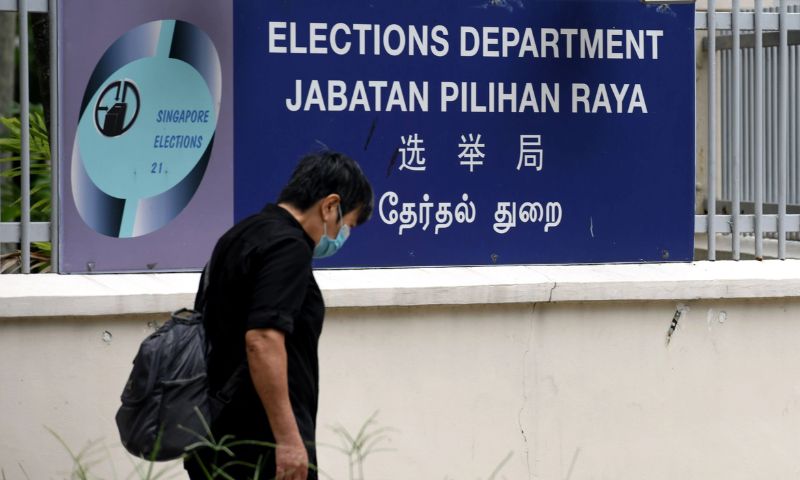



SINGAPORE: Singaporeans headed to the elections on Friday in the city-state’s first contested presidential polls in more than a decade, a vote being closely watched as an indication of support for the ruling party after a rare series of political scandals.
The president’s role is largely ceremonial, but there are important requirements for the position, which formally oversees the city’s accumulated financial reserves and wields the power to veto certain measures as well as approve anti-graft investigations.
While the presidency is a non-partisan position under the country’s constitution, political lines were already drawn ahead of the polls to replace incumbent Halimah Yacob, who ran unopposed for her 6-year term in 2017.
People’s Action Party’s hold on Singapore
The city-state’s government is run by the prime minister, currently Lee Hsien Loong of the People’s Action Party, which has ruled Singapore continuously since 1959.
Experts said the vote could indicate the level of PAP support ahead of general polls due in 2025 or discontent after recent scandals that include a corruption investigation into the transport minister and the resignations of two PAP llawmakers over an affair, according to AFP.
The frontrunner in the elections is former deputy prime minister and finance minister Tharman Shanmugaratnam, a long-time PAP stalwart before he resigned ahead of his candidacy.
The 66-year-old economist is widely perceived as having the government’s support and was questioned about his independence during the election campaign.
Another candidate, former insurance executive Tan Kin Lian, 75, has secured the support of several opposition leaders.
The third contender, Ng Kok Song, 75, is the former chief investment officer of the sovereign wealth fund of Singapore GIC, which manages the country’s foreign reserves.
The vote will have no exit polls before a result is officially announced late Friday night.
The PAP was recently rocked by political scandals, a rarity in a city that has enjoyed on its reputation for clean government to become an international hub for different industries like finance and aviation.
The PAP suffered its worst-ever polls performance in 2020 but maintained its more than two-thirds majority in the parliament.