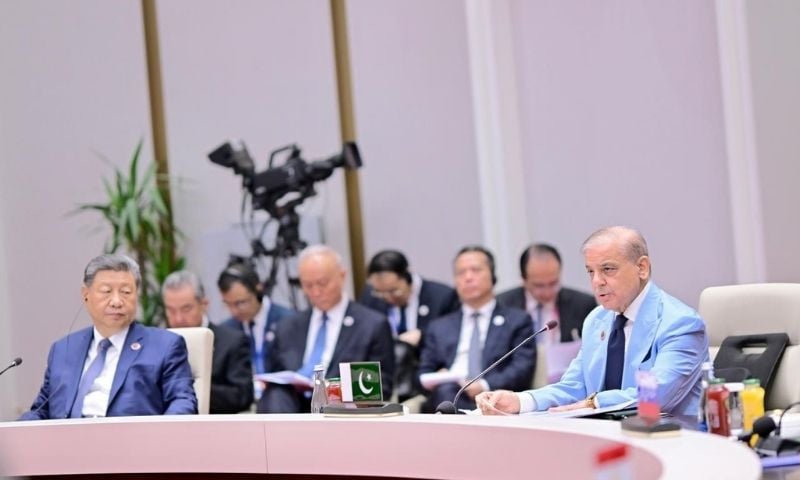
BISHKEK, Kyrgyzstan: Pakistan Prime Minister Shehbaz Sharif has called water the “lifeblood” of South Asia and warned that it must never be weaponised, as he addressed the Shanghai Cooperation Organisation (SCO) summit in Bishkek on Tuesday.
He also urged respect for binding water treaties, including the Indus Waters Treaty, while calling for lasting peace and greater regional cooperation.
Speaking at the SCO Council of Heads of State meeting in Bishkek on Tuesday, Mr Shehbaz said the region could not realise its full potential without lasting peace and called for the Indus Waters Treaty (IWT) to be honoured.
براہِ راست:وزیراعظم محمد شہباز شریف کا بشکیک میں شنگھائی تعاون تنظیم کے اجلاس میں خطاب https://t.co/USDnbgQ6w6
— Government of Pakistan (@GovtofPakistan) September 1, 2026
“Water is the lifeblood of our region. It sustains millions of lives, nourishes our land and secures the very future of our coming generations,” he said.
He stressed that it “must never be weaponised; it cannot be used as an instrument of coercion, nor can it ever be exploited for political leverage”.
“The treaties governing our shared waters are solemn, binding international commitments. They are not matters of political convenience to be cast aside at your will. They must be honoured unconditionally, in both letter and spirit.”
Pakistan’s Fight Against Terrorism
Turning to terrorism, Mr Shehbaz described it as “one of the gravest threats that has affected our entire region in its various forms and manifestations”.
As chair of the SCO Regional Anti-Terrorist Structure, Pakistan has “worked actively to strengthen regional counter-terrorism cooperation”, he said.
“I am honored to join this historic gathering of SCO leaders in the beautiful city of Bishkek and I extend my sincere gratitude to His Excellency President Sadyr Japarov and his team for their gracious hospitality and the excellent arrangements made for this very important… pic.twitter.com/KsQn9zMD20
— Government of Pakistan (@GovtofPakistan) September 1, 2026
“Few nations have fought against the scourge of terrorism as resolutely and valiantly as Pakistan. In the past two and a half decades, we have sacrificed more than 90,000 lives and endured economic losses of over $150 billion in combatting terrorism.”
Mr Shehbaz said Pakistan wanted a peaceful and stable Afghanistan but warned that the continued use of Afghan territory by militants posed a serious obstacle to regional peace.
“But let there be no ambiguity; so long as terrorists continue to use Afghan territory to shed the blood of innocent Pakistanis and other nations, lasting peace will remain beyond our reach,” he said.
The prime minister was welcomed by Kyrgyz President Sadyr Japarov upon arriving at the summit venue and later joined other leaders for a group photograph.
Leaders from China, Iran, Türkiye, Russia and India are also attending the two-day summit.
The SCO, which also includes Kyrgyzstan, Kazakhstan, Tajikistan, Uzbekistan and Belarus, is marking its 25th anniversary.
Pakistan Takes SCO Chair
Pakistan is set to assume the chairmanship of the SCO Council of Heads of State for 2026-27, with Islamabad due to host next year’s summit.
“For years, I have strongly advocated regional connectivity as the key to our prosperity. Today, connectivity is no longer a choice. It is a strategic imperative. The recent crisis has also proven that diversified transport networks, secure energy corridors and resilient supply… pic.twitter.com/LeNRCq8ExE
— Government of Pakistan (@GovtofPakistan) September 1, 2026
“As Pakistan assumes the chairmanship of the SCO, we are proposing an excellent plan that will prioritise key sectors, including IT and AI, energy development, poverty reduction, disaster management, health, culture and sports,” Mr Shehbaz said.
Pakistan has also proposed an SCO framework for sovereign AI infrastructure and governance to “promote responsible and inclusive AI development and to also ensure that no member state is left behind”.
The prime minister said Pakistan’s chairmanship would be pursued under the theme: “Turning vision into action, connectivity, innovation and shared prosperity”.
“We undertake this responsibility with humility, hope and abiding faith that connectivity will bring our peoples closer, innovation will open new doors of opportunity, and shared prosperity will reach every home,” he said.
He called for the SCO’s vision to be translated into practical action and its promises into progress.
Connectivity Key To Regional Prosperity
Mr Shehbaz noted that the SCO region is home to more than 3 billion people and has abundant natural resources, saying its potential placed a responsibility on member states to shape a better future.
He reiterated his long-standing view that regional connectivity was the “key to our prosperity”.
“As Pakistan assumes the chairmanship of the SCO, we are proposing an action plan that shall prioritize key sectors including IT and AI, energy development, poverty reduction, disaster management, health, culture and sports.
Pakistan’s SCO chairmanship shall be pursued under the… pic.twitter.com/F49TilLeBc
— Government of Pakistan (@GovtofPakistan) September 1, 2026
“Today, connectivity is no longer a choice; it is a strategic imperative. The regional crisis has also proven that diversified transport networks, secure energy corridors and resilient supply chains are indispensable to our collective security.”
The prime minister said the China-Pakistan Economic Corridor (CPEC) continued to “serve as a gateway, linking the regional economies to the Arabian Sea”.
He reaffirmed Pakistan’s commitment to advancing trans-regional railway projects, road connectivity initiatives and regional energy projects.
Mr Shehbaz called for implementation of the SCO Development Strategy until 2035, describing the proposed establishment of an SCO Development Bank as a “critical step”.
As permanent chair of the SCO Special Working Group on Poverty Reduction, Pakistan would continue efforts to strengthen social protection and promote inclusive and sustainable development across the region, he said.
‘Intensifying Geopolitical Tensions’
Mr Shehbaz congratulated Kyrgyzstan on completing its “successful SCO chairmanship” and praised its contribution to practical cooperation among member states.
He also congratulated the leadership and people of Kyrgyzstan and Uzbekistan on their respective independence days.
Describing the summit as “historic”, he thanked President Japarov and his team for their hospitality and the arrangements for the gathering.
“Guided by the Shanghai spirit, Pakistan takes great pride in being part of the SCO, as we celebrate 25 years of this remarkable journey, a milestone for which I congratulate all fellow members,” he said.
The prime minister said the global landscape was marked by “intensifying geopolitical tensions, fragmenting global economy, escalating climate crises and unprecedented technological transformation”.
He said the SCO represented a collective effort to address these challenges and deliver peace, security and prosperity.
Mr Shehbaz reaffirmed Pakistan’s commitment to the principles of the UN and SCO charters and to resolving disputes peacefully through international law.
Pakistan Highlights Mediation Role
The prime minister said Pakistan had “staunchly advocated peace” when the sovereignty and territorial integrity of an SCO member state was violated earlier this year, triggering a major regional crisis.
He said Pakistan and the international community had “borne a heavy economic cost” as the “closure of critical energy supply routes” disrupted the global economy, referring to the Strait of Hormuz.
“In these challenging times, Pakistan has consistently acted as an honest and sincere mediator and facilitator,” he said.
Mr Shehbaz recalled that Pakistan’s diplomatic efforts culminated in the signing of the Islamabad Memorandum of Understanding in June, describing it as a “critical step towards regional de-escalation and the restoration of peace”.
He said peace-building efforts were continuing and thanked countries supporting the process.
“We firmly believe that the Islamabad MoU offers the most viable and enduring pathway to lasting peace in the region.”
He also referred to the trilateral defence pact between Pakistan, Saudi Arabia and Türkiye signed last month, calling it the “Makkah Defence Alliance”.
The prime minister reiterated that the pact was “fundamentally defensive in nature and is neither directed against any state nor intended to create any confrontation or division whatsoever”.
Gaza Crisis
Mr Shehbaz also highlighted the situation in Gaza and the West Bank, calling for greater international action.
“International community must honour its commitment to help the Palestinian people alongside all other oppressed nations to secure their fundamental right to self-determination.
Water is the lifeblood of our region. It sustains millions of lives, nourishes our lands and secures… pic.twitter.com/wrgNMKadSO
— Government of Pakistan (@GovtofPakistan) September 1, 2026
“The plight of the innocent people of Gaza and the West Bank continues unabated, causing unimaginable suffering. Palestinian mothers endure the profound grief of mourning their children, families remain torn apart, and entire generations continue to live under a perpetual shadow of fear, deprivation and gross injustice.”
He called on the international community to honour its commitment to help Palestinians and other oppressed peoples secure their fundamental right to self-determination.
On regional connectivity, the prime minister said the China-Pakistan Economic Corridor continued to serve as a gateway linking regional economies to the Arabian Sea, and reaffirmed Pakistan’s commitment to trans-regional railway projects, road connectivity initiatives and regional energy schemes.
He called for full implementation of the SCO Development Strategy until 2035 and said the establishment of the SCO Development Bank would be a critical step in that direction.
Mr Shehbaz arrived in Kyrgyzstan on Monday for the summit. The Prime Minister’s Office said he would present Pakistan’s position on regional and global issues during the gathering.