
KEY POINTS
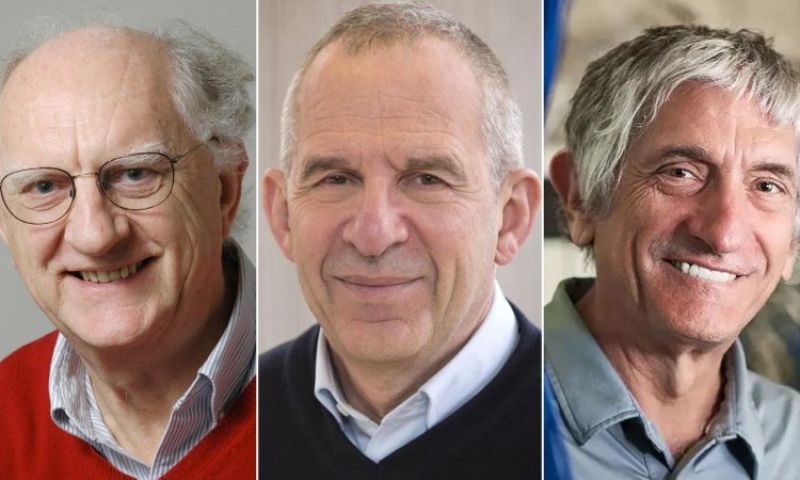
- John Clarke, Michel H. Devoret, and John M. Martinis share the 2025 Nobel Prize
- Recognised for demonstrating quantum mechanical tunnelling in macroscopic systems.
- Work bridges the divide between classical and quantum physics.
- Discovery underpins advances in quantum computing and superconducting technology.
ISLAMABAD: The Royal Swedish Academy of Sciences on Tuesday awarded the 2025 Nobel Prize in Physics jointly to John Clarke, Michel H. Devoret, and John M. Martinis for their groundbreaking experiments demonstrating macroscopic quantum tunnelling.
According to the announcement by the Academy’s award committee, the trio’s work “revealed that quantum mechanical effects—long observed only at the atomic scale—can also govern systems large enough to be seen by the human eye.”
Their experiments, it added, “opened the door to quantum technologies that rely on superconducting circuits behaving as quantum objects.”
According to Reuters, the laureates’ pioneering research confirmed that superconducting electrical circuits can occupy quantised energy states and tunnel between them, validating the theory of quantum tunnelling beyond the microscopic realm. The findings have become fundamental to the design of quantum computers and ultrasensitive magnetometers.
The Nobel Committee noted that Clarke of the University of California, Berkeley, Devoret of Yale University, and Martinis of the University of California, Santa Barbara, will share the 11 million Swedish kronor (about USD 1.2 million) prize equally.
In remarks cited by The Guardian, Prof. Lars Brink of the Nobel Committee said the trio’s achievement “bridges the classical and quantum worlds and transforms quantum physics from a theoretical construct into a tangible engineering reality.”
Their discoveries are credited with helping scientists harness quantum coherence and control at scales suitable for quantum computing, a field expected to revolutionise data encryption, materials design, and simulation technologies.
The physics award is the second Nobel announced this week, following Monday’s prize in physiology or medicine. The Nobel Prizes in Chemistry, Literature, Peace, and Economics will be announced later this week in Stockholm and Oslo.
About the Nobel Prize in Physics
First awarded in 1901, the Nobel Prize in Physics honours outstanding discoveries in the field of physical sciences. Administered by the Royal Swedish Academy of Sciences, it is among the world’s most prestigious scientific distinctions. Laureates receive a gold medal, a diploma, and a cash award, funded by the legacy of Alfred Nobel, the Swedish inventor of dynamite.
Past recipients include Albert Einstein (1921) for the photoelectric effect, Richard Feynman (1965) for quantum electrodynamics, and Roger Penrose (2020) for work on black holes. The 2025 award continues this legacy by recognising breakthroughs that extend quantum mechanics to the macroscopic realm.
What Is Quantum Tunnelling?
Quantum tunnelling is a phenomenon in which a particle passes through a barrier that it classically should not be able to cross. In the quantum world, particles behave like waves, allowing them to “tunnel” through energy barriers rather than bounce back.
This effect is fundamental to technologies such as semiconductors, nuclear fusion, and quantum computing. The 2025 Nobel-winning experiments proved that such tunnelling can also occur in macroscopic superconducting circuits, bridging the gap between quantum and everyday physics.