
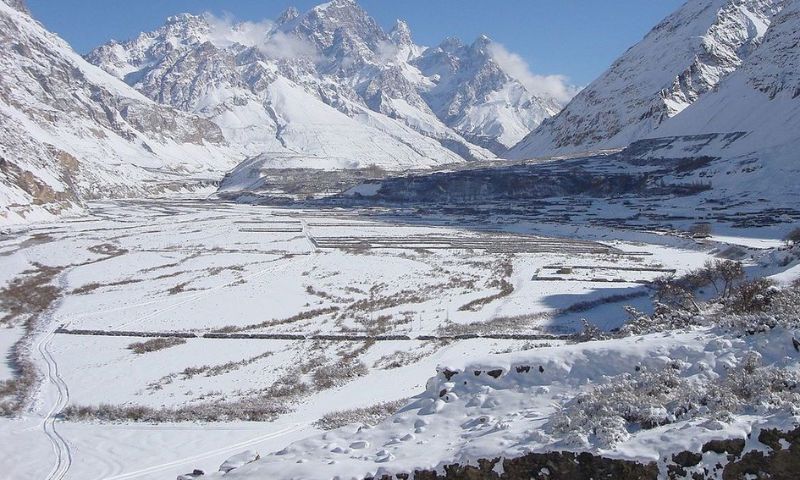
ISLAMABAD: Pakistan Meteorological Department (PMD) on Saturday warned that an incoming westerly wave could trigger glacial lake outburst floods (GLOFs) across the country’s northern regions, including Gilgit-Baltistan (GB) and Khyber Pakhtunkhwa (KP).
🌦️ Pakistan Weather Update (02–05 May 2026)
Rain, thunderstorms & hail expected in northern & central regions due to westerly wave.#PMD #WeatherAlert pic.twitter.com/unaXtHyW0y— Pak Met Department محکمہ موسمیات (@pmdgov) May 2, 2026
What is a GLOF?
A Glof is a sudden discharge of water and debris from a lake fed by a glacier, often causing destruction of homes, livelihoods, and infrastructure in mountainous areas. According to the Ministry of Climate Change, more than 7.1 million residents of GB and KP are exposed to this hazard.
Weather system expected from Sunday
In its Saturday statement, the PMD said a moderate westerly system is likely to enter northern Pakistan starting Sunday. This system is expected to bring scattered rain, windy thunderstorms, and isolated downpours across both GB and KP.
🚨 PMD Press Release : Westerly wave to bring rain, thunderstorms & hail across Pakistan (02–05 May 2026).
⚠️ Landslide risk | Dust storms | Heat relief expected#PMD #WeatherAlert #Pakistan pic.twitter.com/5HLhw1WRgC— Pak Met Department محکمہ موسمیات (@pmdgov) May 2, 2026
High-risk areas identified
The department noted that a sharp rise in temperatures followed by heavy rain greatly increases the likelihood of Glofs, debris flows, and sudden flash floods in sensitive zones, particularly in Hoper, Ghulkin, Shishper, Yasin, Phander, Badswat, lower Hunza, Nagar, Ghanche, Shigar, Swat, upper Chitral, Dir, and Astore.
People living in glacier-fed valleys are advised to stay away from riverbanks and streams during wet weather, move livestock and essential items to elevated safe spots, and circulate the alert through SMS and social media.
The PMD also asked residents to watch local drainage channels for abrupt changes in water colour, such as muddiness, or strange noises that may signal grinding rocks.
🚨 GLOF Alert Pakistan (02 May 2026)
Rising temperatures + westerly wave increase flood risk in GB & KP valleys.
⚠️ Stay alert#GLOF #PakistanWeather #PMD pic.twitter.com/deIRJmRgRp— Pak Met Department محکمہ موسمیات (@pmdgov) May 2, 2026
Coordination with disaster management authorities
The advisory urged close coordination with Community-Based Disaster Risk Management Committees (CBDRMCs). Disaster response agencies were instructed to maintain constant vigilance and keep communication lines open with technical contacts in remote valley areas.
The PMD called on all stakeholders to stay alert and take preventive action.
Climate context: Pakistan’s receding glaciers
Pakistan has more than 13,032 glaciers, the largest collection outside the polar regions. However, experts say around 10,000 glaciers in Chitral and GB are retreating because of rising temperatures linked to climate change.
Earlier in February, the National Emergencies Operation Centre (NEOC) of the NDMA had issued a GLOF risk advisory for March to September 2026, citing expected warming, shifting weather patterns, and possible early summer heatwaves in northern Pakistan.
Past impact and future threats
Last summer, rapid glacier melt, GLOFs, and cloudbursts caused serious damage to residents of GB. Experts warn that communities living downstream of rivers and glacial lakes, particularly in GB, face heightened danger again this summer.
Separate heatwave alert for Sindh
Separately, the PMD issued a heatwave warning for Karachi and many districts of Sindh on Saturday, forecasting that temperatures in the city could top 41°C on Monday and reach 40°C on Sunday.
Hot to very hot and dry weather is expected across most of the province.
‘Feels-like’ temperature may hit 50°C
Karachi may record its hottest day on Saturday and Sunday, with the “feels-like” temperature potentially hitting 50°C. While the actual temperature could reach up to 38°C in the city and 40°C in suburban areas, the heat index during the afternoon is likely to range between 49°C and 50°C.
According to the PMD’s three-day outlook, humidity will remain high from Saturday through Monday.
Saturday’s humidity is expected to peak around 45%, while Sunday morning could see levels as high as 70%. On Monday, daytime humidity is forecast between 40–50%, dropping to 20–30% in the evening.
The Meteorological Department has forecast that the weather in Karachi will remain hot over the next 24 hours. According to the department, an increase in heat intensity is expected in the city, and today’s maximum temperature is likely to range between 36 and 38 degrees Celsius.… pic.twitter.com/jvSFy4lgYD
— Hamza ⚓️ (@Humzazi) May 2, 2026
Daytime highs over the three days are expected to range from 36°C to 41°C. Some relief may arrive in the evening when sea breezes return, although night-time humidity could persist due to light winds.
Severe heat across central and upper Sindh
The PMD added that severe heat will likely persist in central and upper Sindh through the weekend. Districts including Jamshoro, Dadu, Shaheed Benazirabad, Kashmore, Ghotki, Khairpur, Naushahro Feroze, Jacobabad, Larkana, and Sukkur will experience intense heat, with maximum temperatures 3 to 5°C above normal.
Dust storms and strong winds forecast
In addition to extreme heat, dust storms and strong winds are expected over the weekend in Jacobabad, Larkana, Kashmore, Shikarpur, Sukkur, and several other districts. The Met Office cautioned that dust-laden gusts could damage weak structures, under-construction buildings, and solar panels.
Public health advisory
The department urged the public, especially children, women, and the elderly, to take precautions against severe heat.
People are advised to avoid direct sunlight during daytime and increase fluid intake. Farmers were also advised to adjust their crop activities according to the weather and protect their livestock.