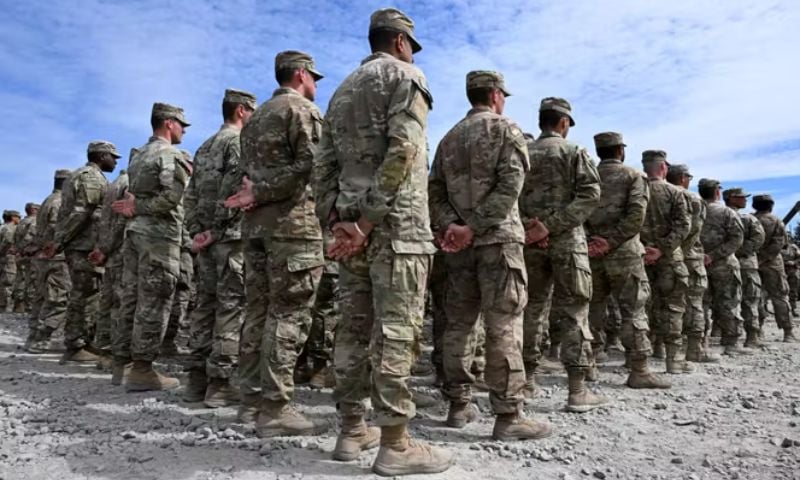
WASHINGTON: NATO said on Saturday it was working with the United States to understand Washington’s decision to withdraw 5,000 troops from Germany as a rift in transatlantic ties deepens over the Iran war.
The US has announced plans to withdraw around 5,000 troops from Germany over the next six to twelve months.
The decision marks a significant shift in the US military posture in Europe amid rising political tensions with key allies.
The Pentagon said the decision followed a review of American force deployment across Europe.
Pentagon spokesman Sean Parnell said on Friday that the withdrawal was expected “to be completed over the next six to twelve months”.
“This decision follows a thorough review of the Department’s force posture in Europe and is in recognition of theatre requirements and conditions on the ground,” Parnell said in a statement.
There were 36,436 active-duty US troops stationed in Germany as of December 31, 2025, according to official figures, compared with 12,662 in Italy and 3,814 in Spain.
Implications for NATO
NATO said it was working with Washington to understand the implications of the move.
“We are working with the U.S. to understand the details of their decision on force posture in Germany,” NATO spokeswoman Allison Hart said in a post on social media platform X.
We are working with the U.S. to understand the details of their decision on force posture in Germany. This adjustment underscores the need for Europe to continue to invest more in defence and take on a greater share of the responsibility for our shared security – where we’re…
— NATO Spokesperson (@NATOpress) May 2, 2026
She added that the decision underscored the need for European allies to invest more in defence and assume greater responsibility for shared security.
“This adjustment underscores the need for Europe to continue to invest more in defence and take on a greater share of the responsibility for our shared security,” she said, noting that allies had already agreed to increase defence spending targets.
Transatlantic rift
The announcement comes amid a deepening rift between Washington and European capitals over the Iran conflict and broader security priorities.
The troop withdrawal follows a public exchange between US President Donald Trump and German Chancellor Friedrich Merz.
Merz had said earlier this week that Iran was “humiliating” Washington at the negotiating table, prompting a sharp response from Trump.
Trump criticised the German leader, saying he “doesn’t know what he’s talking about” and accusing European allies of failing to support US positions on the conflict.
The US president has also linked defence commitments to trade disputes.
He recently announced plans to impose 25 per cent tariffs on cars and trucks from the European Union, accusing the bloc of failing to comply with a trade agreement.
Pressure on European allies
Trump has repeatedly called on European countries to shoulder more of their own defence burden, signalling a reduced US military footprint on the continent.
He has also suggested that troop reductions could extend beyond Germany to other countries.
Speaking to reporters, Trump criticised Italy and Spain over their stance on the Middle East war and indicated he might consider withdrawing forces from those countries as well.
“Yeah, probably, I probably will. Why shouldn’t I?” he said when asked about potential withdrawals.
The move comes as Washington pushes allies to contribute more actively to security operations, including a proposed peacekeeping role in the Strait of Hormuz.
Germany says withdrawal expected
Germany has responded cautiously to the announcement. Defence Minister Boris Pistorius said the withdrawal “from Europe and also from Germany was to be expected”.
Foreign Minister Johann Wadephul said Berlin was “prepared” for a potential reduction and remained engaged in discussions within NATO.
However, he stressed that major US military installations in Germany, including the Ramstein Air Base, were “not up for discussion at all” and served an “irreplaceable function” for both countries.
Security concerns in Europe
The development comes at a time of heightened security concerns across Europe following the Russia-Ukraine war started in 2022.
European governments have stepped up defence spending and reassessed their military readiness amid fears of reduced US commitment to the continent’s security.
The European Union has emphasised that the US military presence in Europe remains in Washington’s strategic interest, describing the United States as a “vital partner” in ensuring regional stability.