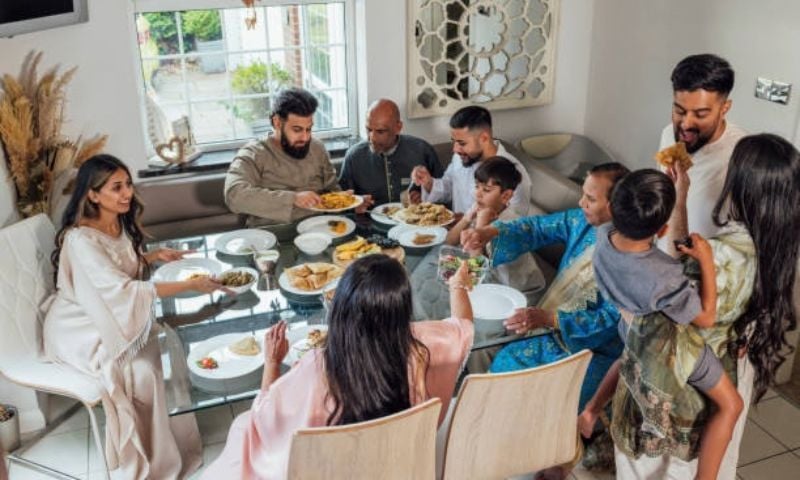
ISLAMABAD: Pakistan’s joint-family system is gradually losing ground, with the share of households living in extended-family arrangements falling from 44.5 per cent in 1990-91 to 38.8 per cent in 2024-25, according to Gallup Pakistan Digital Analytics.
The data, drawn from four national survey rounds spanning 1990-91 to 2024-25, shows that the shift away from joint-family living has been slow and uneven across provinces, with Balochistan recording the sharpest decline and Sindh consistently reporting the lowest share of extended households.
The findings offer a picture of changing household structures in Pakistan as urbanisation and social and economic changes reshape the way families live together.
Read Also: How Indian Caste System has Become a Global Social Issue?
Balochistan records sharpest decline
Balochistan experienced the most significant change among the provinces, with the proportion of extended households falling from 49.3 per cent in 1990-91 to 34.8 per cent in 2024-25.
The decline of 14.5 percentage points was the largest recorded among the four provinces.
Much of the reduction occurred after 2007-08, when the share stood at 43.5 per cent, before falling to 34.8 per cent in the latest survey period.
Sindh recorded the second-largest decline, with extended-family households dropping from 38.7 per cent to 31.5 per cent, a reduction of 7.2 percentage points.
Sindh remains lowest, KP highest
The survey data shows persistent provincial differences in extended-family living.
Sindh has recorded the lowest proportion of extended households in every survey round since 1990, with the latest figure standing at 31.5 per cent.
Khyber Pakhtunkhwa, meanwhile, has remained at or near the top across most of the period. Its share declined from 47.7 per cent in 1990-91 to 44.9 per cent in 2024-25, a relatively modest fall of 2.8 percentage points.
Punjab showed the smallest overall change, declining from 45.6 per cent to 41.6 per cent, a reduction of four percentage points.
The figures indicate that the transition in household structures has not followed a single national pattern, with the pace and scale of change differing considerably between provinces.
Joint-family living remains widespread
Despite the long-term decline, extended-family households continue to represent a substantial proportion of households across Pakistan.
For the purpose of the analysis, a household was classified as “extended” if it included at least one person whose relationship to the household head was something other than the head, spouse or son/daughter.
This means the category includes households in which parents, siblings, grandchildren, in-laws or other relatives live together with the nuclear family.
The findings therefore capture more than the traditional concept of a joint family and provide a broader measure of extended household living.
Read Also: Cristiano Ronaldo’s Christmas Family Video Goes Viral
A gradual transformation, not a sudden shift
The survey trend suggests that Pakistan’s family structure is changing, but the transformation has been gradual rather than abrupt.
Nationally, the proportion of extended households has fallen by 5.7 percentage points over the period covered by the four surveys.
The provincial figures, however, show that the experience has been different across the country. While Balochistan has seen a substantial reduction, Punjab has remained comparatively stable and KP continues to have a high proportion of extended households.
The data itself does not establish why households have changed their living arrangements. Factors such as urbanisation, migration, housing patterns, employment and changing family preferences may be relevant areas for further research, but the survey figures alone do not establish the contribution of each factor.
Read Also: Family Planning 2030: South Asia Faces Challenge of Sustainable Growth Amidst Growing Population
What the findings show
Gallup Pakistan’s data points to a slow evolution of household structures rather than the disappearance of the joint family system.
With nearly four in 10 households still classified as extended in 2024-25, living with members of the wider family remains a significant feature of Pakistani society.
At the same time, the long-term decline suggests that the traditional household model is gradually changing, with the pace varying substantially from one province to another.
The findings do not determine whether living in an extended or nuclear household is better or worse for families. Instead, they provide a statistical snapshot of how household arrangements in Pakistan have evolved over more than three decades.