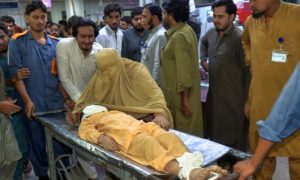
PESHAWAR, Pakistan: Pakistani security sources said on Sunday that the suicide bomber who carried out a deadly attack at a wedding ceremony in northwestern Pakistan was an Afghan national, as authorities released further details of the attack that killed at least seven people.
The attack took place on Friday night in Dera Ismail Khan district of Khyber Pakhtunkhwa province, near Qureshi Morr, at the residence of a member of a local peace committee. At least 10 others were injured, police said.
According to police, the bombing occurred while guests were attending the wedding ceremony of the nephew of Noor Alam Mehsud, the head of the peace committee.
“A suicide bomber detonated explosives inside a room where tribal elders were present,” police official Muhammad Adnan told reporters. The explosion caused part of the building to collapse, he added.
Police said wedding guests were taking part in traditional drum dancing when the attacker struck.
The bomber entered a room at the back of the venue and detonated the explosives moments later.
Bomber identified as Afghan national
Investigators identified the attacker as 21-year-old Abdul Rehman, an Afghan national, according to security sources.
CCTV footage of the incident has surfaced, showing the attacker entering the wedding venue with a white shawl draped around him.
The footage shows him leaving the main gathering area during the dance and moving towards a separate room where elders were seated.
Shortly after he entered, the explosion occurred, collapsing the roof of the room.
The counter terrorism department officials said that a case had been registered under terrorism and related charges.
Forensic teams recovered DNA samples and other evidence from the blast site, which are now being examined as part of the ongoing investigation.
According to the CTD report, Abdul Rahman was raised at an Afghan refugee camp, where he received his early education at non-formal centres and madrassa.
The investigators believed that he fell victim to extremist propaganda during his formative years.
Cross-border terrorism from Afghanistan
Security analysts say terrorist groups have increasingly used Afghan nationals to carry out attacks inside Pakistan.
They say Afghanistan has become a base of operations for several terrorist groups targeting Pakistan.
Last year, a suicide bombing near the Islamabad District Courts, also known as the Judicial Complex, was carried out by an Afghan national.
That attack killed at least 12 people and wounded more than a dozen others.
Terrorist violence in Pakistan has surged in recent years, largely attributed to the banned Tehreek-e-Taliban Pakistan (TTP) terrorist group. TTP is based in Afghanistan and according to UN reports, the banned terrorist group receives financial support from the Afghan Taliban.
The group has intensified attacks since the Afghan Taliban returned to power in Afghanistan in 2021, following the withdrawal of US and NATO forces after the Doha Agreement.
Pakistan has repeatedly accused the Afghan Taliban of allowing the TTP to operate from Afghan territory and carry out terrorist attacks inside Pakistan.
The United Nations has also reported that the Afghan Taliban are supporting terrorist groups on Afghan soil involved in cross-border attacks.
Terror threat from Afghanistan
Earlier this month, Pakistan’s military spokesperson, Lieutenant General Ahmed Sharif Chaudhry, said Afghan nationals were involved in 10 of the largest terrorist incidents in Pakistan last year.
Speaking at a press briefing on January 6, the Director General of Inter-Services Public Relations (ISPR) said the Pakistan Army conducted 75,000 intelligence-based operations nationwide in 2024. These operations uncovered 5,400 terrorist incidents, he said.
According to the military, those attacks killed 1,235 civilians and law enforcement personnel, while 2,597 terrorists were killed during counter-terrorism operations.
“The strongholds of the Khawarij rebellion and Indian-backed terrorism are in Afghanistan, where all major terrorist organisations are nurtured,” Chaudhry said.
He warned that Afghanistan had become a safe haven for terrorist groups, including TTP, Al-Qaeda, ISIS and the Baloch Liberation Army (BLA). He also claimed that about 2,500 foreign militants from Syria had recently arrived in Afghanistan.
Pakistan has experienced a rise in cross-border terrorist incidents since the Taliban regained control of Afghanistan in 2021.
The provinces of Khyber Pakhtunkhwa and Balochistan, which border Afghanistan, have been particularly affected by these attacks.
Pakistan has time and again called on the Afghan Taliban regime in Kabul to prevent its soil from being used by terrorists against Pakistan, and the issue recently resulted in heightened tensions featuring cross-border attacks by the Afghan side, resulting in retaliation from Pakistani forces as well.