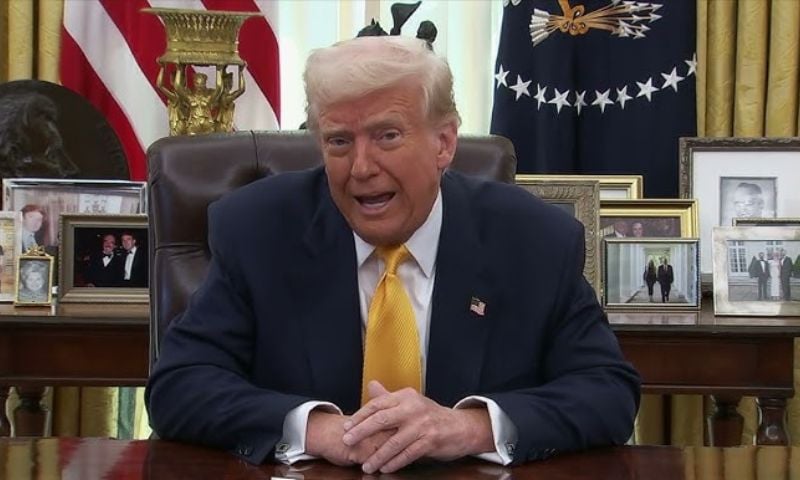



WASHINGTON: US President Donald Trump on Sunday accused Iran of “playing games” with the United States for decades and warned that Tehran “will be laughing no longer”, as Pakistan continued diplomatic efforts to end the conflict between Washington and Tehran through dialogue.
In a statement posted on his Truth Social platform, Trump criticised Iran and repeated accusations against former US presidents over their handling of Tehran.
“Iran has been playing games with the United States, and the rest of the World, for 47 years,” Trump wrote, adding that Tehran had been “laughing at our now GREAT AGAIN Country”.
“They will be laughing no longer,” he said.
They will be laughing no longer! pic.twitter.com/ptJ9sDDjs9
— The White House (@WhiteHouse) May 10, 2026
Trump did not comment on reports that Iran had responded to Washington’s latest peace proposal through Pakistani mediators.
Pakistan receives Iran’s response to US proposal
Earlier on Sunday, Pakistan’s Prime Minister Shehbaz Sharif confirmed that Islamabad had received Iran’s response to a US proposal aimed at ending the war in the region.
Speaking at a ceremony in Islamabad, Prime Minister Sharif said Pakistan was continuing efforts to facilitate dialogue between Tehran and Washington and promote de-escalation through diplomacy.
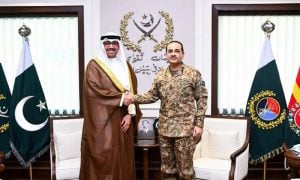
He said Pakistan’s Chief of Defence Forces and Chief of Army Staff, Field Marshal Syed Asim Munir, had informed him “a while ago” that Iran’s response had been received.
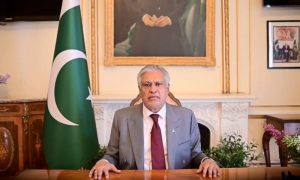
“I cannot go into more detail. I commend the efforts of Deputy Prime Minister Ishaq Dar and congratulate Field Marshal Asim Munir, who has dedicated himself to this cause,” PM Sharif said.
Earlier, Iranian state media also reported that Tehran has sent its response to US proposal via Pakistan.
“The Islamic Republic of Iran sent today through Pakistani mediators its response to the latest text proposed by the United States to end the war,” Iran’s official IRNA news agency reported.
Iran has formally presented to Pakistani mediators its response to the latest US proposal aimed at ending the war of aggression against the country, a source familiar with the matter confirmed on Sunday.https://t.co/swlVezmisJ pic.twitter.com/pi4tt3MiBq
— IRNA News Agency ☫ (@IrnaEnglish) May 10, 2026
Iran’s ISNA news agency said Tehran’s response focused primarily on “ending the war and maritime security” in the Arabian Gulf and Strait of Hormuz.
Pakistan-led diplomatic efforts
Pakistan has emerged as a key diplomatic intermediary since hostilities began on February 28 following US-Israeli strikes on Iran.
Islamabad brokered a ceasefire between Tehran and Washington on April 8 and later hosted direct talks between US and Iranian negotiators on April 11 and 12.
Although the Islamabad talks ended without a final agreement, both sides continued diplomatic engagement through Pakistani mediation.
Prime Minister Sharif said Pakistan remained committed to supporting regional peace and political dialogue.
Pakistan has intensified diplomatic outreach to the Gulf and regional states in recent weeks, with support from China and Gulf countries for de-escalation efforts.
During a telephone conversation on Sunday with Qatar’s Prime Minister and Foreign Minister Mohammed bin Abdulrahman bin Jassim Al Thani, PM Sharif reaffirmed Pakistan’s commitment to regional peace and stability.
14-point US proposal
According to US media reports, Washington’s latest proposal includes 14 points outlining conditions for a broader agreement between the two sides.
The proposal reportedly calls on Iran to suspend uranium enrichment for at least 12 years, transfer around 440 kilograms of uranium enriched to 60 percent, and pledge not to develop nuclear weapons.
In return, the United States would ease sanctions, release billions of dollars in frozen Iranian assets and lift its naval blockade of Iranian ports.
The proposal also envisages the reopening of the Strait of Hormuz within 30 days of any agreement.
Reuters reported that the framework could unfold in three stages: a formal declaration ending the conflict, arrangements concerning maritime security in the Strait of Hormuz, and a 30-day negotiation period aimed at reaching a broader settlement.
A source briefed on the mediation process told Reuters that a one-page memorandum formally ending the conflict was close, although significant differences remained.
Reuters said disputes persisted over Iran’s enriched uranium stockpiles, the future of its nuclear programme and the duration of any suspension of enrichment activities.
US news outlet Axios earlier reported that Washington and Tehran were nearing a preliminary agreement that could establish a framework for future nuclear negotiations.