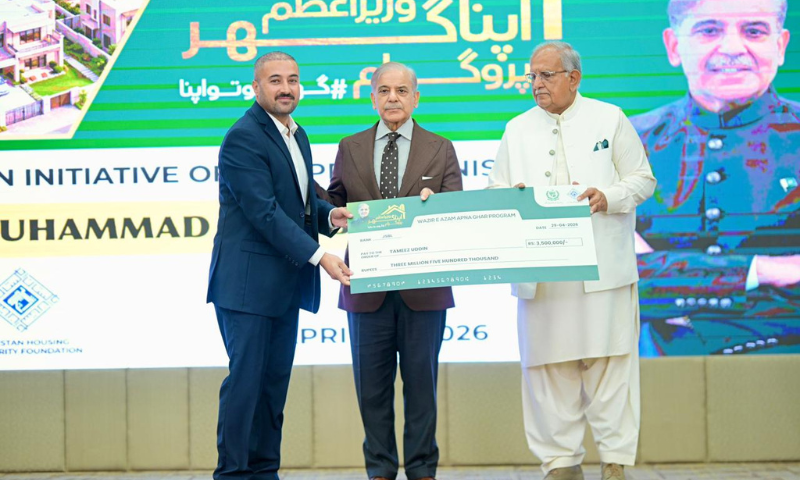
ISLAMABAD: Pakistan on Thursday unveiled a multi-trillion-rupee housing scheme aimed at building up to 500,000 homes over four years, as Prime Minister Shehbaz Sharif positioned the construction sector as central to job creation and economic growth.
The “Apna Ghar” programme will offer subsidised loans and has an initial allocation of Rs321 billion ($1.15bn) to finance 50,000 homes in its first year.
The broader plan is part of Islamabad’s push to transition from economic stabilisation to growth after implementing reforms to secure external financing and ease fiscal pressures.
“وزیراعظم اپنا گھر اسکیم کے تحت پہلے سال کا ہدف پچاس ہزار گھروں کا ہے جس کے لیے 321 ارب روپے فنانسنگ مختص کی گئی ہے۔ آئندہ چار برسوں میں ہمارا ہدف پانچ لاکھ گھروں کا ہے جس میں 10 مرلہ تک پلاٹ پر گھر کی تعمیر کے لیے قرض فراہم کیا جائے گا جس کا کل حجم 3.2 کھرب روپے کا ہے۔
اس اسکیم… pic.twitter.com/Z5mSbAJMaC
— Government of Pakistan (@GovtofPakistan) April 30, 2026
Subsidised loans and housing targets
Under the scheme, low- and middle-income households will be eligible for concessional financing of up to Rs10 million ($35,700). Loans will be repayable over 20 years, with a fixed markup of 5 percent for the first 10 years, followed by a market-based rate.
The government plans total financing of Rs3.2 trillion ($11.5bn) over four years, targeting housing units of up to 10 marla across all provinces, as well as Gilgit-Baltistan and Azad Jammu and Kashmir.
وزیراعظم محمد شہبازشریف نےملک کے غریب و متوسط طبقے کو اپنی چھت کے حصول کے لئے ’’ وزیراعظم اپنا گھر سکیم ‘‘کا باقاعدہ اجراء کر دیا. اس ضمن میں منعقدہ تقریب سے خطاب کرتے ہوئے وزیراعظم نے کہا ہے کہ عام آدمی کو چھت فراہم کرنا حکومت کی اولین ترجیح ہے ،سکیم کے تحت ایک کروڑ روپے… pic.twitter.com/TU29zKfVWn
— Prime Minister’s Office (@PakPMO) April 30, 2026
“Ahead of the budget, we will bring major initiatives because construction is a key industry,” Sharif said at the launch ceremony. “Whether it is a five marla home, 10 marla, or larger housing units, it creates demand for bricks, cement, wood, carpenters, electricians, engineers, and draftsmen.”
Prime Minister Muhammad Shehbaz Sharif addresses the launching ceremony of PM Apna Ghar Program. Islamabad, 30 April, 2026. pic.twitter.com/GSDroaBYLj
— Prime Minister’s Office (@PakPMO) April 30, 2026
A marla is a traditional unit of area in Pakistan, equivalent to about 272 square feet.
Construction as an economic engine
Pakistan’s construction sector is widely seen as a catalyst for economic activity due to its linkages with multiple industries, including cement, steel, transport, and services, as well as its capacity to generate large-scale employment.
Sharif said the housing initiative would stimulate demand across the economy while addressing a significant housing shortage.
“This entire supply chain strengthens industry, increases production and generates employment for millions, from labourers to engineers,” he said.
Economic backdrop and external pressures
The programme comes as Pakistan’s economy shows signs of stabilisation following subsidy cuts and tax reforms, though growth remains subdued and households continue to face high living costs.
At the same time, the country is dealing with external pressures linked to the Iran conflict, which has disrupted global energy markets and constrained liquefied natural gas supplies, posing risks to power generation and industrial output.
Oversight and implementation
Sharif said he would personally review the scheme’s progress every month to ensure timely execution and address bottlenecks.
He added that banks participating in the programme would be rewarded or penalised based on their performance, as the government seeks to ensure effective rollout and broad access to financing.