Key Points
- Eight terrorists killed after Kharan roadblock attempt
- Three terrorists also killed in Washuk hideout operation
- Sanitisation operations continue in affected areas
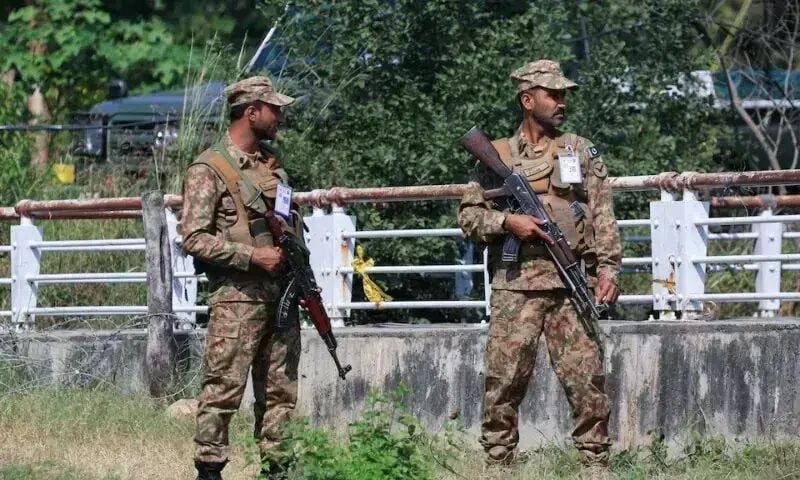
ISLAMABAD: Pakistan’s security forces have killed 11 Indian-sponsored terrorists in separate intelligence-based operations in Balochistan’s Kharan and Washuk districts, the military’s media wing said on Wednesday.
According to the Inter-Services Public Relations (ISPR), an operation was conducted in Kharan on September 6 after terrorists attempted to establish a roadblock and disrupt local traffic.
Security forces “promptly intercepted and engaged” the terrorists, killing eight Indian-sponsored terrorists of ” Fitna al Hindustan”.
In a separate intelligence-based operation in Washuk on September 7, troops busted a terrorists’ hideout after receiving reports of their presence.
Following an intense fire exchange, three terrorists were killed, the ISPR said.
The security forces also recovered 2.9 tonnes of explosives allegedly being used for the preparation of improvised explosive devices (IEDs).
“Sanitisation operations are being conducted to eliminate any other Indian sponsored terrorist found in the area,” the ISPR said.
The military added that the counter-terrorism campaign under “Azm-e-Istehkam” would continue “at full pace” to eliminate the menace of foreign-sponsored and supported terrorism from the country.
“Relentless counter terrorism campaign under vision “Azm-e-Istehkam” (as approved by Federal Apex Committee on National Action Plan) by security forces and law enforcement agencies of Pakistan will continue at full pace to wipe out the menace of foreign-sponsored and supported terrorism from the country,” the statement concluded
READ ALSO: Pakistan Security Forces Kill 48 Indian-Backed Terrorists in Balochistan
Terrorism is a growing problem for Pakistan, with the number of attacks rising every year since 2022, according to Armed Conflict Location & Event Data (ACLED), a global monitoring organisation.
Data from ACLED shows attacks in Pakistan rose nearly fourfold to 2,425 in 2025 from 658 in 2022, and over the same period, the banned Tehrik-i-Taliban Pakistan (TTP), currently taking refuge in Afghanistan after being routed out by the Pakistani Security Forces, increased attacks more than sevenfold to 838 from 118.
Although K-P has borne the brunt of terrorism, Balochistan has also remained a major target of Indian proxies, which often target civilians and military installations in the province.
In one such attack on the last day of 2025, terrorists targeted innocent civilians in Balochistan’s Gwadar and Kharan districts, where 18 people, including women, children, the elderly and labourers, embraced martyrdom.
The forces continued operations across the provinces against Indian-sponsored terrorists and their proxies, but despite these efforts, the groups have continued to target civilian and defence installations.
Earlier this month, at least 30 people, including 27 police personnel, were martyred when terrorists from the Indian proxy Fitna al-Hindustan ambushed police personnel deployed in the Kach Mangi Phase III area of Ziarat, triggering hours-long gun battles.
The attackers also abducted several civilians and police personnel after the assault.
In the aftermath of the attack, the Pakistan Army, Frontier Corps and Balochistan Police launched a joint operation, which remains underway, with forces intensifying action against terrorists across the province.
Pakistan’s National Action Plan
According to the National Counter Terrorism Authority (NACTA), after the Army Public School attack on 16th of December 2014, a national consensus was reached to come down hard on the terrorists through a concerted national effort.
Whereas the National Internal Security Policy 2014 pointed out the broad policy guidelines and long-drawn reforms in various state institutions, a need was felt to chalk out an Action Plan with a specific, mostly quantifiable and ultimately time-bound agenda to curb the scourge of terrorism, which had by now started massacring even innocent school-age children.
Pakistan’s Parliament approved a 20-point National Action Plan (NAP) to counter terrorism and extremism, prepared by NACTA/ Ministry of Interior in consultation with stakeholders on December 24, 2014.
After the National Internal Security Policy 2014, it was the second consensual policy document approved by the Government. The National Action Plan defines the specifics of the counter-terrorism drive.