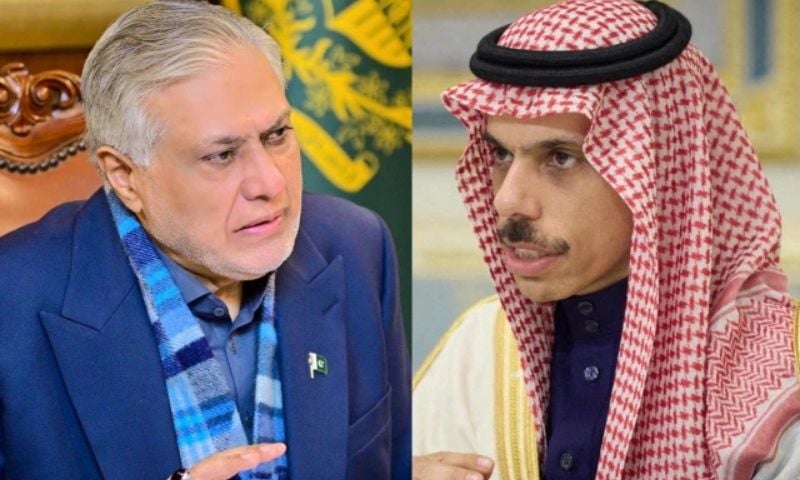
ISLAMABAD: Pakistan’s Deputy Prime Minister and Foreign Minister Ishaq Dar on Monday held a phone conversation with Saudi Arabia’s Foreign Minister Prince Faisal bin Farhan and discussed regional developments.
They discussed matters of mutual interest, including multilateral cooperation and regional developments, the Foreign Office said in a statement.
They also underscored the importance of continued close coordination and cooperation, both bilaterally and at multilateral forums.
Pakistan, Saudi Arabia and Turkiye signed a joint defence pact on Friday, establishing a collective security framework under which an armed attack against any one member is considered an attack against all three.
Deputy Prime Minister/Foreign Minister Senator Mohammad Ishaq Dar @MIshaqDar50 today spoke with the Foreign Minister of Saudi Arabia, Prince Faisal bin Farhan @FaisalbinFarhan.
They discussed matters of mutual interest, including multilateral cooperation and regional… pic.twitter.com/YjNPobj7MP
— Ministry of Foreign Affairs – Pakistan (@ForeignOfficePk) August 10, 2026
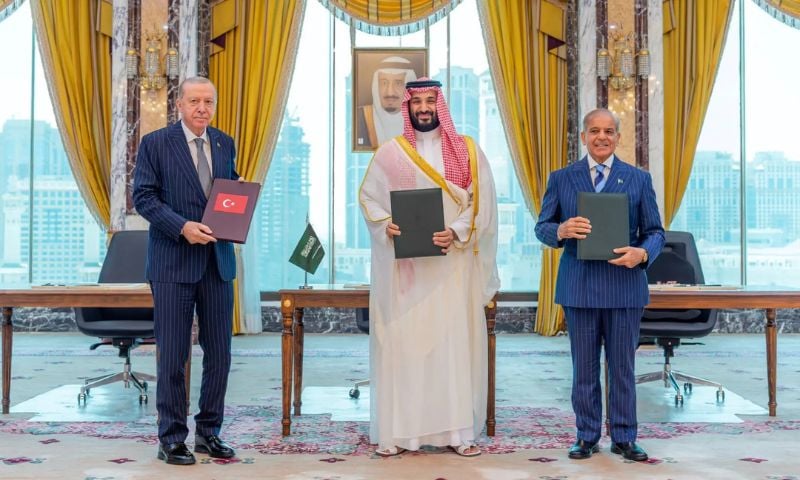
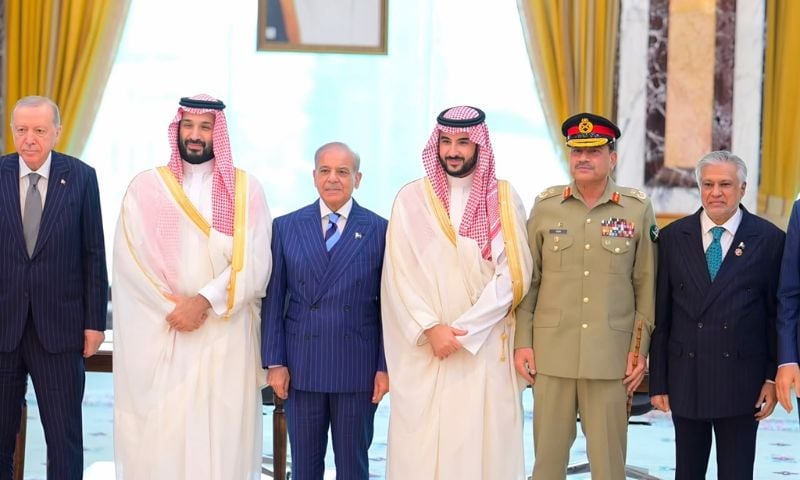
Pakistan’s Prime Minister Shehbaz Sharif, Saudi Crown Prince and Prime Minister Prince Mohammed bin Salman and Turkish President Recep Tayyip Erdogan signed the pact during the “Makkah Al-Mukarramah Summit for Joint Defence”.
Chief of Defence Forces and Chief of the Army Staff, Field Marshal Syed Asim Munir, Deputy Prime Minister and Foreign Minister Ishaq Dar, and Defence Minister Khawaja Muhammad Asif were also present at the signing ceremony.
Dar felicitates Pakistani nation on signing of Makkah Joint Defence Agreement
Earlier, Deputy Prime Minister Ishaq Dar extended warm felicitations to the nation on the signing of the “Makkah Joint Defence Agreement” by Pakistan, Saudi Arabia and Türkiye.
In his message to the nation, he said this historic accord reflects the depth of our brotherly bonds, shared values and common commitment to peace, security and stability.
🔈 PR No. 2️⃣0️⃣7️⃣/2️⃣0️⃣2️⃣6️⃣
Message to the Nation by the Deputy Prime Minister/Foreign Minister Senator Mohammad Ishaq Dar @MIshaqDar50 on the Signing of the Makkah Joint Defence Agreement
🔗⬇️ pic.twitter.com/KY5vao3SFt
— Ministry of Foreign Affairs – Pakistan (@ForeignOfficePk) August 10, 2026
Ishaq Dar said the signing of the Makkah Joint Defence Agreement (Makkah Accord) is a significant milestone in Pakistan’s longstanding strategic relationships with the Kingdom of Saudi Arabia and the Republic of Turkiye. It embodies our shared resolve to strengthen cooperation in addressing the evolving peace and security challenges facing our region.
He reiterated that the Makkah Accord is defensive in nature and that it is not directed against any country. He emphasised that its purpose is to strengthen collective deterrence against external aggression and reinforce our capacity to defend our sovereignty, territorial integrity and peoples.
Ishaq Dar said the Makkah Accord provides that an armed attack against any one of the three countries shall be regarded as an attack against all, consistent with the inherent right of individual and collective self-defence under Article 51 of the United Nations Charter.
The Deputy Prime Minister said Pakistan remains firmly committed to the peaceful resolution of disputes, respect for sovereignty and international law, and the pursuit of regional peace, stability and prosperity.
He said the Makkah Accord is not an instrument of confrontation, but an expression of our collective commitment to peace through strength, solidarity and mutual respect.
Pakistan says Makkah Defence Pact open to countries committed to its core principles
Deputy Prime Minister and Foreign Minister Ishaq Dar had said that the Makkah Joint Defence Agreement remains open to countries willing to uphold its core principles and resolve differences through mutual respect, cooperation and peaceful means.
“The Makkah Joint Defence Agreement, jointly signed by Pakistan, Saudi Arabia and Türkiye in Makkah Mukaramma on Friday 7th August 2026, reflects the depth of the brotherly relations between the leadership and peoples of the three countries,” Ishaq Dar said in a post on X.
Also Read: Pakistan Says Makkah Defence Pact Open to Countries Committed to its Core Principles
He added the Accord is the culmination of years of discussions and coordination, with a common desire to strengthen strategic cooperation in addressing multifarious peace and security challenges and advancing regional peace, stability and prosperity.
In the light of ongoing discussion and interest surrounding the “Makkah Joint Defence Agreement” (The Makkah Accord) over the past two days, the following context and clarity on this Agreement may be useful for everyone to note:
• The Makkah Joint Defence Agreement, jointly…
— Ishaq Dar (@MIshaqDar50) August 9, 2026
“The Makkah Accord does not abrogate or replace any existing bilateral or multilateral agreements between these countries, or with other countries or organisations,” said the Deputy Prime Minister.
Any external armed attack on any one of the three countries will be considered as an attack on all, consistent with the inherent right of individual and collective self-defence under Article 51 of the UN Charter.
🔈 PR No. 2️⃣0️⃣4️⃣/2️⃣0️⃣2️⃣6️⃣
Makkah Al-Mukarramah Summit for Joint Defence
🔗⬇️ pic.twitter.com/mIzASADmau
— Ministry of Foreign Affairs – Pakistan (@ForeignOfficePk) August 7, 2026
Turkish Foreign Minister Hakan Fidan said on Saturday the provision was technically similar to NATO’s Article 5 collective-defence clause and that the agreement did not identify any particular country as a common threat.
Pakistan and Saudi Arabia had already signed the “Strategic Mutual Defence Agreement” in Riyadh last September, pledging that any attack on either nation would be treated as an act of aggression against both.