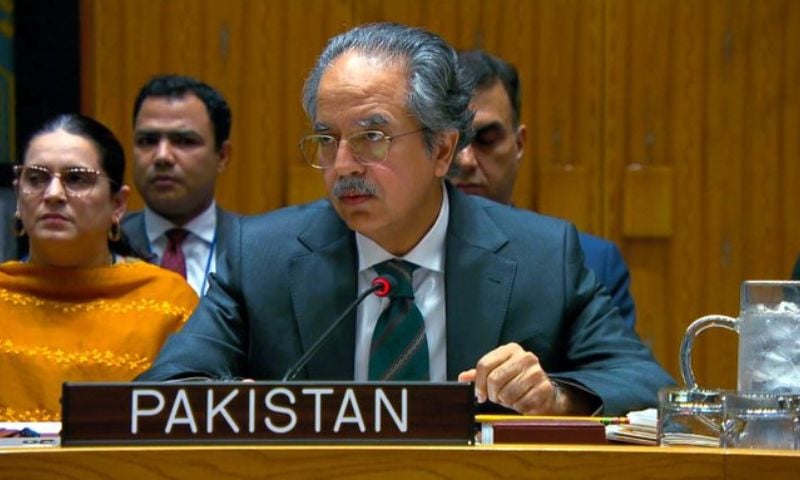
UNITED NATIONS: Pakistan has reaffirmed its commitment to the peaceful resolution of the Jammu and Kashmir dispute in accordance with United Nations Security Council resolutions, while calling for stronger use of diplomacy and preventive engagement to resolve international conflicts before they escalate.
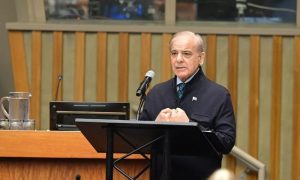
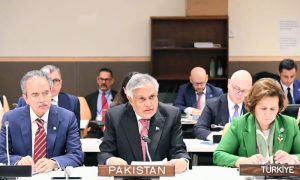
Addressing a UN Security Council session on strengthening mechanisms for the peaceful settlement of disputes, Pakistan’s Permanent Representative to the United Nations, Ambassador Asim Iftikhar Ahmad, said the country’s foreign policy remained firmly rooted in the principles of dialogue, mediation and the peaceful settlement of disputes under the UN Charter.
He said the longstanding Jammu and Kashmir dispute remained the central issue affecting peace and stability in South Asia.
“Pakistan remains committed to a peaceful settlement in accordance with the numerous resolutions of the Security Council that affirmed the principle of self-determination of the Kashmiri people and provided that the final disposition of the State of Jammu and Kashmir will be decided through the democratic method of a free and impartial plebiscite to be conducted under the auspices of the United Nations,” the ambassador told the Security Council.
Today, the imperative of peaceful settlement is more urgent than ever before. At a time when armed conflicts are growing across regions, the costs of delayed diplomacy are becoming more evident. Every new crisis underscores a simple truth: there is no military substitute for a… pic.twitter.com/ITgheZpBLd
— Permanent Mission of Pakistan to the UN (@PakistanUN_NY) July 23, 2026
Pakistan stresses preventive diplomacy
The Pakistani envoy said Security Council Resolution 2788, adopted unanimously during Pakistan’s presidency of the Council last year, reaffirmed the importance of preventive diplomacy.
“Diplomacy must not be the instrument we scramble for after peace has failed. It must be the means through which we prevent that failure,” he said.
He argued that while the UN Charter already provides comprehensive mechanisms for the peaceful settlement of disputes under Chapter VI, the problem lies in their delayed, selective and inconsistent implementation.
According to the ambassador, the Security Council often becomes engaged only after positions have hardened and trust has collapsed, leaving little room for compromise.
“The resulting costs are visible in protracted conflicts, unresolved disputes and situations of foreign occupation, where delay entrenches injustice and inaction manifests in acute human suffering,” he said.
Remarks by Ambassador Asim Iftikhar Ahmad,
Permanent Representative of Pakistan to the UN,
At the Security Council Open Debate on Strengthening the Mechanisms for the Peaceful Settlement of Disputes in Follow-up to Resolution 2788
(23 July 2026)
****Madam President,
I thank… pic.twitter.com/GFNcTncmix
— Permanent Mission of Pakistan to the UN (@PakistanUN_NY) July 23, 2026
Pakistan’s mediation efforts
Referring to developments in West Asia, Ambassador Ahmad highlighted Pakistan’s diplomatic efforts to facilitate dialogue between Iran and the United States.
He said Pakistan, together with partner countries, had played a constructive mediating role that culminated in the Islamabad Memorandum of Understanding and the launch of subsequent negotiations.
“The Islamabad MoU was a clear demonstration of what determined diplomacy can achieve: channels were opened, parties were brought together, precious lives were saved and all efforts redirected towards dialogue,” he said.
The ambassador expressed regret over the renewed outbreak of hostilities and the interruption of the diplomatic process.
“We earnestly hope that all parties will exercise restraint and return soon to the negotiating table to pursue a durable settlement and lasting peace,” he said.
“Whenever negotiations falter, the answer is not in less but more determined diplomacy.”
He added that Pakistan would continue its efforts to promote dialogue and peaceful conflict resolution.
Calls for stronger UN action
Ambassador Ahmad also proposed a series of measures to strengthen implementation of Security Council Resolution 2788 and improve the UN’s ability to prevent conflicts.
He urged the Security Council to engage at the earliest signs of tension rather than waiting until conflicts had erupted, and called for practical confidence-building measures, including direct communication channels, humanitarian gestures and commitments to avoid inflammatory rhetoric.
“The most consequential success of this Council may be the crisis that is prevented from escalating,” he said.
He also called for structured follow-up on Security Council resolutions, arguing that the Council should receive regular assessments on unresolved disputes and support time-bound diplomatic processes.
“A Council resolution must not mark the end of the Council’s engagement. It must initiate an accountable implementation that should lead to resolution of the conflict,” he said.
Support for Secretary-General’s good offices
The Pakistani envoy urged greater political and financial support for the UN Secretary-General’s good offices, mediation efforts and the Mediation Support Unit.
He also advocated greater use of legal mechanisms, including the International Court of Justice and arbitration, where disputes involve questions of international law.
Furthermore, he called for closer cooperation between the United Nations and regional organisations through joint analysis, coordinated mediation and regular information-sharing.
The ambassador further proposed periodic reviews of the Security Council’s use of Chapter VI of the UN Charter to assess where preventive diplomacy had succeeded, identify missed opportunities and institutionalise best practices.
‘No military substitute for lasting peace’
Concluding his address, Ambassador Ahmad said the international community faced an increasingly urgent need to prioritise peaceful dispute resolution as armed conflicts continued to spread across different regions.
“Every new crisis underscores a simple truth: there is no military substitute for a just and lasting peace,” he said.
Calling for renewed emphasis on prevention, dialogue and mediation, he said the success of Resolution 2788 would ultimately depend not on its unanimous adoption but on its consistent implementation by UN member states.
Reflecting on the role of diplomacy, the ambassador said history often overlooked conflicts that never occurred because dialogue remained open and leaders exercised restraint.
“Those unseen victories are diplomacy’s highest achievement,” he said, expressing hope that Resolution 2788 would help build a United Nations better equipped to deliver peace and justice in accordance with the principles of the UN Charter.